
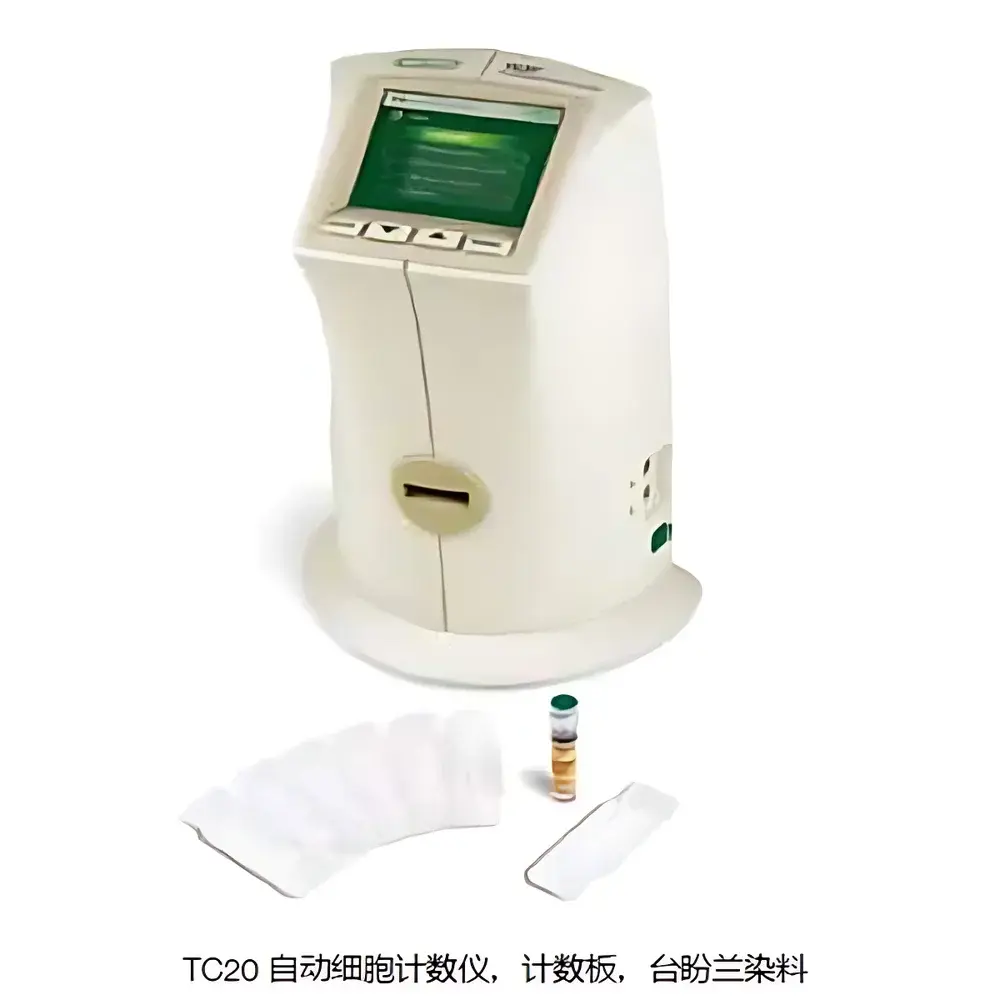
Bio-Rad TC20 Automated Cell Counter
| Brand | Bio-Rad |
|---|---|
| Origin | USA |
| Model | TC20 |
| Measurement Time | 30 s |
| Cell Concentration Range | 5 × 10⁴ – 1 × 10⁷ cells/mL |
| Sample Volume | 10 µL |
| Throughput | 2 samples per run |
| Detectable Cell Diameter | 6–50 µm |
| Data Storage | Internal memory for 100 assays |
| Dimensions (W × D × H) | 19 × 15 × 25.4 cm |
| Weight | 2.2 kg |
Overview
The Bio-Rad TC20 Automated Cell Counter is an optical, brightfield-based instrument engineered for rapid, objective, and reproducible quantification of mammalian cells in suspension. It employs high-resolution digital microscopy coupled with proprietary auto-focus algorithms and adaptive image segmentation to deliver accurate total cell counts and viability assessments—without the subjectivity or variability inherent in hemocytometer-based manual counting. Designed specifically for routine cell culture workflows, the TC20 operates on the principle of contrast-enhanced brightfield imaging: cells are visualized using standard trypan blue exclusion staining, and multi-plane focus scanning ensures optimal image capture across heterogeneous sample depths. Its fixed 10 µL sample requirement minimizes reagent consumption while maintaining statistical robustness for concentrations ranging from 5 × 10⁴ to 1 × 10⁷ cells/mL—covering typical passage densities for adherent and suspension cell lines, primary isolates (e.g., PBMCs, hepatocytes), and stem cell preparations. The system’s 30-second measurement cycle enables real-time decision-making during subculturing, transfection, or assay setup.
Key Features
- Auto-focus imaging engine with multi-plane depth scanning for consistent focus across variable cell settling patterns
- Adjustable size-gating algorithm allowing user-defined diameter thresholds (6–50 µm) to isolate target populations—critical for mixed samples such as tumor digests or co-cultures
- Integrated viability analysis based on trypan blue dye exclusion, validated against standard flow cytometry protocols
- Dual-sample capability per run supports side-by-side comparisons (e.g., treated vs. control, different passage numbers)
- Onboard memory stores up to 100 assay records with timestamp, image thumbnail, and full parameter metadata
- Compact benchtop footprint (19 × 15 × 25.4 cm) and low mass (2.2 kg) facilitate placement in biosafety cabinets or shared core facility spaces
Sample Compatibility & Compliance
The TC20 accommodates a broad spectrum of mammalian cell types—including immortalized lines (HeLa, CHO, HEK293), primary cells derived from blood (PBMCs), tissues (fibroblasts, neurons), and pluripotent stem cells—provided they fall within the 6–50 µm detection range and are suspended in isotonic buffers compatible with trypan blue. It complies with laboratory quality standards requiring traceability and data integrity: all count results include embedded acquisition parameters (exposure time, focus plane, threshold settings), and exported CSV files retain full audit trail information. While not FDA 21 CFR Part 11–certified out-of-the-box, the TC20 supports GLP/GMP-aligned documentation practices when paired with Bio-Rad’s TC20 Data Analysis Software (v2.0+), which enables electronic signature-capable reporting and version-controlled image archiving.
Software & Data Management
Raw images and quantitative outputs are exportable via USB flash drive in standardized formats (JPEG + CSV). The optional TC20 Data Analysis Software (Windows-compatible) extends functionality by enabling batch re-analysis, custom gate adjustment post-acquisition, histogram generation for size distribution profiling, and comparative overlay of multiple runs. All software modules adhere to ISO/IEC 17025 documentation guidelines for method validation, and audit logs record user actions, file modifications, and software version history. Data export paths can be configured to network drives or LIMS-integrated repositories, supporting centralized QC review in regulated environments.
Applications
- Routine cell passaging and seeding density optimization in academic and industrial cell culture labs
- Pre-transfection and pre-plating QC for CRISPR editing, lentiviral transduction, or organoid formation
- Viability monitoring during bioprocess development, including fed-batch and perfusion cultures
- Primary cell isolation validation (e.g., post-Ficoll separation or enzymatic digestion yield assessment)
- Stem cell expansion tracking where morphological heterogeneity necessitates size-based gating
- Training platform for new technicians due to minimal operational steps and built-in error guidance
FAQ
Does the TC20 require calibration with standardized beads or reference samples?
No—the TC20 uses fixed optical geometry and factory-characterized sensor response; routine verification is performed using the included control slide and standardized trypan blue solution.
Can the TC20 distinguish between clumped cells and single-cell events?
Yes—its adaptive segmentation algorithm applies intensity gradient and edge-detection heuristics to resolve partial overlaps, though severe aggregation (>3 cells per cluster) may require prior dispersion optimization.
Is the instrument compatible with alternative viability dyes beyond trypan blue?
It is optimized for trypan blue; use of other dyes (e.g., propidium iodide, acridine orange) is not supported due to spectral mismatch with the fixed LED illumination and CMOS sensor response profile.
How is data security handled during USB export?
Files are written in plain CSV/JPEG format without encryption; users must implement institutional policies for portable media handling in compliance with HIPAA or GDPR requirements.
What maintenance is required for long-term accuracy?
Annual verification using the Bio-Rad TC20 Performance Verification Kit (Cat. #17007800) is recommended to confirm focus stability, illumination uniformity, and counting repeatability per ISO 21501-4 Annex B protocols.
Related Products




