
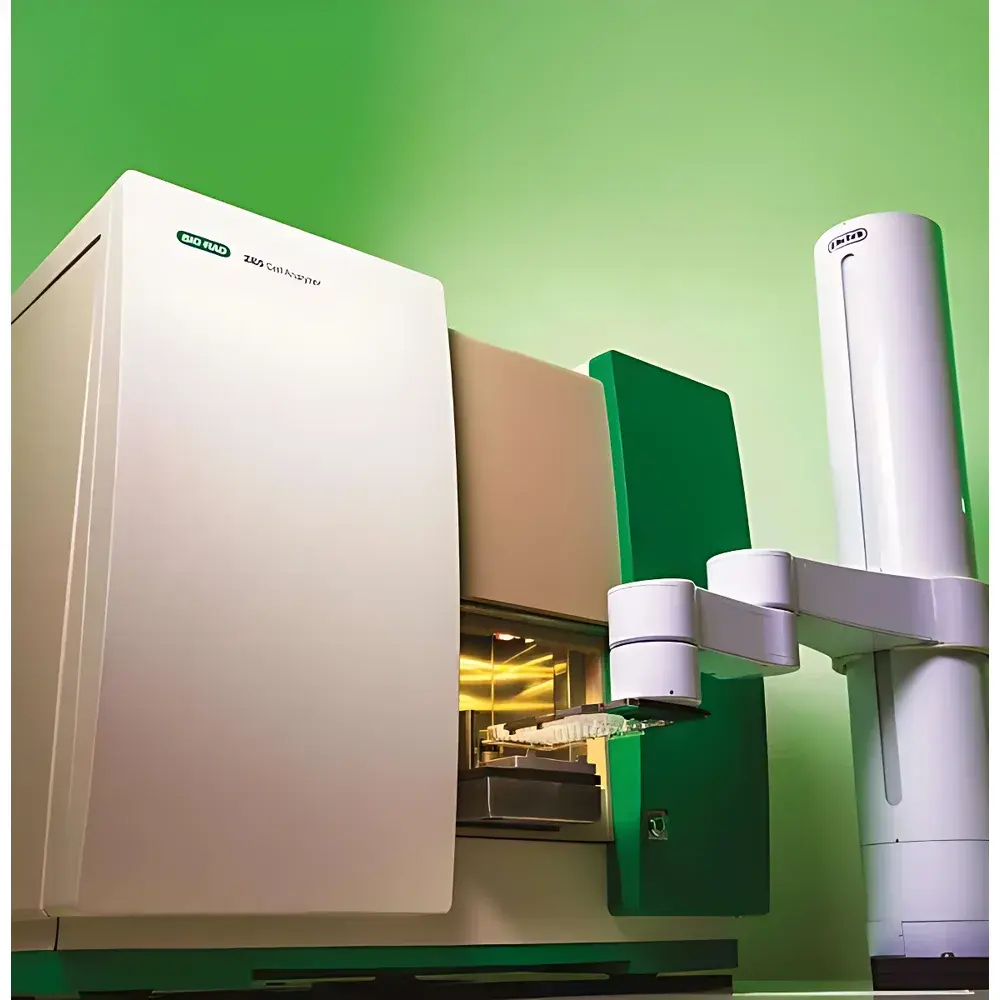
Bio-Rad ZE5 Cell Analyzer
| Brand | Bio-Rad |
|---|---|
| Origin | USA |
| Manufacturer Type | Authorized Distributor |
| Product Category | Imported Instrument |
| Model | ZE5 |
| Product Type | Flow Cytometer |
| Application | Research |
| Lasers | 5 lasers |
| Detection Parameters | 30 parameters |
| Coefficient of Variation (CV) | ≤3% |
| Sample Flow Rate | 3.5 µL/min |
| Fluorescence Sensitivity | ≤10 MESF (Molecules of Equivalent Soluble Fluorochrome) for FITC |
| Event Acquisition Rate | Up to 100,000 events/sec |
| Maximum Data Storage per Acquisition | 100 million events |
| Throughput | 96-well plate in ≤12 minutes |
| Fluidic Velocity | 8 m/sec |
| Software | Everest Flow Cytometry Software |
Overview
The Bio-Rad ZE5 Cell Analyzer is a high-performance benchtop flow cytometer engineered for precision, scalability, and experimental flexibility in academic, pharmaceutical, and translational research laboratories. It operates on the principle of hydrodynamic focusing combined with multi-laser excitation and spectral detection, enabling simultaneous interrogation of up to 30 independent fluorescence and scatter parameters per cell event. Its five solid-state lasers—covering violet (405 nm), blue (488 nm), yellow-green (561 nm), red (640 nm), and deep-red (685 nm) wavelengths—provide broad excitation coverage compatible with modern fluorochrome panels including tandem dyes, quantum dots, and fluorescent proteins. The system’s optical architecture features precisely aligned, temperature-stabilized detectors and low-autofluorescence fluidics, ensuring high signal-to-noise ratios and exceptional resolution across the full dynamic range.
Key Features
- Five integrated solid-state lasers with independent power control and real-time stability monitoring
- 30-parameter detection capability using high-quantum-efficiency photomultiplier tubes (PMTs) and avalanche photodiodes (APDs)
- Optimized fluidic design with 8 m/sec sheath flow velocity—double the speed of conventional systems—enabling 2× volumetric sampling efficiency at equivalent sample concentrations
- Automated, interchangeable sample introduction: supports single tubes, rack-loaded tubes, 96-well plates, and 384-well plates via a universal flatbed autosampler
- High-throughput operation: complete acquisition from a full 96-well plate in under 12 minutes with minimal carryover (<0.1%)
- Low-vibration, ultra-quiet fluidic system compliant with ISO 14644-1 Class 5 cleanroom-compatible lab environments
- High-fidelity electronics architecture supporting full-parameter acquisition at 100,000 events/sec without data truncation or parameter gating loss
- On-instrument data storage capacity for up to 100 million events per file, minimizing reliance on external computing resources during acquisition
Sample Compatibility & Compliance
The ZE5 accommodates a wide range of biological samples—including peripheral blood mononuclear cells (PBMCs), dissociated tissues, cultured cell lines, and microorganisms—without requiring specialized preparation protocols. Its low-shear, laminar-flow fluidics preserve cell viability and surface epitope integrity over extended run times. The instrument meets IEC 61010-1 safety standards for laboratory equipment and complies with electromagnetic compatibility (EMC) requirements per EN 61326-1. While not certified for clinical diagnostics (IVD), its performance aligns with research-grade validation frameworks referenced in CLSI EP17-A2 (evaluation of detection limits) and ISO 13843:2017 (performance evaluation of flow cytometers). Data integrity is supported through audit-trail-enabled software operations consistent with GLP and GMP-aligned workflows.
Software & Data Management
Everest Software serves as the native acquisition, analysis, and management platform for the ZE5. Built on a modular, scriptable architecture, it supports automated panel configuration, spectral unmixing, and real-time compensation matrix generation. Its dye-matching engine cross-references >1,200 commercially available fluorochromes against laser/detector configurations to recommend optimal combinations and warn of spillover conflicts. All acquisition sessions are timestamped and metadata-tagged (user, protocol, instrument settings, calibration status), fulfilling traceability requirements for reproducible science. Export formats include FCS 3.1, CSV, and HDF5; integration with third-party analysis tools (e.g., FlowJo, Cytobank, R/Bioconductor) is facilitated via open API access and standardized data schemas.
Applications
The ZE5 is routinely deployed in immunophenotyping, intracellular cytokine staining, phospho-flow analysis, apoptosis and cell cycle profiling, stem cell characterization, and rare-event detection (e.g., circulating tumor cells, antigen-specific T cells). Its high-speed, high-parameter capability supports longitudinal studies requiring large cohort screening, multiplexed vaccine response monitoring, and single-cell functional assays where kinetic resolution and marker co-expression fidelity are critical. The platform is widely adopted in core facilities serving NIH-funded projects, biotech target discovery pipelines, and academic consortia engaged in Human Cell Atlas–level profiling initiatives.
FAQ
Is the ZE5 suitable for clinical diagnostic use?
No—the ZE5 is intended for research use only (RUO) and is not FDA-cleared or CE-IVD marked.
Does the system support spectral unmixing?
Yes—Everest Software includes built-in spectral unmixing algorithms validated for 5-laser, 30-parameter configurations.
What calibration standards are recommended for routine QC?
Bio-Rad’s Flow-Check Pro and Rainbow Calibration Particles (RCP-30-5A) are validated for daily performance verification per manufacturer guidelines.
Can acquisition files be archived in compliance with 21 CFR Part 11?
While Everest itself does not provide electronic signature or role-based access controls, its structured metadata export and integration-ready architecture enable deployment within validated LIMS or ELN ecosystems meeting Part 11 requirements.
What maintenance is required between runs?
Automated daily cleaning cycles and weekly sheath fluid filter replacement are standard; no user-performed optical alignment is needed due to factory-sealed, thermally stabilized optics.





