
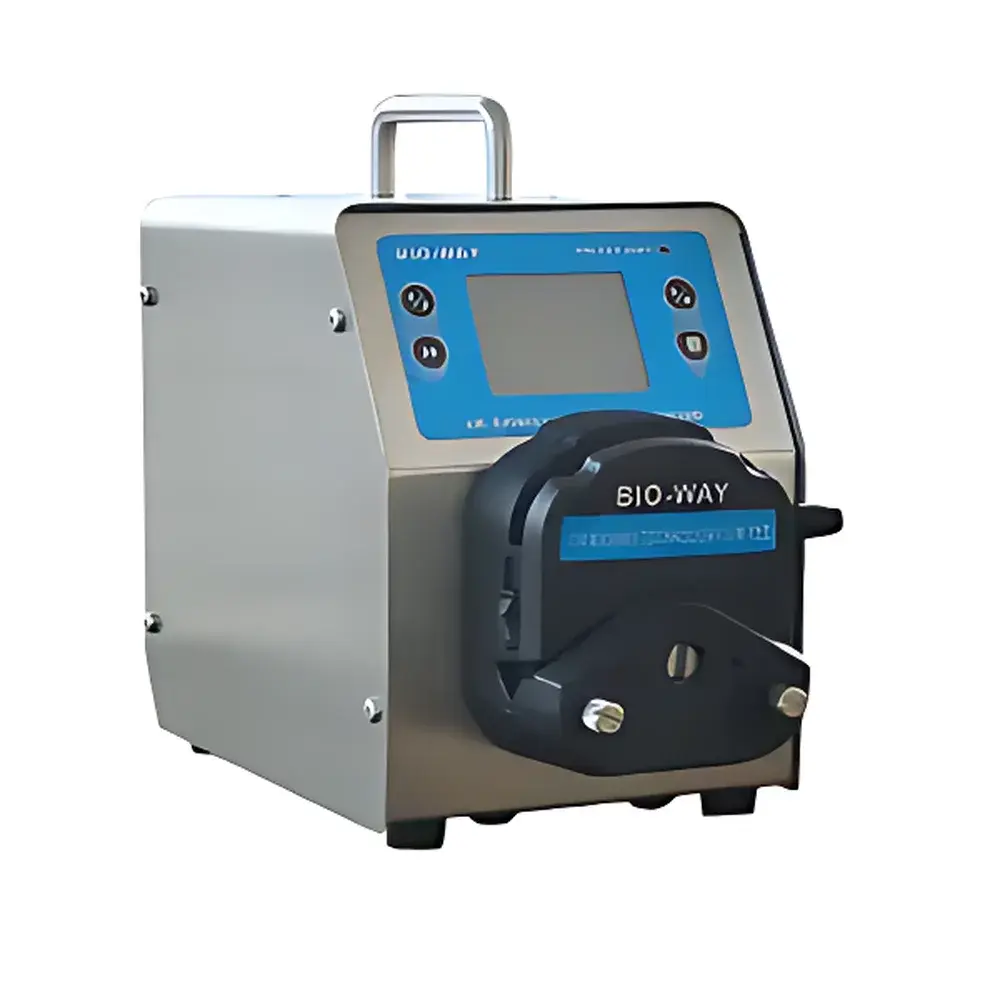
BIO-WAY BWTFZY-300T Automated Plate Dispenser for Microbiological Media
| Brand | BIO-WAY |
|---|---|
| Origin | United Kingdom |
| Model | BWTFZY-300T |
| Flow Rate | 0.006–990 mL/min (Accuracy: < ±0.2%) |
| Dimensions (L×W×H) | 255 × 181 × 198 mm |
| Display | Touchscreen + Keypad Interface |
| Pump Head Compatibility | Interchangeable per application |
| External Control | Footswitch-enabled dispensing start/stop |
| Enclosure Protection | Dual-layer isolation with conformal-coated PCBs for dust/moisture resistance |
| Included Accessories | Silicone tubing, handheld controller, sterile filtration cap |
Overview
The BIO-WAY BWTFZY-300T Automated Plate Dispenser is a precision-engineered laboratory instrument designed specifically for the reproducible, low-contamination dispensing of liquid microbiological growth media into Petri dishes, multiwell plates, and other standardized culture vessels. Operating on a positive-displacement peristaltic pumping principle, the system delivers consistent volumetric output across its full dynamic range—from microliter-scale inoculation volumes to high-throughput 1 L/min equivalent dispensing—without requiring syringe calibration or fluid-path reconfiguration. Its architecture integrates closed-loop motor angle control, real-time flow monitoring, and programmable dispensing profiles to ensure compliance with ISO 17025-accredited microbiology workflows. The BWTFZY-300T is not a generic liquid handler; it is purpose-built for regulatory environments where traceability, repeatability, and sterility assurance are non-negotiable—particularly in pharmaceutical QC labs, food safety testing facilities, public health reference laboratories, and clinical microbiology departments.
Key Features
- High-fidelity peristaltic dispensing with factory-calibrated flow accuracy better than ±0.2% across the entire operational range (0.006–990 mL/min), validated using gravimetric and volumetric traceable standards.
- Intuitive dual-mode interface combining a responsive 5.7-inch TFT touchscreen with tactile membrane keys, enabling glove-compatible operation and rapid parameter entry without software dependency.
- Modular pump head design supporting rapid interchange of chemically resistant silicone or fluoropolymer tubing assemblies, accommodating viscous media (e.g., molten agar at 45°C) and aggressive solvents (e.g., ethanol-based disinfectants).
- Dual-isolation internal layout: primary electronics compartment sealed with IPC-class conformal coating, secondary mechanical zone isolated via gasketed chassis partitions—meeting IP54-equivalent environmental resilience for routine lab use.
- Footswitch-triggered dispensing mode enables hands-free initiation and termination of media transfer, minimizing operator-induced aerosol generation and cross-contamination risk during biosafety cabinet workflows.
- Onboard flow correction algorithm compensates for tubing wear, temperature drift, and backpressure variation—maintaining long-term volumetric stability without manual recalibration.
Sample Compatibility & Compliance
The BWTFZY-300T is validated for use with standard microbiological media formulations including Tryptic Soy Agar (TSA), Nutrient Agar, MacConkey Agar, Sabouraud Dextrose Agar, and buffered peptone water. It accommodates both pre-sterilized liquid media and autoclaved molten agar up to 60°C (with optional heat-stable tubing). All wetted components comply with USP Class VI biocompatibility requirements and FDA 21 CFR 177.2600 for food-contact polymers. The device supports GLP/GMP documentation protocols through audit-trail-capable operation logs (timestamped, user-ID-tagged, and exportable via USB), and its dispensing parameters can be locked under password protection to satisfy ISO/IEC 17025 clause 7.7.1 (control of equipment settings).
Software & Data Management
While the BWTFZY-300T operates autonomously via its embedded firmware—requiring no PC connection for routine use—it includes a USB-C port for firmware updates and log file export. Operation records include date/time stamp, operator ID (if assigned), dispense volume, duration, pump speed, and error codes (e.g., occlusion detection, tubing slip alert). These logs are stored in CSV format compatible with LIMS integration or Excel-based trend analysis. Optional configuration files (.cfg) allow pre-programming of up to 20 distinct media protocols—including dwell time, pause intervals between wells, and ramp-up/down profiles—enabling unattended overnight plate preparation in regulated environments.
Applications
- Routine preparation of ISO 4833-1:2013-compliant pour plates for aerobic colony count determination.
- Standardized streak plate inoculation in antibiotic susceptibility testing (AST) workflows per CLSI M02-A12 guidelines.
- High-volume production of ready-to-pour plates for environmental monitoring programs in cleanrooms (ISO 14644-1 Class 5–8).
- Dispensing of selective enrichment broths (e.g., BPW, EE broth) into 96-well microtiter plates for pathogen screening in food safety labs.
- Automated filling of blood agar plates in clinical microbiology labs operating under CAP accreditation requirements.
FAQ
Does the BWTFZY-300T support validation documentation for GMP environments?
Yes—full IQ/OQ documentation templates, as well as test protocols aligned with ASTM E2500-13 and EU Annex 15, are available upon request from authorized BIO-WAY distributors.
Can the instrument be integrated into a robotic workstation?
It features TTL-level digital I/O ports (start/stop, ready signal, fault output) compatible with common lab automation buses (RS-232, Modbus RTU) for synchronization with robotic arms or conveyor systems.
What maintenance is required for long-term accuracy?
Tubing replacement every 500–1,000 hours of operation (depending on media abrasiveness); annual verification of flow performance using NIST-traceable gravimetric methods is recommended.
Is sterilization of the fluid path possible?
The pump head and tubing assembly are fully autoclavable at 121°C for 15 minutes; the main unit chassis must remain outside sterilization cycles but may be wiped with 70% isopropanol or hydrogen peroxide vapor.



