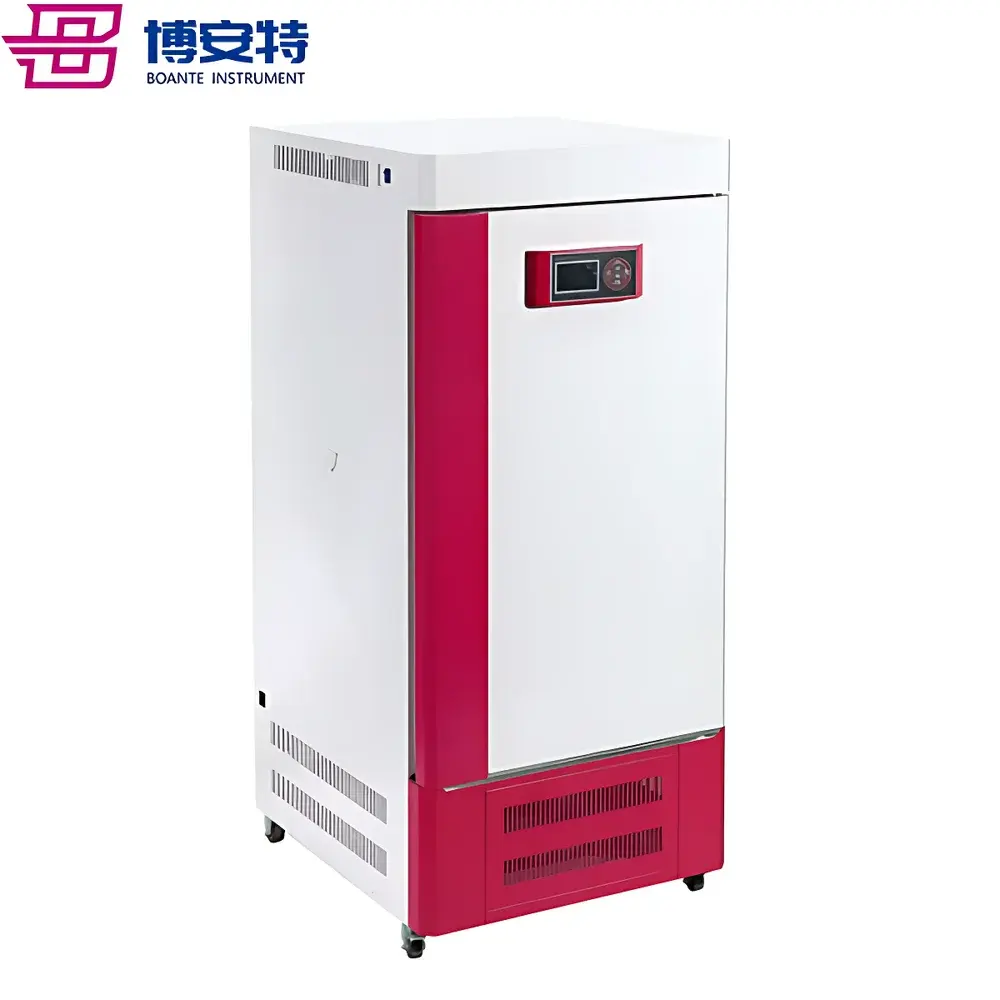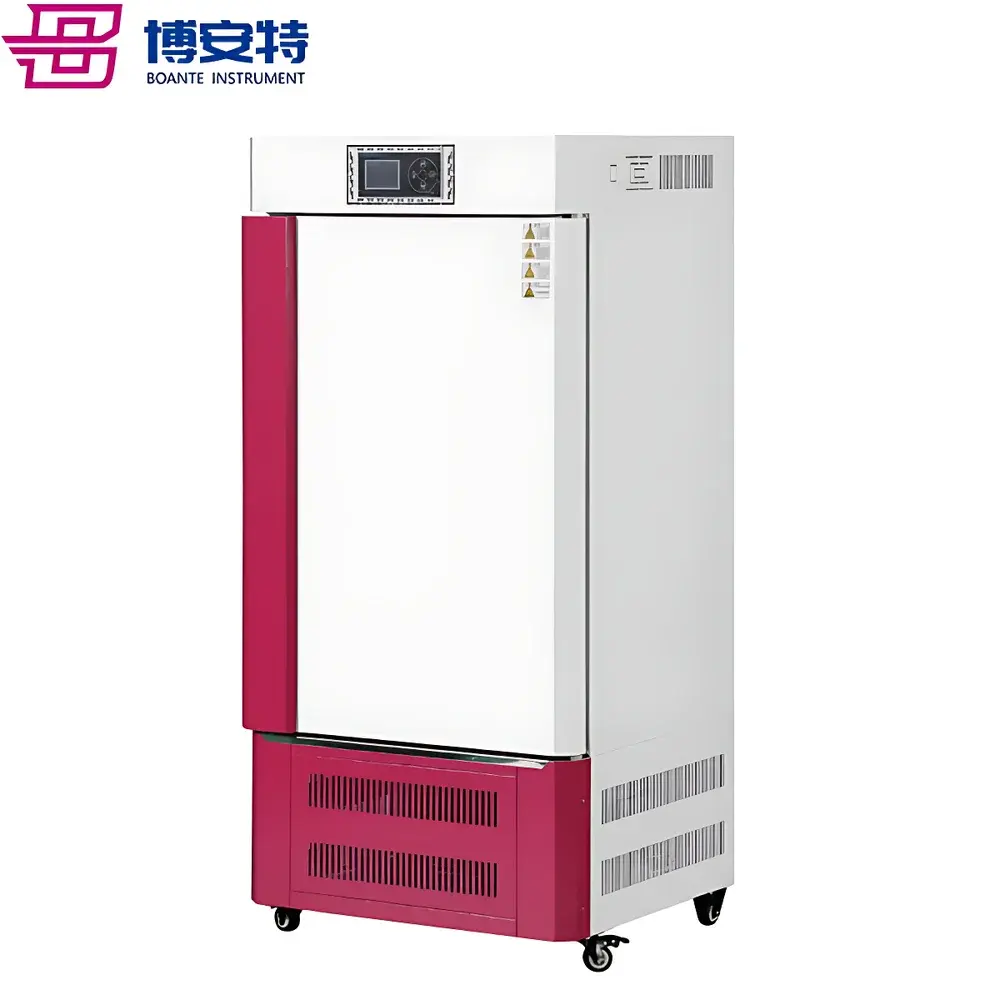
Biochemical Incubator D-250B
| Origin | Zhejiang, China |
|---|---|
| Manufacturer Type | Distributor |
| Origin Category | Domestic |
| Model | D-250B |
| Price Range | USD 1,400–2,800 |
| Temperature Range | 5–50 °C |
| Temperature Control Accuracy | ±1 °C |
| Temperature Uniformity (Fluctuation) | ±1 °C |
| Chamber Volume | 250 L |
| Power Supply | AC 220 V ±10%, 50 Hz ±2% |
| Rated Power | ≤500 W |
| Operating Ambient Temperature | 0–40 °C |
| Max. Relative Humidity | <85% RH |
| Construction | Exterior – Powder-coated carbon steel |
| Insulation | Polyurethane foam (≥50 mm thickness) |
| Air Circulation | Top-mounted micro-circulation fan |
| Display | LED digital, microprocessor-based controller |
| Safety Features | Compressor delay start, power interruption protection |
| Lighting | Internal LED illumination |
| Duty Cycle | Continuous operation |
Overview
The Biochemical Incubator D-250B is a precision-engineered, dual-mode (heating and refrigeration) environmental chamber designed for stable, long-term temperature-controlled cultivation of biological samples in academic, clinical, and industrial life science laboratories. It operates on a thermoelectric and compressor-based hybrid cooling system coupled with resistive heating elements, enabling accurate thermal regulation across a biologically relevant range of 5 °C to 50 °C. Unlike ambient-only incubators, the D-250B maintains consistent setpoint fidelity under variable load and ambient conditions—critical for reproducible microbial growth kinetics, enzyme activity assays, cell line maintenance, and biochemical stability studies. Its robust mechanical architecture—including a 250 L stainless steel (AISI 304) inner chamber, 50 mm polyurethane insulation, and top-mounted forced-air circulation—ensures uniform thermal distribution (±1 °C fluctuation) and minimizes stratification effects common in passive convection units.
Key Features
- Microprocessor-based PID temperature controller with LED digital display for real-time monitoring and intuitive parameter adjustment
- Dual-mode thermal management: Peltier-assisted pre-cooling + hermetic compressor refrigeration + tubular heating elements for rapid stabilization and low-drift operation
- Uniform air distribution via top-mounted low-noise micro-circulation fan (non-turbulent flow profile optimized for sensitive cultures)
- Corrosion-resistant interior constructed from electropolished AISI 304 stainless steel; exterior finished with epoxy-polyester powder coating for durability and cleanability
- Integrated safety logic: automatic compressor delay (≥3 min) after power restoration, over-temperature cut-off, and voltage fluctuation compensation (±10% tolerance)
- Internal LED lighting with independent switch—provides shadow-free illumination without thermal load interference
- Continuous-duty rated design compliant with IEC 61010-1 for laboratory equipment safety
Sample Compatibility & Compliance
The D-250B accommodates standard microbiological and cell culture formats including Petri dishes (up to 150 mm), multi-well plates (6–96-well), Erlenmeyer flasks (up to 2 L), and test tube racks. Its temperature uniformity profile meets ASTM E145-22 Class II performance criteria for gravity-convection and forced-air laboratory ovens and incubators. While humidity control is not integrated, the chamber’s sealed construction and low internal vapor permeability support ambient-humidity-dependent protocols (e.g., bacterial colony isolation, fungal sporulation, or non-hygroscopic reagent storage). The unit complies with CE marking requirements (2014/30/EU EMC Directive and 2014/35/EU LVD Directive) and conforms to ISO/IEC 17025 documentation expectations for instrument qualification when used in GLP-regulated environments.
Software & Data Management
The D-250B operates as a standalone instrument with no embedded data logging or network interface. However, its analog voltage output (0–5 V DC proportional to chamber temperature) enables integration with third-party data acquisition systems (e.g., LabVIEW, MATLAB, or PLC-based SCADA platforms) for time-stamped thermal profiling and audit-ready record generation. For users requiring 21 CFR Part 11 compliance, external validation packages—including IQ/OQ documentation templates, calibration traceability logs (NIST-traceable RTD probe), and electronic signature-capable software—are available through authorized distributors. Routine operational checks align with USP Analytical Instrument Qualification guidelines.
Applications
- Bacterial and yeast culture propagation (e.g., E. coli, S. cerevisiae) under defined thermal regimes
- Enzyme kinetics assays requiring precise thermal staging (e.g., restriction digests, ligations, PCR master mix equilibration)
- Environmental simulation for ecotoxicology studies (e.g., algal growth inhibition tests per OECD 201)
- Long-term stability testing of diagnostic reagents and biopharmaceutical intermediates (ICH Q1A–Q1E aligned)
- Seed germination and plant tissue culture under controlled chilling or warm-acclimation protocols
- Quality control incubation for pharmaceutical raw material testing (USP , , )
FAQ
Does the D-250B support programmable ramp-and-soak temperature profiles?
No. It features fixed-setpoint control only. For multi-stage thermal protocols, external programmable controllers or retrofit modules are required.
Is the chamber humidity-controlled?
No. Relative humidity is ambient-dependent and unregulated. For humidity-sensitive applications, supplemental desiccants or external humidification systems must be employed.
What is the recommended calibration interval?
Annual verification using a NIST-traceable reference thermometer is advised. In GxP environments, calibration frequency should follow risk-based assessment per ALCOA+ principles.
Can the unit operate continuously at 5 °C in a 35 °C ambient lab?
Yes—within specified ambient limits (0–40 °C). Sustained sub-ambient operation at maximum delta-T may reduce compressor service life; periodic maintenance every 18 months is recommended.
Is stainless steel shelving included?
Yes—two adjustable, load-rated (15 kg max per shelf) AISI 304 shelves are standard. Additional shelves and tray inserts are available as accessories.