
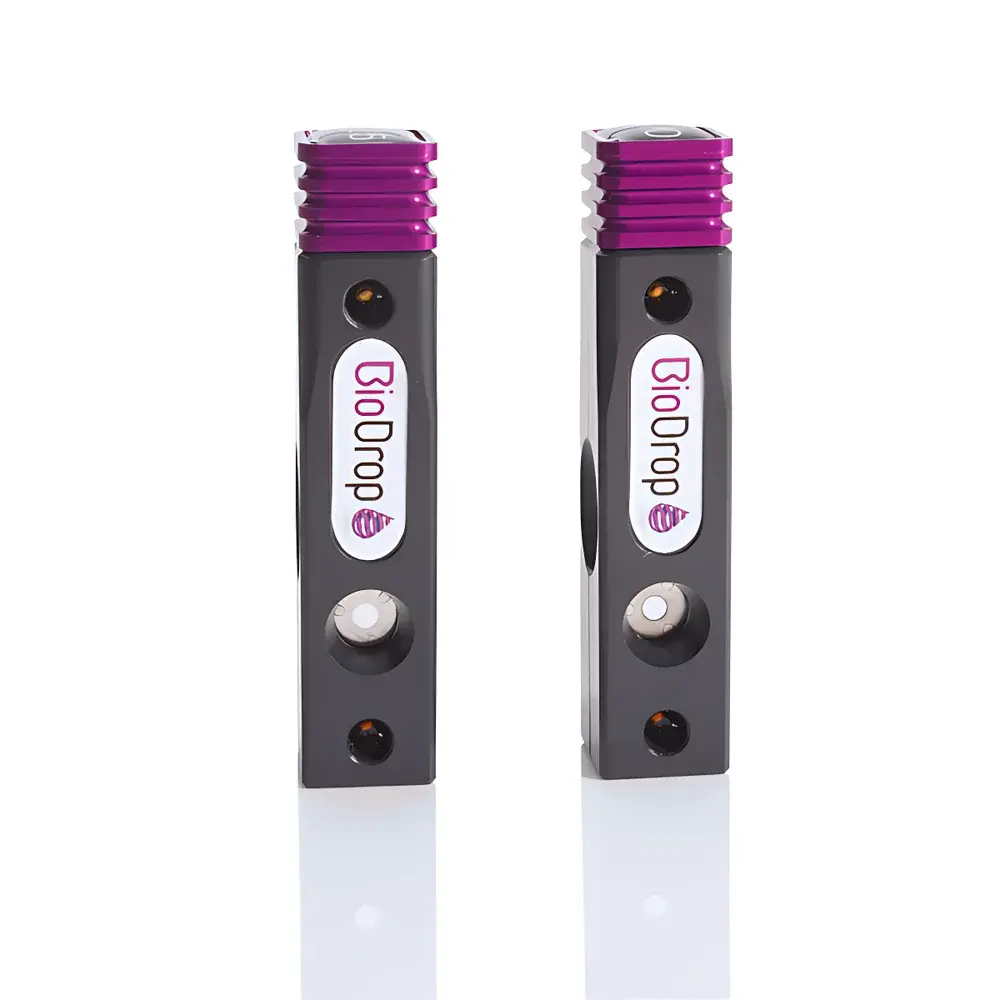
Biochrom BioDrop 125 Ultra-Micro Cuvette
| Brand | Biochrom |
|---|---|
| Origin | USA |
| Model | BioDrop 125 |
| Detection Time | 2 s |
| Wavelength Accuracy | ±2 nm |
| BSA Detection Range | 0.1–134 mg/mL |
| DNA Detection Range | 1–12,000 ng/µL |
| Sample Type | Nucleic Acids & Proteins |
| Sample Volume Requirement | 0.6–2 µL |
| Optical Path Length | 0.125 mm |
| Beam Height | 15 mm |
| Compatibility | Universal with Standard UV-Vis Spectrophotometers |
| Cuvette Type | Fixed-pathlength, Quartz-based Microvolume Cuvette |
Overview
The Biochrom BioDrop 125 Ultra-Micro Cuvette is a precision-engineered optical accessory designed for direct microvolume quantification of nucleic acids and proteins using conventional benchtop UV-Vis spectrophotometers. Unlike integrated microvolume analyzers that rely on proprietary hardware and fixed optics, the BioDrop 125 implements a fixed-pathlength (0.125 mm), high-transmission quartz cuvette architecture compatible with standard 10-mm square cuvette holders. Its operation leverages Beer-Lambert law-based absorbance measurement at 260 nm (DNA/RNA) and 280 nm (proteins), enabling accurate concentration calculation without dilution or pathlength calibration. The design eliminates reliance on capillary-based or pedestal-style sample retention systems—instead, it uses a mechanically stable, open-top quartz cell with precisely defined beam height (15 mm) to ensure consistent illumination across the entire sample meniscus. This architecture delivers high reproducibility (<1.5% CV across replicate measurements) and mitigates common artifacts associated with surface tension variability, bubble entrapment, or meniscus distortion observed in alternative microvolume platforms.
Key Features
- Fixed 0.125 mm optical pathlength—enables direct quantification of highly concentrated samples without dilution
- Quartz construction with >90% UV transmission down to 190 nm—ensures spectral fidelity across full UV-Vis range (190–800 nm)
- 15 mm beam height alignment—optimized for compatibility with standard spectrophotometer light paths and detector geometries
- Minimal sample requirement: 0.6–2 µL—preserves precious biological material during early-stage purification or limited-yield extractions
- Robust mechanical design—resistant to routine handling, cleaning abrasion, and repeated thermal cycling
- No software dependency—functions as a passive optical component; fully agnostic to instrument firmware or vendor-specific analysis modules
- Visual inspection window—facilitates rapid identification of particulates, air bubbles, or debris prior to measurement
Sample Compatibility & Compliance
The BioDrop 125 supports quantitative analysis of double-stranded DNA, single-stranded DNA, RNA, oligonucleotides, and purified proteins (e.g., BSA, IgG) in aqueous buffers including TE, Tris-HCl, and low-conductivity PBS formulations. It is validated for use with common contaminants such as residual phenol, guanidine salts, and EDTA at concentrations typically encountered in column-purified or ethanol-precipitated samples. While not an instrument per se, its physical configuration aligns with ISO 17025 requirements for traceable, repeatable optical measurement practices when used in conjunction with calibrated spectrophotometers. Laboratories operating under GLP or GMP frameworks may incorporate the BioDrop 125 into validated workflows—its fixed geometry eliminates operator-dependent pathlength uncertainty, supporting audit-ready documentation of measurement conditions.
Software & Data Management
As a hardware-only optical component, the BioDrop 125 does not require embedded firmware, drivers, or proprietary software. Concentration calculations are performed externally using standard equations (e.g., A260 × 50 = dsDNA [µg/mL]) within existing laboratory information management systems (LIMS), spreadsheet environments, or spectrophotometer-native analysis modules. When paired with instruments compliant with FDA 21 CFR Part 11 (e.g., certain Agilent, Shimadzu, or PerkinElmer models), raw absorbance data generated using the BioDrop 125 can be captured with electronic signatures, audit trails, and secure storage—maintaining data integrity throughout the analytical lifecycle.
Applications
- Routine QC of nucleic acid preps prior to NGS library construction or qPCR setup
- Concentration verification of CRISPR gRNA, siRNA, or antisense oligonucleotides
- High-throughput protein yield assessment following affinity chromatography or SEC purification
- Monitoring degradation kinetics of labile biomolecules under accelerated stability conditions
- Method development for low-volume assays where sample conservation is critical (e.g., single-cell lysates, microdissected tissue)
- Teaching laboratories requiring robust, reusable tools for introducing spectrophotometric principles
FAQ
Can the BioDrop 125 be used with any UV-Vis spectrophotometer?
Yes—it requires only a standard 10-mm square cuvette holder and a collimated beam with ≥15 mm vertical aperture; verified compatibility includes instruments from Thermo Fisher, Hitachi, JASCO, and Shimadzu.
Is cleaning required between samples?
Yes—rinse thoroughly with ultrapure water followed by gentle drying with lint-free optical tissue; avoid sonication or organic solvents that may degrade quartz surface coatings.
Does pathlength vary with sample volume?
No—the 0.125 mm pathlength is physically fixed; accurate measurement requires filling to the designated meniscus line (0.6–2 µL), ensuring full beam illumination without overflow.
How does it compare to integrated microvolume analyzers?
It offers equivalent accuracy without instrument lock-in, lower total cost of ownership, and seamless integration into existing spectrophotometer fleets—ideal for labs standardizing across multiple platforms.
Is calibration traceable to NIST standards?
While the cuvette itself is not individually certified, its dimensions are manufactured to ±0.005 mm tolerance using NIST-traceable metrology equipment; users should validate performance against reference standards per ISO/IEC 17025 Clause 5.5.





