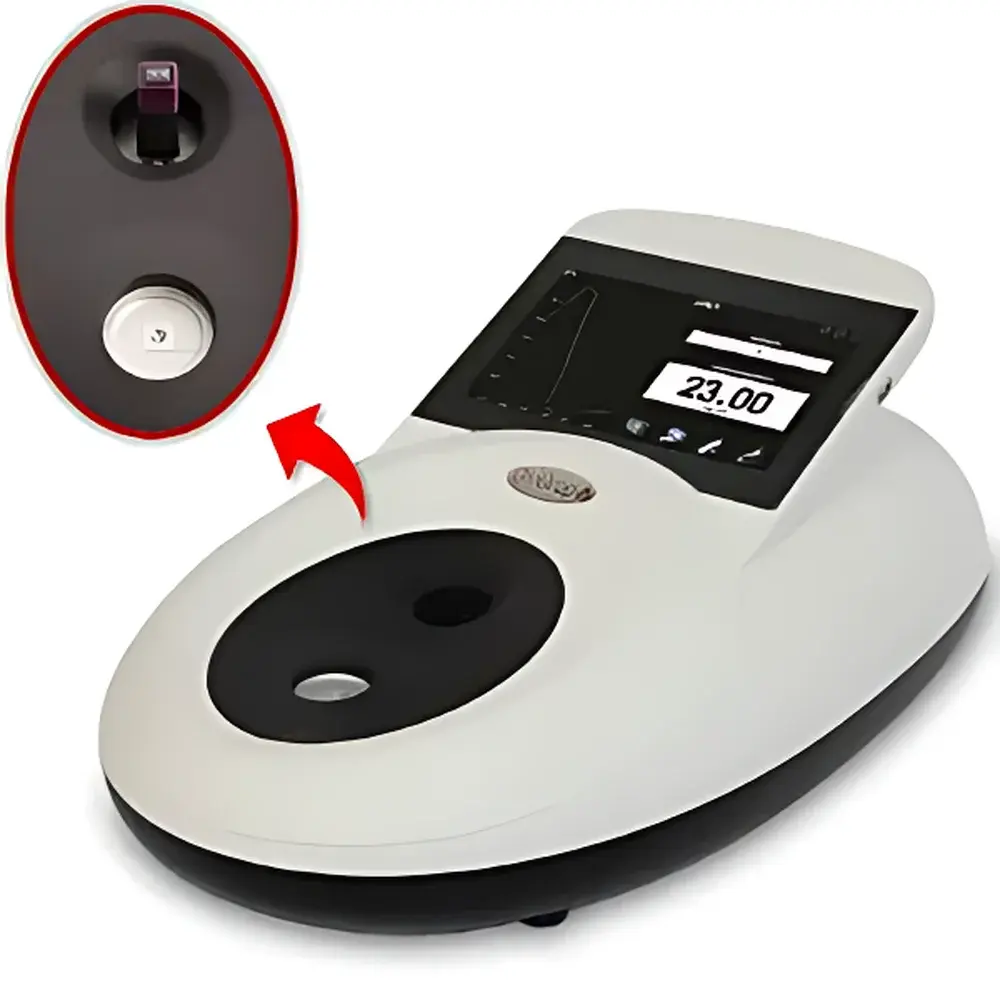
Biochrom BioDrop DUO+ Ultra-Micro Spectrophotometer
| Brand | Biochrom |
|---|---|
| Origin | USA |
| Model | BioDrop DUO+ |
| Sample Volume Requirement | 0.5 µL |
| Detection Time | <3 s |
| Wavelength Accuracy | ±2 nm |
| Wavelength Range | 190–1100 nm |
| Absorbance Range | –0.3 A to 2.5 A |
| dsDNA Detection Limit | 1–12,000 ng/µL |
| Protein (BSA) Detection | Supported |
| Light Source | Pulsed Xenon Lamp |
| Detector | 1024-pixel CCD Array |
| Spectral Bandwidth | 5 nm |
| Stray Light | <0.5% T (220 nm, NaCl |
| Absorbance Accuracy | ±0.005 A or ±1% of reading (whichever is greater, at 546 nm) |
| Absorbance Reproducibility | ±0.003 A (0–0.5 A), ±0.007 A (0.5–1.0 A) |
| Optical Path Accuracy (Microvolume) | ±5 µm |
| Dimensions | 410 × 280 × 190 mm |
| Weight | 3.55 kg |
| Power Input | 120–250 V, 50/60 Hz, max. 40 VA |
| Interface | 7-inch capacitive color touchscreen (English, French, German, Spanish, Chinese), USB port for flash drive and PC connectivity |
Overview
The Biochrom BioDrop DUO+ Ultra-Micro Spectrophotometer is a dual-mode, fixed-optic UV-Vis spectrophotometer engineered for precise, rapid quantification and purity assessment of nucleic acids and proteins in life science laboratories. It operates on the principle of direct UV absorbance measurement at 260 nm (nucleic acids), 280 nm (proteins), and 230 nm (contaminants), leveraging a high-stability pulsed xenon lamp and a 1024-pixel CCD array detector to deliver full-spectrum acquisition (190–1100 nm) in under three seconds. Its dual-sample-path architecture integrates a permanently aligned microvolume sampling point—requiring only 0.5 µL of sample—and a standard 10 mm cuvette holder, eliminating mechanical recalibration and ensuring long-term photometric stability. The optical path length for microvolume analysis is precisely maintained at 0.05 mm (50 µm), with path accuracy controlled to ±5 µm, enabling accurate concentration calculation without user-entered pathlength correction. Designed for routine QC in molecular biology, genomics, and biopharmaceutical development workflows, the DUO+ meets the analytical rigor required for applications ranging from plasmid prep validation to purified monoclonal antibody characterization.
Key Features
- Dual-sample capability: Simultaneous support for microvolume (0.5 µL) drop-based analysis and conventional 10 mm cuvette measurements—no moving parts, no alignment drift.
- Fixed optical path system: Factory-aligned optics with lifetime calibration stability; zero user-performed wavelength or photometric recalibration required.
- High-fidelity spectral acquisition: Pulsed xenon light source ensures uniform intensity across UV-Vis range; 5 nm spectral bandwidth enables resolution of key biomolecular absorbance peaks (e.g., 260/280 ratio, 260/230 ratio).
- Integrated 7-inch capacitive touchscreen interface: Supports five language options (English, French, German, Spanish, Chinese); intuitive navigation for method selection, real-time spectrum display, and result export.
- Robust data handling: USB host port for direct saving to flash drives; seamless transfer to PC via USB cable; no proprietary dongles or external power adapters needed.
- Low-maintenance microvolume stage: Hydrophobic, chemically resistant sampling surface; cleanable with ethanol or mild detergent—no consumable pedestals or capillaries.
Sample Compatibility & Compliance
The BioDrop DUO+ accommodates diverse biological samples including double-stranded DNA, single-stranded RNA, oligonucleotides, fluorescently labeled probes, and both pure and crude protein solutions (e.g., BSA, IgG, lysozyme). It supports direct UV quantification (A280) and colorimetric assays (e.g., Bradford, BCA) when used with cuvettes. All measurements comply with internationally recognized photometric standards, including ISO 8579 (spectrophotometer performance verification) and ASTM E275 (describing UV-Vis spectrophotometric terminology and practices). For regulated environments, the optional Resolution CFR software module provides full 21 CFR Part 11 compliance—including electronic signatures, audit trail logging, user access controls, and data integrity safeguards—enabling use in GLP and GMP settings where traceability and documentation are mandatory.
Software & Data Management
The instrument ships with on-board firmware supporting preconfigured life science methods (dsDNA, ssRNA, oligo, protein A280, protein colorimetric) and custom protocol creation. Raw spectra, concentration values, purity ratios (A260/A280, A260/A230), and melting temperature (Tm) estimates are stored locally and exportable as CSV or PDF. The PC-based Resolution Life Science Software extends functionality with advanced tools: kinetic time-course plotting, multi-wavelength scanning, batch processing of sample sets, and automated report generation with embedded instrument metadata (serial number, date/time stamp, operator ID). Data files retain full spectral fidelity (1 nm increments across 190–1100 nm), facilitating retrospective reanalysis or cross-laboratory comparison.
Applications
- Quantification and purity assessment of extracted genomic DNA and total RNA prior to NGS library preparation or RT-qPCR.
- Routine QC of CRISPR guide RNAs, siRNAs, and antisense oligonucleotides during synthesis and purification.
- Concentration determination of recombinant proteins expressed in E. coli or mammalian systems, including His-tagged constructs and fusion proteins.
- Verification of labeling efficiency for fluorophore-conjugated antibodies and nucleic acid probes.
- Monitoring protein denaturation profiles via thermal melt analysis using intrinsic tryptophan fluorescence (via UV absorbance shift tracking).
- Supporting upstream process development in biomanufacturing, where rapid, low-volume feedback on harvest titer and impurity levels is critical.
FAQ
Does the BioDrop DUO+ require routine wavelength calibration?
No. Its fixed optical path design eliminates mechanical movement and relies on factory-traceable xenon lamp emission lines for inherent wavelength stability; no user calibration is necessary over the instrument’s service life.
Can the microvolume stage be used for viscous or detergent-containing samples?
Yes—its hydrophobic surface minimizes carryover and supports samples containing up to 1% SDS or 0.1% Triton X-100; rinse with 70% ethanol between runs.
Is the Resolution CFR software validated for FDA submission environments?
The Resolution CFR module includes IQ/OQ documentation templates and supports installation qualification under GxP frameworks; it is routinely deployed in labs preparing regulatory filings for biologics and diagnostics.
What is the minimum detectable dsDNA concentration using the built-in sampling point?
1 ng/µL (measured at 260 nm, A = 0.01, with 0.05 mm pathlength), verified per ISO 8579 Annex D protocols.
How is photometric accuracy maintained across different ambient temperatures?
The CCD detector incorporates real-time dark-current compensation and temperature-stabilized readout electronics, ensuring absorbance reproducibility within ±0.003 A (0–0.5 A range) across 15–30 °C operating conditions.