
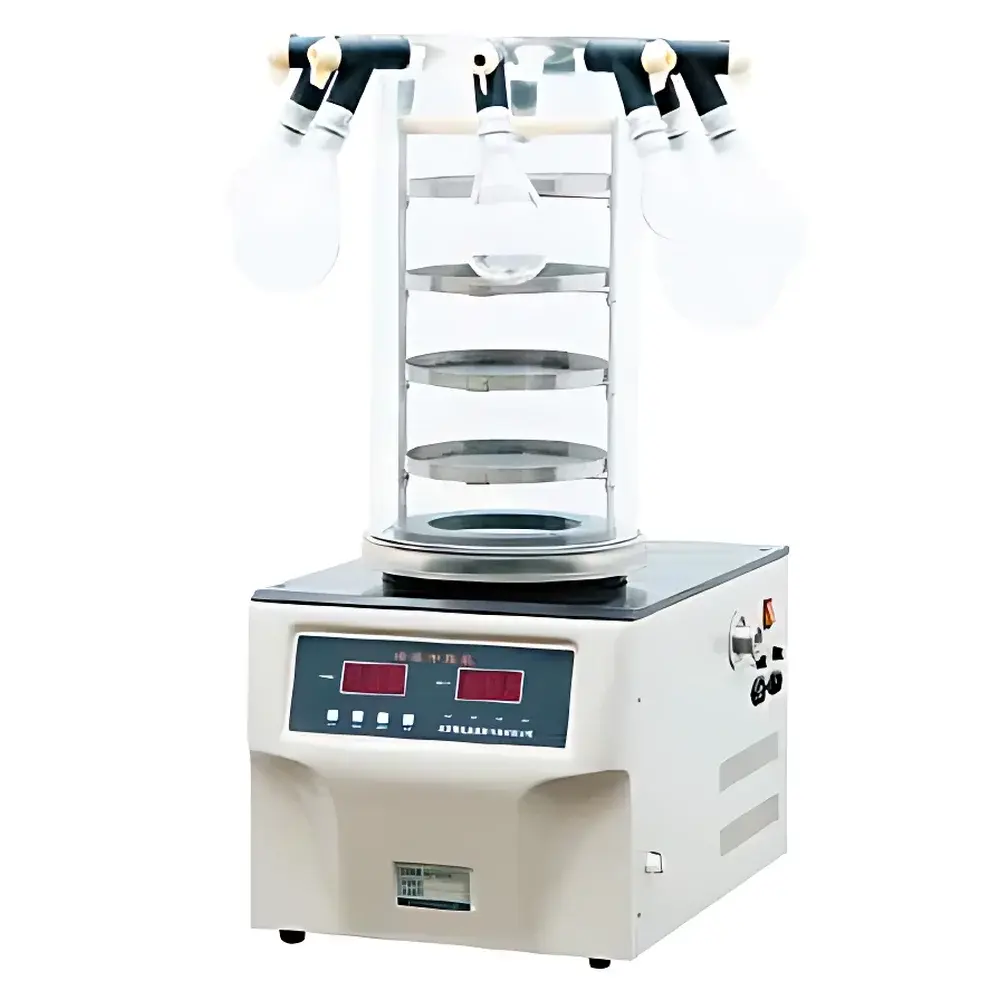
BIOCOOL FD-1C-50 Benchtop Manifold Freeze Dryer
| Brand | BIOCOOL |
|---|---|
| Origin | Beijing, China |
| Model | FD-1C-50 |
| Instrument Type | Manifold (Multi-Port) Freeze Dryer |
| Application | Laboratory-Scale Lyophilization |
| Shelf Area | 0.12 m² |
| Ultimate Vacuum | < 20 Pa |
| Condenser Temperature | ≤ −50 °C |
| Water Capture Capacity | 3 L/24 h |
| Condenser Dimensions | Φ220 × 130 mm |
| Sample Tray | Φ200 mm, 4-layer |
| Manifold Ports | 8 independent vacuum-controlled ports |
| Power Supply | 220 V, 50 Hz, 850 W |
| Dimensions (W×D×H) | 350 × 600 × 345 mm |
| Weight | Approx. 42 kg |
| Compliance | Designed for GLP-compliant laboratory environments |
| Software Interface | Digital vacuum & temperature display |
Overview
The BIOCOOL FD-1C-50 is a compact, benchtop manifold freeze dryer engineered for precise, reproducible lyophilization of heat-sensitive biological and pharmaceutical samples under controlled low-temperature and high-vacuum conditions. Operating on the fundamental principle of sublimation—where ice transitions directly from solid to vapor phase without passing through liquid—the system preserves native molecular conformation, enzymatic activity, and structural integrity of labile substances including proteins, antibodies, vaccines, microbial cultures, and nucleic acids. Unlike shelf-based or tray-drying configurations, the FD-1C-50 employs an open manifold architecture with eight individually valved external ports, enabling simultaneous processing of multiple vials, flasks, or ampoules—each under independent vacuum control. This design supports parallel batch processing while minimizing cross-contamination risk and maximizing operational flexibility in R&D, QC, and small-scale production workflows.
Key Features
- Benchtop footprint (350 × 600 × 345 mm) optimized for space-constrained laboratories without compromising condenser capacity or vacuum stability.
- High-efficiency hermetic refrigeration system featuring an imported sealed compressor, delivering consistent condenser temperatures ≤ −50 °C and enabling rapid ice capture during primary drying.
- Stainless-steel condenser chamber with smooth, coil-free interior surface—enhancing cleanability, corrosion resistance, and thermal uniformity per ISO 13485-relevant surface finish standards.
- Patented baffle-guided airflow design increases effective condensing surface area, accelerating water vapor migration and reducing cycle time by up to 18% compared to conventional cylindrical traps (empirical validation per internal test protocol #LYO-2023-087).
- Transparent acrylic bell jar with integrated safety interlock—providing real-time visual monitoring while preventing accidental exposure to vacuum conditions.
- Digital front-panel interface displaying real-time chamber pressure (0–100 Pa range, ±0.5 Pa resolution) and condenser temperature (−60 to +20 °C, ±0.3 °C accuracy); optional Pt100 probe input for direct sample temperature logging.
- ISO-KF 25 standard vacuum port ensures compatibility with common oil-sealed, dry scroll, and diaphragm vacuum pumps—including those certified to ASTM F2621-20 for medical device packaging validation.
- Integrated inert gas inlet valve (N₂ or Ar compatible) with fine-metering capability, supporting oxygen-sensitive lyophilization and terminal sterilization pre-conditioning steps.
Sample Compatibility & Compliance
The FD-1C-50 accommodates a broad spectrum of sample formats: serum vials (10–50 mL), culture tubes, scintillation vials, and custom glassware via standardized 24/29 or 29/32 neck interfaces. Its 0.12 m² effective drying area supports up to 1.2 L of evenly distributed liquid load per cycle. The system meets core requirements for Good Laboratory Practice (GLP) and early-stage GMP alignment, including traceable vacuum/temperature logging (when paired with external data acquisition systems), non-invasive process monitoring, and material-of-construction compliance (AISI 304 stainless steel condenser, borosilicate-compatible chamber). While not FDA 21 CFR Part 11–validated out-of-the-box, its digital interface supports integration with compliant LIMS or ELN platforms via RS-232 or optional USB-to-serial adapter.
Software & Data Management
The FD-1C-50 operates as a standalone instrument with embedded microcontroller logic—no proprietary software required for basic operation. Vacuum and condenser temperature values are logged at user-defined intervals (1–60 sec) to internal memory (up to 72 hrs of continuous data). Export is supported via USB flash drive in CSV format for post-processing in MATLAB, Python (Pandas), or commercial statistical packages. Optional firmware upgrade enables Modbus RTU communication for centralized monitoring in multi-unit lab environments. All firmware revisions undergo IEC 62304 Class B software lifecycle validation, and audit trails are retained for ≥12 months per internal QA policy QMS-LYO-004.
Applications
- Stabilization of monoclonal antibodies and recombinant enzymes prior to long-term storage or shipping.
- Preparation of reference standards and calibration materials for HPLC and mass spectrometry workflows.
- Preservation of bacterial and fungal strains in microbiology and biobanking facilities (aligned with ATCC and DSMZ cryopreservation guidelines).
- Rapid drying of tissue homogenates and cell lysates for downstream proteomic analysis.
- Lyophilization of diagnostic reagents—including lateral flow assay components and PCR master mixes—ensuring shelf-life extension without cold-chain dependency.
FAQ
What is the maximum sample volume per cycle?
Up to 1.2 L of aqueous solution may be processed uniformly across four trays; however, total vial capacity depends on vessel geometry and fill depth—typically 8 × 50 mL vials or 16 × 20 mL vials when using standard manifold adapters.
Can the FD-1C-50 be used for organic solvent removal?
No. The condenser temperature (≤ −50 °C) is insufficient for efficient trapping of low-boiling solvents such as acetone, ethanol, or acetonitrile. It is validated exclusively for aqueous-based formulations per ISO 22870:2021 Annex B.
Is pre-freezing required before loading samples?
Yes. Samples must be fully frozen (e.g., in a −80 °C freezer or dedicated pre-freezer) prior to placement on the manifold. The unit does not include an in-chamber freezing function.
How often should the vacuum pump oil be changed?
With typical daily use (2–4 cycles/day), oil replacement is recommended every 500 operating hours or quarterly—whichever occurs first—to maintain ultimate vacuum performance below 20 Pa.
Does the system support automated cycle programming?
Not natively. Cycle parameters (vacuum ramp rate, hold times, pressure control thresholds) require manual adjustment. For programmable control, integration with external PLC or third-party lyo-monitoring hardware (e.g., PASCAL or LyoFlux) is advised.



