
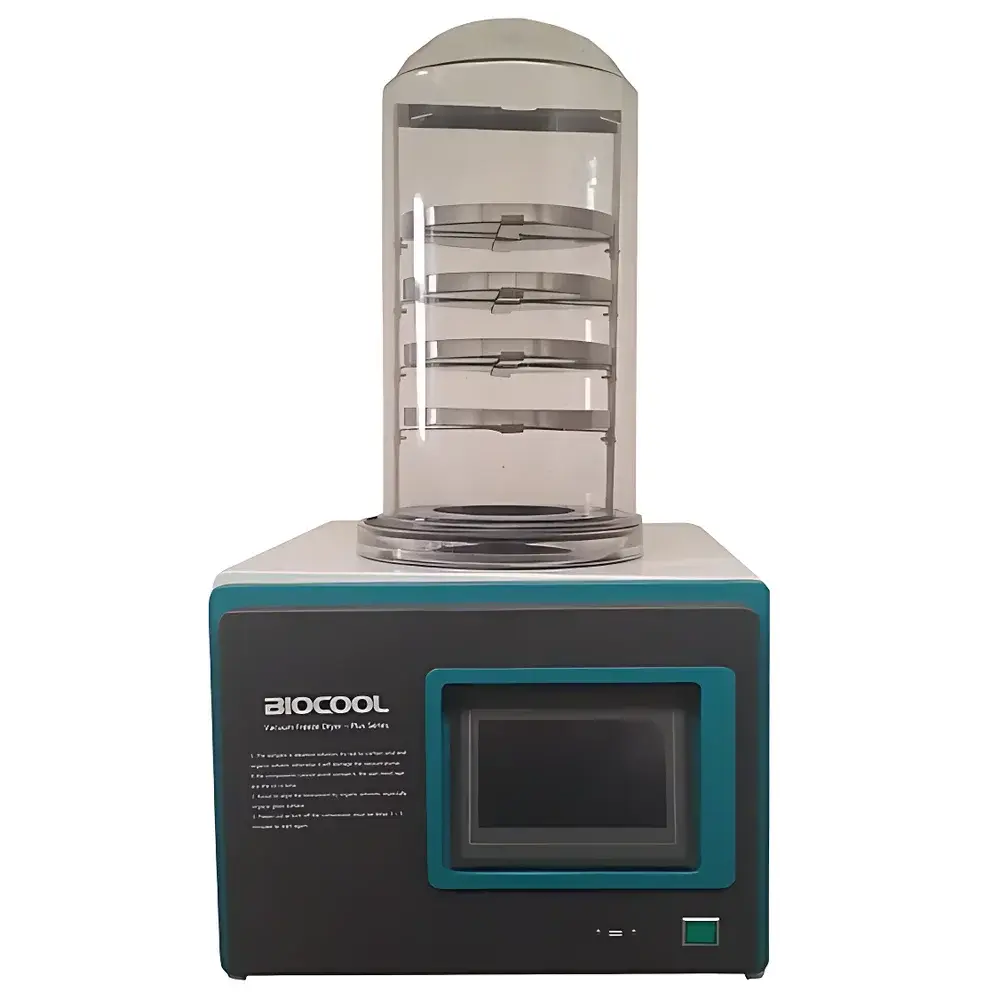
BIOCOOL FD-1E-80+ Laboratory Benchtop Freeze Dryer
| Brand | BIOCOOL |
|---|---|
| Origin | Beijing, China |
| Model | FD-1E-80+ |
| Instrument Type | Manifold Freeze Dryer |
| Application | Laboratory-Scale Lyophilization |
| Shelf Area | 0.12 m² |
| Ultimate Vacuum | <9 Pa |
| Condenser Temperature (No Load) | −85 °C |
| Condensate Capacity (24 h) | 4 L |
Overview
The BIOCOOL FD-1E-80+ is a compact, manifold-type benchtop freeze dryer engineered for precise, reproducible lyophilization of heat-sensitive biological and pharmaceutical samples in research and quality control laboratories. It operates on the fundamental principle of sublimation—removing water from frozen samples under deep vacuum while maintaining product integrity through controlled thermal management. Designed for small-batch processing of vial-contained materials, the system integrates a high-efficiency dual-stage cascade refrigeration unit capable of achieving −85 °C condenser temperature, enabling effective capture of volatile solvents and low-eutectic-point formulations. Its all-welded drying chamber eliminates potential leak paths, ensuring vacuum stability and long-term operational reliability. The FD-1E-80+ complies with core engineering requirements for GLP-compliant lyophilization workflows, supporting method development, stability studies, and pre-formulation screening in accordance with ICH Q5C and USP .
Key Features
- Monolithic stainless-steel drying chamber: Seamless construction ensures structural rigidity, zero weld-induced leakage, and enhanced vacuum integrity.
- High-performance cascade condenser: Achieves −85 °C no-load temperature using internationally certified compressors—optimized for low-noise operation and thermal stability.
- Manifold configuration with 8 independent stopcock valves: Supports simultaneous lyophilization of up to eight standard serum vials or custom glassware; compatible with external flasks via optional T-type manifold adapters.
- Real-time sample temperature monitoring: Dual Pt100 sensors (standard) enable direct measurement of product temperature at critical phases—freezing, primary drying, and secondary drying.
- Graphical lyophilization curve logging: Integrated PLC-based controller records time–temperature–vacuum profiles; data exportable via USB flash drive for post-process analysis and audit trail generation.
- Intelligent hot-gas defrost system: Uses controlled refrigerant reverse-flow technology for rapid, uniform condenser defrosting without mechanical stress or thermal shock to internal components.
- Inert gas backfill capability: Factory-installed imported solenoid valve permits nitrogen or argon purging post-drying to prevent oxidation and support anaerobic storage protocols.
- Cold trap–assisted low-temperature drying mode: Enables direct sublimation of moisture from samples placed directly onto the condenser surface—ideal for high-viscosity pastes or low-volume suspensions.
Sample Compatibility & Compliance
The FD-1E-80+ is validated for lyophilizing aqueous solutions, colloidal suspensions, and semi-solid formulations with eutectic temperatures above −20 °C. It accommodates standard 10–20 mL serum vials (with optional crimp-cap compatibility), as well as external flask configurations using T-manifold adaptors (e.g., 52- or 104-port variants). All wetted surfaces contact-grade 304 stainless steel or borosilicate glass, meeting ISO 13485 material biocompatibility expectations. The system supports traceable process documentation aligned with FDA 21 CFR Part 11 requirements when paired with validated data export protocols and user-access-controlled firmware. Vacuum performance (<9 Pa ultimate pressure) satisfies ASTM F2674–19 specifications for laboratory-scale lyophilizer baseline vacuum integrity.
Software & Data Management
The touch-enabled HMI interface runs on an industrial-grade PLC platform with embedded real-time clock and non-volatile memory. Each lyophilization cycle automatically logs timestamped vacuum pressure, condenser temperature, shelf temperature (if equipped), and user-defined sensor inputs. Cycle files are stored internally and exportable in CSV format via USB 2.0 port—compatible with Excel, MATLAB, and LabArchives for metadata tagging and long-term archival. Audit trail functionality includes operator ID input, parameter change history, and alarm event timestamps—facilitating internal QA reviews and regulatory inspections. Optional software upgrades support automated cycle sequencing and remote status monitoring via Ethernet (requires add-on module).
Applications
- Stabilization of monoclonal antibodies, enzymes, and plasmid DNA for long-term storage.
- Preparation of sterile powders for analytical reference standards in QC labs.
- Routine dehydration of microbial cultures, probiotics, and diagnostic reagents.
- Process development for parenteral formulations prior to pilot-scale freeze drying.
- Lyophilization of nanosuspensions and liposomal drug carriers requiring cryoprotectant optimization.
- Material science studies involving porous scaffold fabrication via freeze-casting techniques.
FAQ
What types of vials are compatible with the FD-1E-80+ manifold system?
Standard 10–20 mL serum vials with rubber stoppers and aluminum crimp seals; optional adapters available for 5–50 mL scintillation vials and glass ampoules.
Is the system suitable for organic solvent removal?
Yes—when used with appropriate cold trap maintenance and vacuum pump oil selection (e.g., perfluoropolyether-based oils), it supports lyophilization of acetone-, ethanol-, or tert-butanol-containing formulations.
Does the FD-1E-80+ meet GMP documentation requirements?
While the base unit does not include electronic signature or full 21 CFR Part 11 validation out-of-the-box, its data export architecture and cycle logging design support integration into validated environments with supplementary SOPs and third-party verification.
Can the condenser be cleaned without disassembly?
Yes—the condenser chamber features a removable front access panel and smooth-welded interior surfaces compatible with IPA wipe-down and ultrasonic cleaning protocols.
What maintenance intervals are recommended for optimal performance?
Vacuum pump oil replacement every 500 operating hours; condenser defrost cycle after each 3–5 batches; annual calibration of Pt100 sensors and vacuum gauge against NIST-traceable references.
Related Products



