
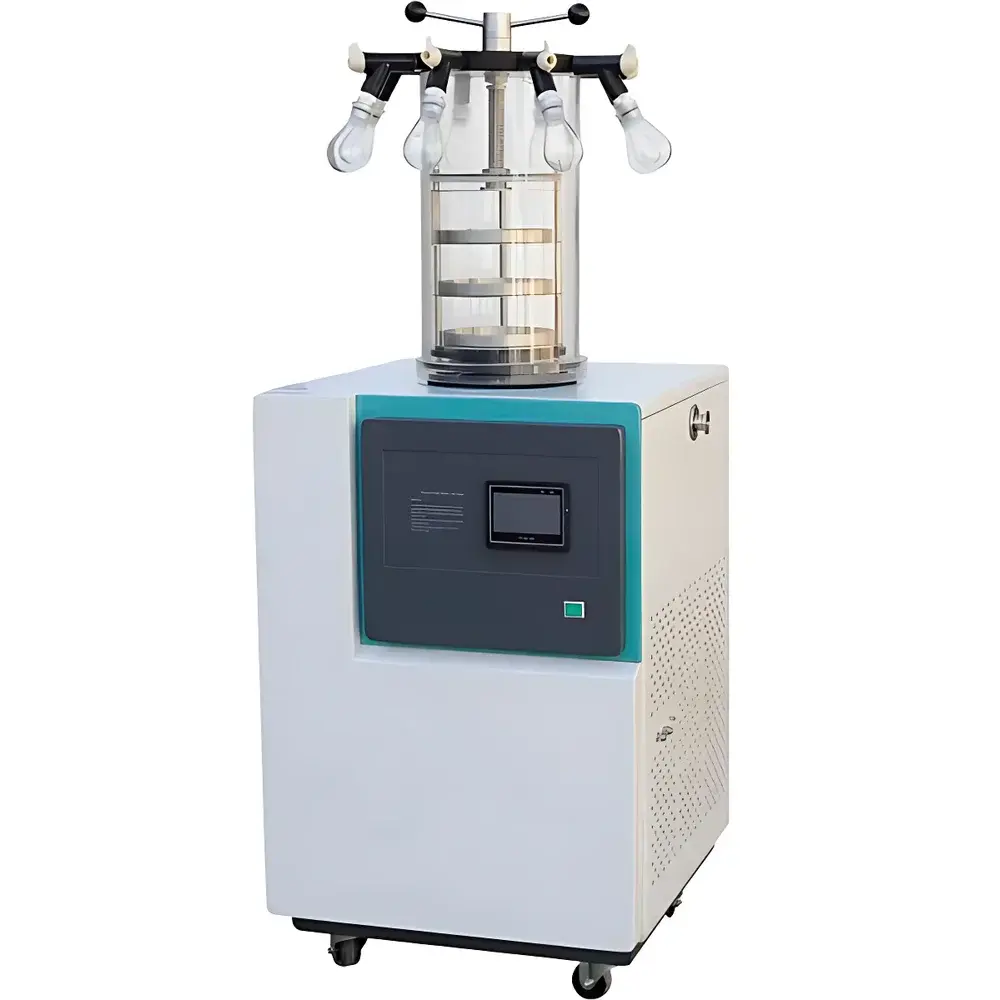
BIOCOOL Lab-1B-110 Benchtop Vacuum Freeze Dryer
| Brand | BIOCOOL |
|---|---|
| Origin | Beijing, China |
| Model | Lab-1B-110 |
| Instrument Type | Standard Shelf-Type Freeze Dryer |
| Application | Laboratory-Scale Lyophilization |
| Lyophilization Area | 0.08 m² |
| Ultimate Vacuum | <3 Pa |
| Condenser Temperature | −110 °C |
| Condensate Capacity (24 h) | 3 L |
| Refrigeration System | Industrial Scroll Compressor |
| Vacuum Pump | Korean-Made Rotary Vane Pump (2 L/s) |
| Control System | PLC + 7″ Industrial Touchscreen HMI |
| Data Logging | Internal Memory (90 days), USB Storage (optional), PC Database Integration (optional) |
| Safety Features | Overcurrent/Overload Protection, 36 V Low-Voltage Heating Circuit, Dual-Temperature Overheat Cut-off, Vacuum Interlock for Drain Valve |
Overview
The BIOCOOL Lab-1B-110 is a benchtop vacuum freeze dryer engineered for precise, reproducible lyophilization of heat-sensitive biologicals, pharmaceuticals, and organic-solvent-based formulations in research and quality control laboratories. It operates on the fundamental principle of sublimation under deep vacuum: frozen samples are subjected to controlled primary drying (ice removal via sublimation) followed by secondary drying (removal of bound water) at elevated shelf temperatures while maintaining condenser temperatures at −110 °C. This ultra-low condenser temperature enables efficient capture of volatile organic solvents—including acetone, ethanol, and acetonitrile—up to 95% v/v concentration, mitigating corrosion risks to internal components and ensuring long-term system integrity. The unit integrates a high-efficiency scroll compressor and a robust 2 L/s rotary vane vacuum pump, delivering stable vacuum performance below 3 Pa—critical for consistent ice nucleation kinetics and minimal product collapse during drying.
Key Features
- Deep-cold condenser (−110 °C) with solvent-compatible stainless-steel coil and non-electric auto-defrost system for rapid, safe ice removal without thermal shock to condenser surfaces
- Aerospace-grade acrylic drying chamber—seamless, adhesive-free construction ensures zero leakage, full optical visibility, and mechanical resilience under repeated vacuum cycling
- Programmable PLC-based controller with 7-inch industrial touchscreen interface; supports up to 500 user-defined or preloaded lyo cycles with real-time parameter monitoring (50 ms sampling interval)
- Shelf heating system featuring PID-fuzzy logic control, dual temperature sensors per shelf, and 36 V low-voltage safety architecture compliant with IEC 61000-6-2 EMC standards
- Optional pulse backfill system with three adjustable flow rates (slow/medium/fast) to prevent particle dispersion during inert gas (N₂ or Ar) reconstitution
- Integrated vacuum regulation module (optional) enabling dynamic pressure modulation during primary and secondary drying phases—reducing boil-over, vial breakage, and drying heterogeneity
- Auto-drain interlock function prevents vacuum loss due to operator error; system disables vacuum operation if drain valve remains open post-cycle
Sample Compatibility & Compliance
The Lab-1B-110 accommodates aqueous solutions, suspensions, emulsions, and organic-aqueous mixtures with eutectic points above −20 °C. Its −110 °C condenser enables reliable processing of formulations containing methanol, ethyl acetate, DMSO, and other low-boiling solvents commonly encountered in peptide synthesis, nanocarrier preparation, and botanical extract stabilization. All critical process parameters—including shelf temperature, chamber pressure, condenser temperature, and elapsed time—are logged with timestamped audit trails, supporting GLP-compliant documentation and FDA 21 CFR Part 11 readiness when paired with optional PC database storage and electronic signature modules. The system meets CE marking requirements for electromagnetic compatibility (EN 61326-1) and low-voltage safety (EN 61000-6-3), and its construction adheres to ISO 22042:2017 guidelines for laboratory freeze dryer design.
Software & Data Management
Data acquisition and traceability are central to the Lab-1B-110’s architecture. Internal flash memory retains ≥90 days of continuous cycle data (shelf temp, condenser temp, vacuum level, time). Optional USB logging enables portable export of CSV-formatted freeze-drying curves for offline analysis in MATLAB, Python, or JMP. For enterprise integration, the optional PC database module supports ODBC-compliant SQL Server or PostgreSQL backends, enabling centralized validation, multi-user access control, and automated report generation aligned with Annex 11 and ALCOA+ principles. Remote monitoring (up to 1.5 km via RS485 or Ethernet) allows off-site supervision of active cycles, alarm status, and system health—essential for unattended overnight runs or satellite lab coordination.
Applications
- Stabilization of monoclonal antibodies, vaccines, and recombinant proteins for long-term storage and transport
- Lyophilization of small-molecule APIs dissolved in mixed organic/aqueous solvents prior to crystallization studies
- Drying of microbial cultures, probiotics, and enzyme preparations without activity loss
- Preparation of porous scaffolds for tissue engineering using solvent-free cryogelation protocols
- Routine QC drying of reference standards, calibration materials, and environmental samples (e.g., soil extracts, wastewater concentrates)
- Method development for GMP-scale lyophilization processes—scalable parameters include shelf ramp rate, hold duration, and pressure setpoints
FAQ
What types of organic solvents can be safely processed in the Lab-1B-110?
The −110 °C condenser enables effective trapping of solvents with boiling points up to ~120 °C, including ethanol, isopropanol, acetone, acetonitrile, and ethyl acetate—provided final concentrations remain ≤95% v/v.
Is the system suitable for sterile processing or aseptic filling?
The Lab-1B-110 is not classified as Grade A/B cleanroom equipment; however, it may be installed within ISO Class 5–7 environments when coupled with validated vapor-phase hydrogen peroxide (VHP) decontamination of the chamber between batches.
Can I validate temperature and vacuum sensors on-site?
Yes—the system includes built-in calibration routines for both Pt100 shelf/condenser sensors and capacitance manometers, supporting NIST-traceable verification using external dry-well calibrators and vacuum standards.
What is the maximum sample volume per batch?
With a 0.08 m² shelf area and standard 180 mm diameter trays (3-layer configuration), the recommended loading volume is 1.2–1.6 L of unfrozen solution, assuming 5–8 mm fill depth and typical collapse temperature margins.
Does the unit support IQ/OQ documentation packages?
BIOCOOL provides factory-issued IQ/OQ templates compliant with ASTM E2500 and EU GMP Annex 15; site-specific execution requires qualified third-party validation partners or trained internal QA personnel.



