
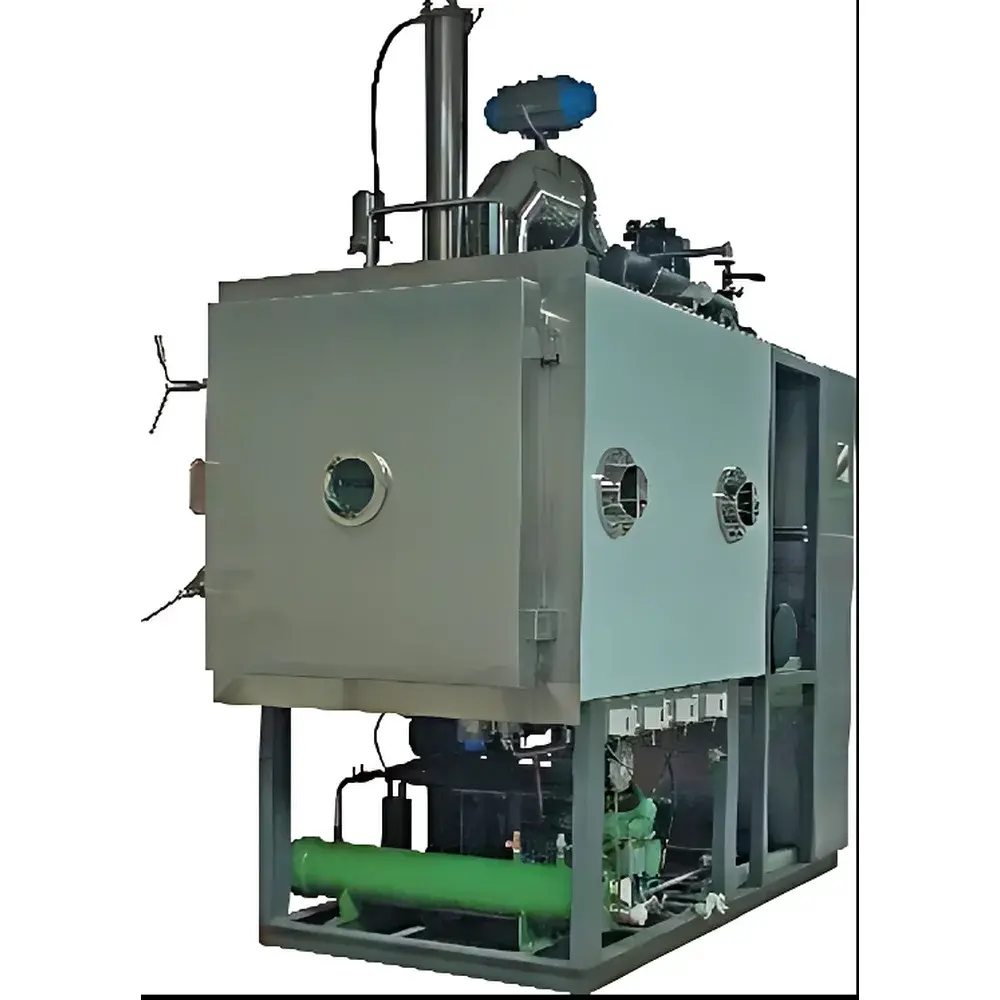
BIOCOOL LYO-2 Production-Scale Freeze Dryer
| Brand | BIOCOOL |
|---|---|
| Origin | Beijing, China |
| Model | LYO-2 |
| Instrument Type | Standard Shelf-Type Freeze Dryer |
| Application | Production-Scale Lyophilization |
| Freeze-Drying Area | 2.16 m² |
| Ultimate Vacuum | <3 Pa |
| Condensate Capacity (24 h) | 40 L/24 h |
| Cold Trap Temperature | <−70 °C |
| Shelf Temperature Range | −55 °C to +80 °C |
| Power Consumption | 12 kW |
| Shelf Configuration | 4+1 shelves (600 × 900 mm), ±1.0 °C uniformity |
| Compliance | Meets GB150-2011, PED, ASME, FDA 21 CFR Part 11, GMP, and CIP/SIP requirements |
Overview
The BIOCOOL LYO-2 is a production-scale, shelf-type freeze dryer engineered for reproducible, scalable lyophilization under stringent regulatory environments. It operates on the fundamental principle of sublimation—removing water from frozen samples under deep vacuum while maintaining product integrity through precise thermal control. Designed for pharmaceutical, biotechnology, and high-value industrial applications, the LYO-2 integrates structural pressure vessel compliance (GB150-2011/PED/ASME), full-cycle process automation, and validated CIP/SIP capabilities. Its 2.16 m² drying area supports batch processing of up to 4,200 vials (Ø22 mm), with shelf temperature control ranging from −55 °C to +80 °C and cold trap performance stabilized below −70 °C. The system achieves ultimate vacuum levels <3 Pa via helium-leak-tested vacuum piping and employs TIG-orbital welded stainless steel construction throughout primary process chambers.
Key Features
- Integrated shelf pre-freezing capability enables direct in-chamber freezing without external ultra-low temperature equipment.
- Programmable logic controller (PLC) with industrial-grade HMI touchscreen (≥10″) supports fully automated cycles—from freezing and primary drying to secondary drying, endpoint detection, and controlled backfilling.
- Three-speed nitrogen/inert gas pulse backfill system prevents particle dispersion during repressurization, critical for fragile amorphous or fibrous formulations.
- Dual-stage vacuum regulation allows dynamic pressure modulation during both sublimation and desorption phases, mitigating boil-over, collapse, or vial breakage in sensitive biologicals.
- Real-time data acquisition at 50 ms intervals for shelf temperature, product temperature (via optional Pt100 probes), chamber pressure, and condenser load.
- 2,000-user-configurable or factory-default lyophilization protocols with timestamped version control and audit trail functionality.
- Robust mechanical design: pressure-rated chamber (−0.15 MPa to +0.5 MPa), mirror-polished interior surfaces (Ra ≤ 0.4 µm), and sloped floor geometry compliant with CIP drainage standards.
- Comprehensive safety architecture including triple overpressure protection, interlocked SIP/CIP sequencing, logic-based subsystem enablement, and independent thermal/vacuum fault monitoring.
Sample Compatibility & Compliance
The LYO-2 accommodates vials (Ø12–Ø32 mm), trays, and bulk containers across diverse matrices—including monoclonal antibodies, viral vectors, live attenuated vaccines, diagnostic reagents, and functional food ingredients. Its chamber geometry and shelf thermal uniformity (±1.0 °C) ensure consistent drying kinetics across heterogeneous loads. Regulatory alignment includes full adherence to current Good Manufacturing Practice (cGMP) Annex 1, USP , ISO 20957, and EU GMP Guide Part I. All wetted surfaces meet ASTM A276/A479 316L specifications; orbital welds are 100% X-ray inspected per ASME BPVC Section V. The system satisfies FDA 21 CFR Part 11 requirements for electronic records and signatures, featuring role-based access control, immutable audit logs, and cryptographic hash verification of archived cycle files.
Software & Data Management
The embedded control software provides deterministic cycle execution, with real-time deviation alerts and automatic hold/resume logic upon parameter excursion. Process data—including shelf/product thermocouple traces, vacuum ramp profiles, and condenser loading curves—are stored locally on encrypted SSD and exportable in CSV or PDF format. Optional PC-based remote monitoring extends operational visibility up to 1.5 km via secure TCP/IP connection with TLS 1.2 encryption. Integrated calibration management supports traceable NIST-traceable temperature (−80 °C to +100 °C) and vacuum (0.1–1000 Pa) verification routines. Optional modules include lyo-endpoint determination (via pressure rise test or tunable diode laser spectroscopy), co-lyophilization recipe synchronization, and integration with MES/SCADA platforms via OPC UA.
Applications
The LYO-2 serves as a bridge between laboratory development and commercial manufacturing. It is routinely deployed for clinical-phase batch production of sterile injectables, stability study batches under ICH Q5C conditions, and scale-down modeling for tech transfer to commercial freeze dryers. In biomanufacturing, it supports lyophilization of cell therapy intermediates where residual moisture must remain <1.0% w/w and collapse temperature (Tc) is tightly monitored. In diagnostics, its inert-gas backfill and low-oxygen environment preserve enzyme activity in rapid-test strip reagents. Food-grade configurations (non-SIP) support dehydration of probiotics, botanical extracts, and heat-labile nutraceuticals without Maillard degradation.
FAQ
Does the LYO-2 support validation documentation packages (IQ/OQ/PQ)?
Yes—BIOCOOL supplies vendor-qualified protocols aligned with ASTM F2975 and ISPE Baseline Guide Vol. 4, including sensor calibration certificates, leak test reports (helium mass spectrometry), and thermal mapping datasets.
Can the system be integrated into an existing cleanroom HVAC or SCADA infrastructure?
Standard Ethernet/IP and Modbus TCP interfaces are provided; custom OPC UA or Profibus DP gateways are available upon request.
What maintenance intervals are recommended for the refrigeration and vacuum systems?
Compressor oil analysis every 2,000 operating hours; cold trap cleaning after every 100 cycles or when ice accumulation exceeds 80% capacity; vacuum pump oil replacement every 500 hours for oil-lubricated units.
Is the CIP/SIP cycle fully automated and validated?
Yes—SIP cycles deliver Fo ≥ 15 at 121 °C with real-time Fo logging; CIP uses heated WFI (≤80 °C) with conductivity and TOC verification endpoints.
Are spare parts and technical support available outside China?
Global service network includes certified field engineers in North America, EU, and APAC regions; critical spares (valves, sensors, PLC modules) held in regional distribution hubs.



