
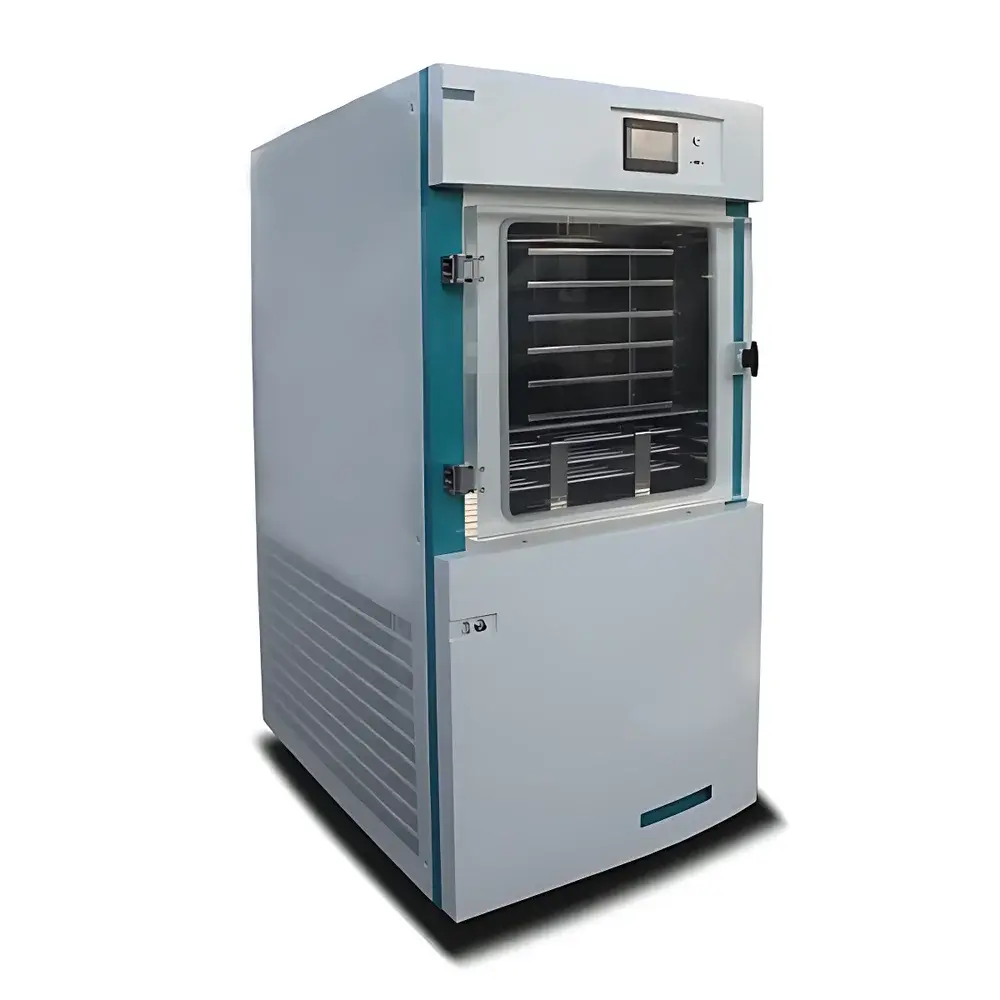
BIOCOOL Pilot10-15S Pilot-Scale Vacuum Freeze Dryer
| Brand | BIOCOOL |
|---|---|
| Origin | Beijing, China |
| Manufacturer Type | Authorized Distributor |
| Product Category | Domestic |
| Model | Pilot10-15S |
| Instrument Type | Shelf-Type Freeze Dryer |
| Application Scope | Pilot-Scale Production |
| Lyophilization Area | 0.525 m² |
| Ultimate Vacuum | <10 Pa |
| Condensate Capacity (24 h) | 8 L/24 h |
| Cold Trap Temperature | −55 °C |
Overview
The BIOCOOL Pilot10-15S is a pilot-scale shelf-type vacuum freeze dryer engineered for reproducible, scalable lyophilization of heat-sensitive biopharmaceuticals, diagnostics, and research-grade biological materials. It operates on the fundamental principles of sublimation under deep vacuum and controlled thermal management: frozen aqueous samples are subjected to low-pressure conditions (<10 Pa), enabling ice to transition directly from solid to vapor without passing through the liquid phase. Simultaneous condensation occurs on a −55 °C cold trap, capturing up to 8 liters of water vapor within 24 hours. With a lyophilization area of 0.525 m² and dual-mode shelf temperature control (−40 °C to +60 °C), the system supports both pre-freezing and primary/secondary drying stages in a single chamber—eliminating manual transfer and minimizing contamination risk. Its design complies with core engineering requirements for GMP-aligned pilot operations, including traceable process parameters, thermal uniformity across shelves, and mechanical robustness for extended duty cycles.
Key Features
- Aerospace-grade acrylic viewing door—optically transparent, non-adhesive, leak-tight, and impact-resistant for real-time visual monitoring without compromising vacuum integrity.
- Integrated shelf pre-freezing capability: shelves cool to −40 °C prior to primary drying, ensuring uniform nucleation and eliminating separate ultra-low-temperature freezing steps.
- Industrial-grade hermetic scroll compressor (3 HP) paired with a high-efficiency 6 L/s oil-lubricated vacuum pump—delivering stable vacuum performance with acoustic noise <62 dB(A) at 1 m.
- Non-electrical cold trap defrosting system: utilizes ambient heat exchange and pressure differential—eliminates resistive heating elements, reducing fire hazard and thermal stress on condenser surfaces.
- Programmable logic controller (PLC) with 10.1″ industrial touchscreen HMI: intuitive interface supporting multi-language operation, no manual required for basic cycle initiation or parameter adjustment.
- Triple data storage options: internal flash memory (retains ≥90 days of 50-ms-interval logs), USB external storage (user-supplied), and optional PC-based database integration via RS485/Modbus TCP.
Sample Compatibility & Compliance
The Pilot10-15S is validated for aqueous solutions, suspensions, and pastes with eutectic temperatures above −30 °C—commonly encountered in protein formulations, bacterial cultures, enzyme preparations, and diagnostic reagents. It supports inert gas backfilling (N₂ or Ar) post-drying to prevent oxidation and facilitate sterile vial stoppering. While not certified to ISO 13485 or FDA 21 CFR Part 11 out-of-the-box, its architecture enables full audit trail implementation—including user-level access control, electronic signatures, and time-stamped parameter logging—when integrated with compliant laboratory information management systems (LIMS). All temperature and vacuum sensors are field-calibratable per ISO/IEC 17025 guidelines, supporting GLP/GMP documentation workflows.
Software & Data Management
The embedded control software provides full-cycle programmability: users define ramp rates, hold durations, shelf setpoints, vacuum setpoints, and pressure-controlled drying phases. Up to 500 custom lyophilization protocols—including fixed and variable-rate profiles—can be stored and recalled. Real-time acquisition records shelf temperature, condenser temperature, chamber pressure, and elapsed time at 50 ms intervals. Curve replay functionality allows overlay comparison of historical batches for process consistency evaluation. Optional PC connectivity enables remote monitoring, automated report generation (PDF/CSV), and integration with enterprise quality systems using standard OPC UA or Modbus protocols.
Applications
- Pilot-scale process development for parenteral drug products prior to clinical manufacturing.
- Stabilization of monoclonal antibodies, vaccines, and viral vectors under defined thermal-vacuum profiles.
- Preservation of microbial strains and cell lines for biobanking and reference material preparation.
- R&D lyophilization of diagnostic assay components—including ELISA reagents and lateral flow conjugates—to assess stability and reconstitution fidelity.
- Material science studies requiring structural preservation of porous matrices (e.g., aerogels, hydrogels) without collapse.
FAQ
What is the maximum batch size this unit can handle?
Based on lyophilization area (0.525 m²) and typical loading density (1–2 L/m²), the Pilot10-15S accommodates up to 8 L of aqueous solution per batch—equivalent to approximately 1,200–1,600 standard 2R vials.
Does the system support validation documentation (IQ/OQ/PQ)?
Yes—the hardware architecture includes calibrated Pt100 temperature sensors (±0.3 °C accuracy), capacitance-based vacuum transducers (±5% FS), and timestamped digital I/O logs. Full qualification packages are available upon request and require on-site execution by qualified personnel.
Can shelf temperature be controlled independently during primary and secondary drying?
Yes—dual PID algorithms govern shelf heating and cooling; users may define distinct ramp/hold sequences for each drying phase, with automatic transition triggered by pressure rise detection or time thresholds.
Is nitrogen purge integration included as standard?
A dedicated inert gas inlet port and solenoid valve are factory-installed; gas flow rate and timing are programmable within the cycle editor.
What maintenance intervals are recommended for long-term reliability?
Vacuum pump oil replacement every 500 operating hours; cold trap cleaning after every 3–5 full-capacity cycles; annual calibration verification of all critical sensors per ISO/IEC 17025 procedures.



