
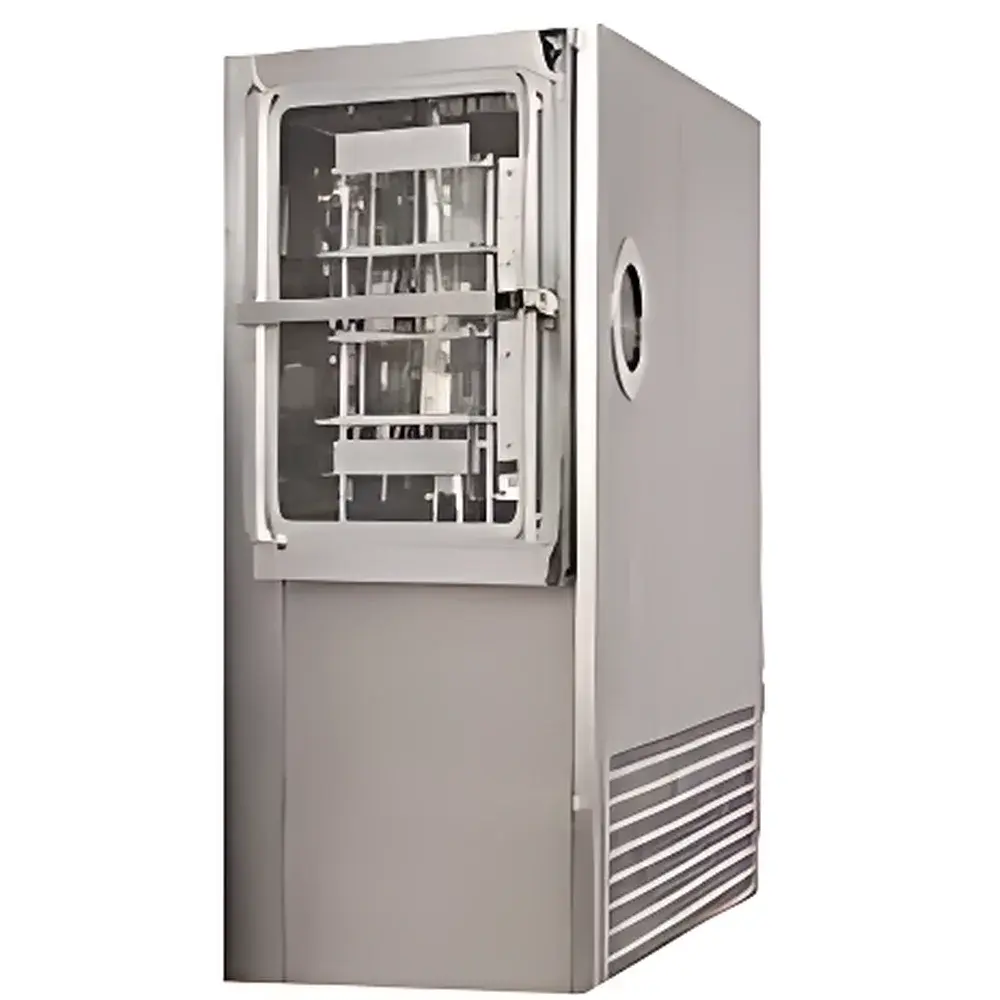
BIOCOOL Pilot3-6T Pilot-Scale Freeze Dryer
| Brand | BIOCOOL |
|---|---|
| Origin | Beijing, China |
| Model | Pilot3-6T |
| Type | Standard Shelf-Type Freeze Dryer |
| Application | Pilot-Scale Production |
| Lyophilization Area | 0.42 m² |
| Ultimate Vacuum | ≤1 Pa |
| Condensate Capacity (24 h) | 6 L/24 h |
| Cold Trap Temperature | <−85 °C |
| Shelf Temperature Range | −55 °C to +70 °C |
| Shelf Spacing | 100 mm |
| Hydraulic Stoppering System | Standard |
| Vacuum Pump | Imported High-Capacity Oil-Sealed Rotary Vane Pump |
| Compressor | Imported Industrial-Grade Refrigeration Compressor |
| Control Interface | Industrial Touchscreen HMI |
| Data Storage | Internal Memory (3-month retention), USB Export (optional), PC Database Integration (optional) |
| Compliance | Designed for GMP-aligned environments |
| Remote Monitoring | Optional (up to 1.5 km) |
Overview
The BIOCOOL Pilot3-6T is a pilot-scale shelf-type freeze dryer engineered for reproducible, scalable lyophilization under controlled process conditions. It operates on the fundamental principles of sublimation—removing water from frozen samples under deep vacuum while maintaining product integrity through precise thermal management. Designed for transition from laboratory R&D to small-batch production, the system supports validation-driven workflows in pharmaceutical, biotechnology, and advanced material development laboratories. Its architecture integrates refrigeration, vacuum, and thermal control subsystems into a single robust platform compliant with foundational engineering requirements for Good Manufacturing Practice (GMP)-aligned facilities. The unit features a stainless steel drying chamber with an aviation-grade acrylic transparent door—ensuring structural integrity, zero leakage, and real-time visual monitoring without compromising vacuum stability.
Key Features
- Shelf-based lyophilization with silicone oil circulation for uniform temperature distribution across all shelves (−55 °C to +70 °C).
- Integrated hydraulic stoppering system enabling safe, programmable vial sealing under vacuum or inert gas atmosphere.
- Dual-stage refrigeration system using imported compressors and optimized heat exchange design, achieving cold trap temperatures below −85 °C and stable condensation performance at ≤1 Pa vacuum.
- Intelligent process control algorithm supporting multi-stage freeze-drying cycles—including pre-freezing, primary drying (sublimation), and secondary drying (desorption)—with dynamic vacuum regulation and ramp/soak profiles.
- Non-electric cold trap defrosting mechanism eliminating thermal shock, reducing downtime, and enhancing operational safety versus immersion-based methods.
- Fully programmable freeze-dry curve optimization: automatic adjustment of shelf heating rate and chamber vacuum setpoints during primary and secondary drying phases to prevent collapse, melt-back, or foaming.
- End-point detection system performing automated residual moisture assessment via pressure rise test (PRT) after desorption drying.
- Pulse-controlled backfill system offering slow, medium, and fast nitrogen or inert gas reintroduction modes to preserve fragile cake morphology and minimize particle dispersion.
- Auto-drain interlock function preventing vacuum system damage due to inadvertent valve misoperation.
- Real-time data acquisition at 50 ms intervals for shelf temperature, chamber pressure, and condenser temperature—enabling high-fidelity process documentation.
Sample Compatibility & Compliance
The Pilot3-6T accommodates aqueous solutions, suspensions, and pastes with eutectic points above −40 °C—suitable for proteins, monoclonal antibodies, vaccines, diagnostic reagents, and polymer-based formulations. Its construction meets mechanical and electrical safety standards applicable to Class I, Division 1 laboratory equipment per IEC 61010-1. While not certified as a Class A cleanroom device, its optional穿墙隔离 (wall-penetration isolation) configuration supports integration into segregated processing suites. All firmware and data handling protocols support audit trail generation, electronic signature readiness, and time-stamped event logging—facilitating alignment with FDA 21 CFR Part 11 expectations when deployed with validated software configurations. Calibration functions for temperature sensors and vacuum transducers are accessible to users, supporting long-term metrological traceability.
Software & Data Management
The embedded industrial touchscreen HMI provides intuitive navigation without requiring reference manuals. Up to 500 user-defined or factory preset lyophilization protocols can be stored locally. Data recording includes shelf temperature, chamber pressure, condenser temperature, and system status flags—with internal memory retaining up to three months of continuous operation logs. Optional external storage via USB flash drive enables portable data export for offline analysis. For centralized oversight, the PC remote monitoring interface (optional) allows secure access to live parameters, alarm history, and historical trend charts within a 1.5 km radius via Ethernet or RS485. All data exports comply with CSV and XML schema conventions for compatibility with LIMS and statistical process control (SPC) platforms.
Applications
This system serves critical roles in formulation development, stability testing, and clinical batch manufacturing. Typical use cases include: lyophilized vaccine intermediate processing; sterile drug product cycle development for Phase I–II clinical supply; excipient screening under varying annealing and drying conditions; analytical reference standard preparation; and preservation of sensitive enzymes or nucleic acid constructs. Its 0.42 m² shelf area and 6 L/24 h condensation capacity enable consistent processing of up to 1,200 standard 20 mL vials per batch—making it suitable for bridging studies between benchtop units (e.g., Labconco FreeZone series) and commercial-scale systems (e.g., SP Scientific Virtis Genesis).
FAQ
What is the maximum vial capacity for Pilot3-6T at standard 20 mL fill volume?
Approximately 1,200 vials (based on 0.42 m² shelf area and typical 10 mm spacing).
Does the system support validation documentation packages (IQ/OQ/PQ)?
Yes—BIOCOOL provides vendor-supplied test protocols and calibration certificates; site-specific PQ execution requires qualified third-party support.
Is the hydraulic stoppering system compatible with ISO-standard vial sizes?
Yes—it accommodates 10 mm, 20 mm, and 30 mm diameter serum vials with adjustable stroke depth and force control.
Can the freeze-drying cycle be paused and resumed without data loss?
Yes—interruption recovery preserves all active parameter states and resumes from the exact point of pause.
What maintenance intervals are recommended for the vacuum pump and refrigeration system?
Vacuum pump oil change every 500 operating hours; compressor service inspection annually or per 2,000 runtime hours—whichever occurs first.



