
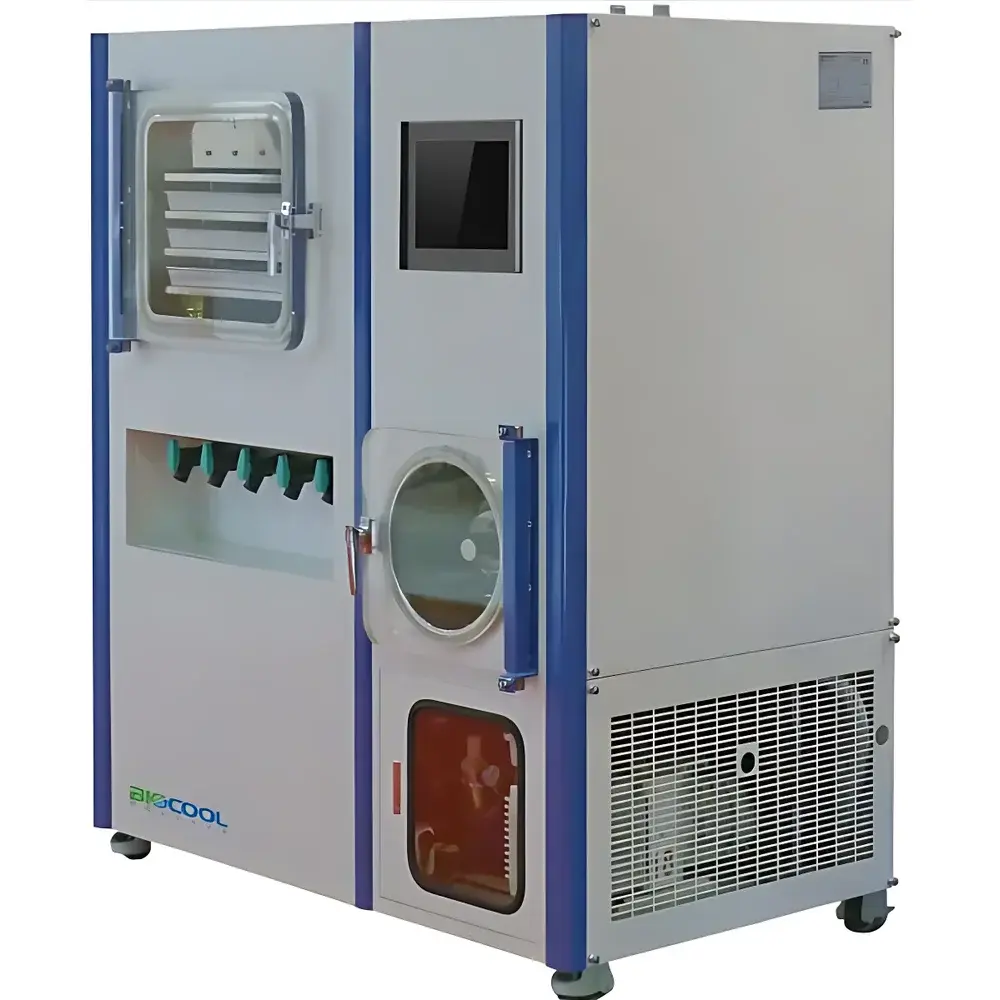
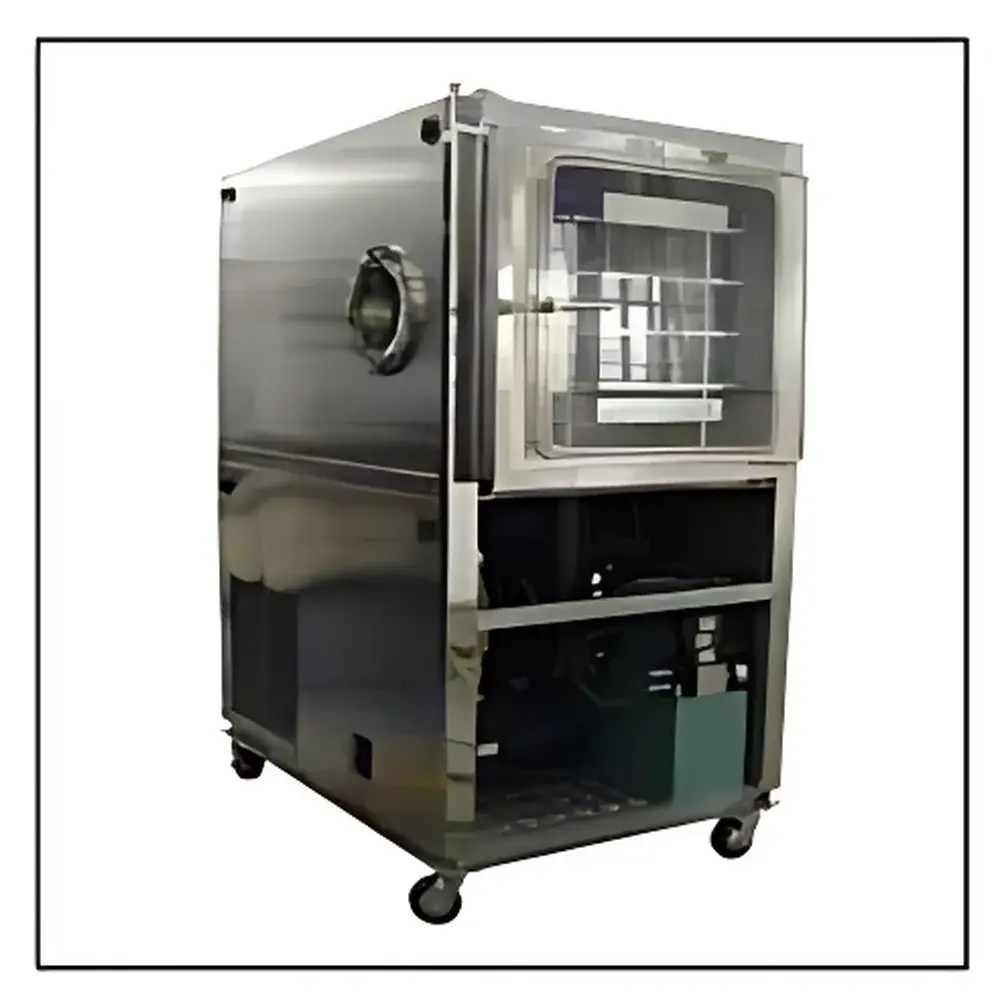
BIOCOOL Pilot5-8H Pilot-Scale Freeze Dryer
| Brand | BIOCOOL |
|---|---|
| Origin | Beijing, China |
| Model | Pilot5-8H |
| Type | Standard Shelf-Type Freeze Dryer |
| Application | Pilot-Scale Processing |
| Lyophilization Area | 0.5 m² |
| Ultimate Vacuum | <3 Pa |
| Condenser Capacity (24 h) | 8 L/24 h |
| Condenser Temperature (No-Load) | <−80 °C |
| Shelf Temperature Range | −55 °C to +70 °C |
| Shelf Cooling Method | Silicone Oil Circulation |
| Control Interface | Industrial Touchscreen HMI |
| Data Storage | Internal (3-month retention), USB (optional), PC Database (optional) |
| Compliance | Designed for GMP-aligned operation and GLP-compliant data integrity |
Overview
The BIOCOOL Pilot5-8H is a fully programmable, pilot-scale freeze dryer engineered for reproducible process development, scale-up validation, and small-batch production of thermolabile pharmaceuticals, biologics, diagnostics, and functional food ingredients. It operates on the fundamental principles of sublimation under high vacuum and controlled thermal input: frozen aqueous or semi-aqueous samples are subjected to low-pressure conditions (<3 Pa), enabling ice to transition directly from solid to vapor without passing through the liquid phase. Simultaneous shelf heating—via silicone oil circulation—and deep condensation (<−80 °C) ensure efficient water vapor capture and stable primary drying kinetics. Unlike laboratory benchtop units, the Pilot5-8H bridges the gap between R&D and manufacturing by supporting lyophilization cycles with full parameter traceability, repeatable shelf temperature profiles, and process-critical vacuum regulation—essential for defining robust operating envelopes per ICH Q5C and FDA Guidance for Industry: Lyophilization of Biotechnology/Biological Products.
Key Features
- Optically transparent drying chamber door fabricated from aerospace-grade acrylic—bond-free construction ensures zero vacuum leakage and mechanical integrity under cyclic pressure differentials.
- Integrated shelf pre-freezing capability enables complete sample freezing within the chamber prior to primary drying, eliminating external ultra-low temperature dependency.
- High-efficiency dual-stage scroll compressor and oil-sealed rotary vane vacuum pump (imported) deliver stable ultimate vacuum (<3 Pa) with acoustic noise <62 dB(A) at 1 m distance.
- Hydraulic stopper system (imported) provides precise, vibration-dampened vial compression during secondary drying—critical for maintaining container closure integrity in regulatory submissions.
- Oil mist filtration standard; eliminates airborne hydrocarbon contamination during vacuum generation and complies with ISO 8573-1 Class 2 particulate/oil requirements for sterile processing environments.
- Multi-stage vacuum regulation system allows dynamic setpoint control during both sublimation and desorption phases—preventing melt-back, collapse, or foaming in sensitive formulations.
- Non-electric condenser defrosting via inert gas purging and thermal siphon design—eliminates electrical hazards, reduces downtime, and avoids condensate recontamination risks associated with immersion defrost methods.
- Fuzzy PID-controlled shelf heating with real-time thermal loop monitoring ensures ±0.5 °C uniformity across all shelves (±1.0 °C max deviation over full load).
- Automated endpoint detection algorithm evaluates residual moisture trends via pressure rise test (PRT) and comparative vapor pressure modeling—supports compliance with USP and Ph. Eur. 2.9.40.
Sample Compatibility & Compliance
The Pilot5-8H accommodates standard 2R–50R glass vials, trays (up to 0.5 m²), and custom stainless-steel containers. It is validated for aqueous solutions, suspensions, emulsions, and pastes with eutectic temperatures >−40 °C. Optional co-lyophilization accessories—including organic solvent traps and cryo-concentrator modules—extend compatibility to ethanol-, acetone-, or DMSO-based systems. The system architecture supports 21 CFR Part 11-compliant electronic records when paired with optional PC database software (audit trail, user role management, digital signature). All temperature and vacuum sensors are field-calibratable per ISO/IEC 17025 traceable standards, and hardware interlocks enforce safety-critical logic (e.g., vacuum interlock on drain valve actuation, overtemperature cutoff on shelf heaters).
Software & Data Management
A 10.1-inch industrial touchscreen HMI hosts an embedded Linux-based control platform with intuitive icon-driven navigation—requiring no operator manual for routine cycle execution. Up to 500 user-defined or factory preset lyophilization protocols can be stored onboard. Real-time acquisition occurs at 50 ms intervals for shelf temperature, condenser temperature, chamber pressure, and refrigerant discharge temperature. Data logging options include internal flash memory (retains ≥90 days of continuous 50 ms-resolution data), USB export (FAT32-formatted drives), and TCP/IP-linked remote database archiving. Optional PC remote monitoring extends supervision up to 1.5 km via fiber or Ethernet—enabling centralized facility-wide oversight while preserving local cycle autonomy. All exported datasets conform to ASTM E2500-22 Annex A2 structured metadata conventions for analytical traceability.
Applications
This system serves as a critical tool in formulation development laboratories conducting stability-indicating lyophilization studies, comparability assessments for biosimilar candidates, and Phase I–II clinical supply manufacturing. Its precision vacuum modulation supports optimization of drying rates for monoclonal antibodies, viral vectors, mRNA-LNPs, and probiotic cultures—where excessive heat input or uncontrolled pressure ramping induces aggregation or lipid oxidation. Regulatory filing packages (e.g., IND, MAA) routinely reference Pilot5-8H-derived cycle parameters due to its documented thermal uniformity, vacuum repeatability, and data integrity features aligned with ALCOA+ principles. Academic users leverage its co-crystallization mode and optional eutectic point analyzer for solid-state characterization of amorphous dispersions.
FAQ
What is the maximum allowable load volume for this unit?**
The nominal lyophilization area is 0.5 m², corresponding to approximately 1,200 × 5R vials or 18 standard 300 mm × 400 mm trays under optimal loading density.
Can the system operate under nitrogen or argon blanket?**
Yes—the integrated inert gas backfill module supports programmable pulse-controlled repressurization using N₂, Ar, or custom gas mixtures, with adjustable flow rate (0.1–5.0 L/min) and pressure ramp profiles.
Is GMP documentation available for qualification?**
IQ/OQ documentation templates compliant with Annex 15 and EU GMP Annex 15 are provided; PQ support includes protocol drafting assistance and witnessed execution at customer site or BIOCOOL’s Beijing validation center.
How frequently does calibration require verification?**
Temperature sensors and capacitance manometers are recommended for annual calibration verification; field-adjustable offsets allow user-performed checks between formal calibrations.
Does the system support PAT integration?**
Yes—RS485 Modbus RTU and Ethernet/IP interfaces enable real-time data streaming to third-party Process Analytical Technology platforms (e.g., DeltaV, PI System) for multivariate statistical process control (MSPC).



