
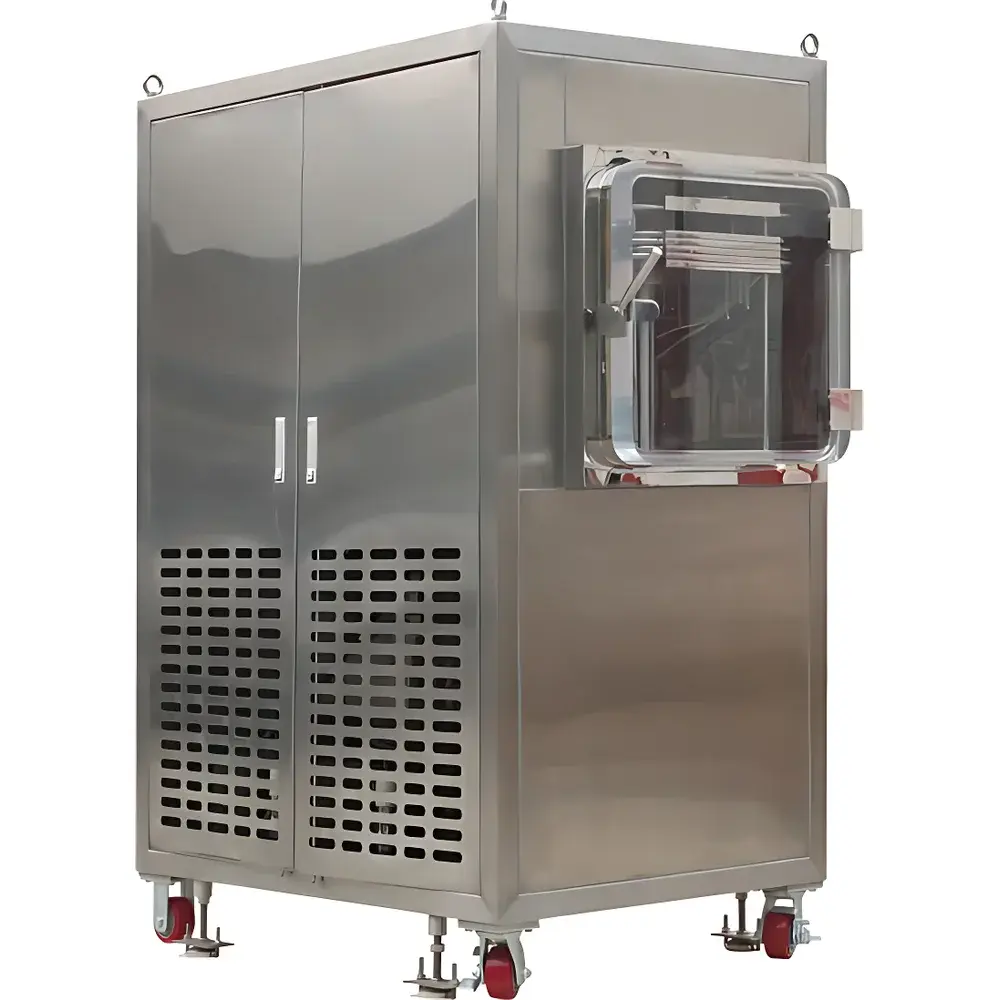
BIOCOOL Pilot5-8T Wall-Mounted Pilot-Scale Freeze Dryer
| Brand | BIOCOOL |
|---|---|
| Origin | Beijing, China |
| Model | Pilot5-8T Wall-Mounted Pilot-Scale |
| Instrument Type | Shelf-Type Freeze Dryer |
| Application Scope | Pilot-Scale Production & Process Development |
| Lyophilization Area | 0.56 m² |
| Ultimate Vacuum | ≤1 Pa |
| Condensate Capacity (24 h) | 8 L/24 h |
| Cold Trap Temperature | < −85 °C |
| Shelf Temperature Range | −55 °C to +70 °C (silicone oil circulation) |
| Shelf Spacing | 80 mm |
| Wall-Mounted Isolation Configuration | Yes |
| Control System | Industrial Touchscreen with Programmable Logic Controller (PLC) |
| Data Storage | Internal memory (3-month retention), USB export (optional), PC database integration (optional) |
| Compliance | Designed to support GLP/GMP-aligned workflows |
Overview
The BIOCOOL Pilot5-8T is a wall-mounted, pilot-scale freeze dryer engineered for reproducible lyophilization process development, scale-up validation, and small-batch manufacturing under controlled laboratory or cleanroom conditions. It operates on the fundamental principles of sublimation-based drying: frozen aqueous or semi-aqueous samples are subjected to deep vacuum (<1 Pa) while heat is precisely applied to shelves, enabling ice to transition directly from solid to vapor without passing through the liquid phase. The system integrates silicone oil-circulated shelf temperature control (−55 °C to +70 °C), a high-efficiency cold trap operating below −85 °C, and real-time vacuum regulation—enabling precise management of primary and secondary drying stages. Its wall-mounted isolation design allows seamless integration into segregated processing environments, minimizing cross-contamination risk and supporting containment requirements for sensitive biologics, diagnostics, or pharmaceutical intermediates.
Key Features
- Wall-mounted isolation configuration with integrated pass-through interface for aseptic or containment-compliant operation
- Aerospace-grade acrylic drying chamber door—bond-free, leak-tight, and optically transparent for visual process monitoring
- Silicone oil-heated/cooled shelves with fuzzy PID temperature control and thermal cycle protection
- Optimized lyophilization curve algorithm: dynamically regulates shelf ramp rate and chamber vacuum during sublimation and desorption phases
- Non-electric cold trap defrosting system—rapid, safe, and eliminates immersion-related downtime and maintenance hazards
- Programmable vacuum modulation: prevents boil-over, vial collapse, or foaming in formulations with low eutectic points or high viscosity
- Pulse-controlled backfill system with three adjustable flow rates (slow/medium/fast) to preserve delicate cake morphology during inert gas reintroduction
- Automated end-point detection: performs in-situ moisture assessment at the conclusion of desorption drying to verify residual water content compliance
- Integrated oil mist filter on vacuum pump exhaust—eliminates operator exposure to hydrocarbon vapors during operation
- Industrial-grade HMI touchscreen interface with intuitive navigation; no manual required for routine operation
- Dual-mode operation: manual mode for empirical parameter exploration; automatic mode for validated, repeatable cycles
Sample Compatibility & Compliance
The Pilot5-8T is optimized for aqueous solutions, suspensions, and pastes with eutectic temperatures above −40 °C. It accommodates standard 2R–50R glass vials, serum bottles, and open trays across its 0.56 m² shelf area. The system supports process qualification per ICH Q5C and USP , and its architecture aligns with core elements of FDA 21 CFR Part 11 when configured with optional PC-based database logging (including electronic signatures, audit trails, and user access controls). Calibration functions for shelf temperature and chamber vacuum are built-in, facilitating periodic verification per ISO/IEC 17025 or internal SOP requirements. Optional accessories—including eutectic point analyzers, organic solvent traps, and nitrogen purge modules—extend compatibility to non-aqueous or volatile solvent systems.
Software & Data Management
Control logic resides in a deterministic PLC platform with 50 ms sampling resolution for shelf temperature, condenser temperature, and chamber pressure. Up to 500 custom lyophilization protocols can be stored locally. Data logging offers three tiers: onboard flash memory (retains ≥90 days of timestamped temperature/vacuum/shelf power data), USB export (FAT32-formatted drives), and optional PC-hosted SQL database with remote access capability (up to 1.5 km via Ethernet or fiber). All logged parameters include metadata (operator ID, batch ID, cycle version), supporting traceability in GLP/GMP audits. Calibration logs, alarm histories, and system event timestamps are retained separately and exportable in CSV or PDF format.
Applications
- Pharmaceutical formulation development: optimization of cryoprotectant ratios, annealing steps, and primary drying endpoints
- Vaccine and monoclonal antibody intermediate drying: preservation of conformational integrity under controlled thermal stress
- Diagnostics reagent stabilization: lyophilization of enzyme conjugates, lateral flow components, and PCR master mixes
- Biopolymer and nanomaterial processing: drying of hydrogels, liposomal dispersions, and colloidal suspensions
- Academic and contract research: reproducible scale-down modeling for commercial freeze dryer qualification (e.g., correlation to 10–50 m² production units)
- Medical device coating drying: uniform dehydration of bioactive polymer coatings on implants or sensors
FAQ
What distinguishes the Pilot5-8T from benchtop freeze dryers?
The Pilot5-8T features wall-mounted isolation, larger shelf area (0.56 m²), deeper cold trap (≤−85 °C), and programmable vacuum modulation—enabling robust process transfer and regulatory documentation not feasible with standard lab-scale units.
Can the system handle organic solvents?
Yes—when equipped with the optional organic solvent trap accessory, it safely condenses acetone, ethanol, or tert-butanol vapors without compromising vacuum integrity or cold trap performance.
Is remote monitoring supported out of the box?
Remote status viewing and basic alarm notification are enabled via Ethernet; full remote control and historical data access require the optional PC database module and local network configuration.
How is calibration traceability maintained?
Built-in temperature and vacuum calibration routines accept NIST-traceable reference inputs; calibration events are timestamped, operator-logged, and exported with full metadata.
What safety interlocks are implemented?
Independent overcurrent and overload protection per subsystem; vacuum-dependent heater enable logic; automatic shutdown on shelf overtemperature, vacuum loss, or condenser overload; full system interlock matrix compliant with IEC 61508 SIL1.
Related Products



