
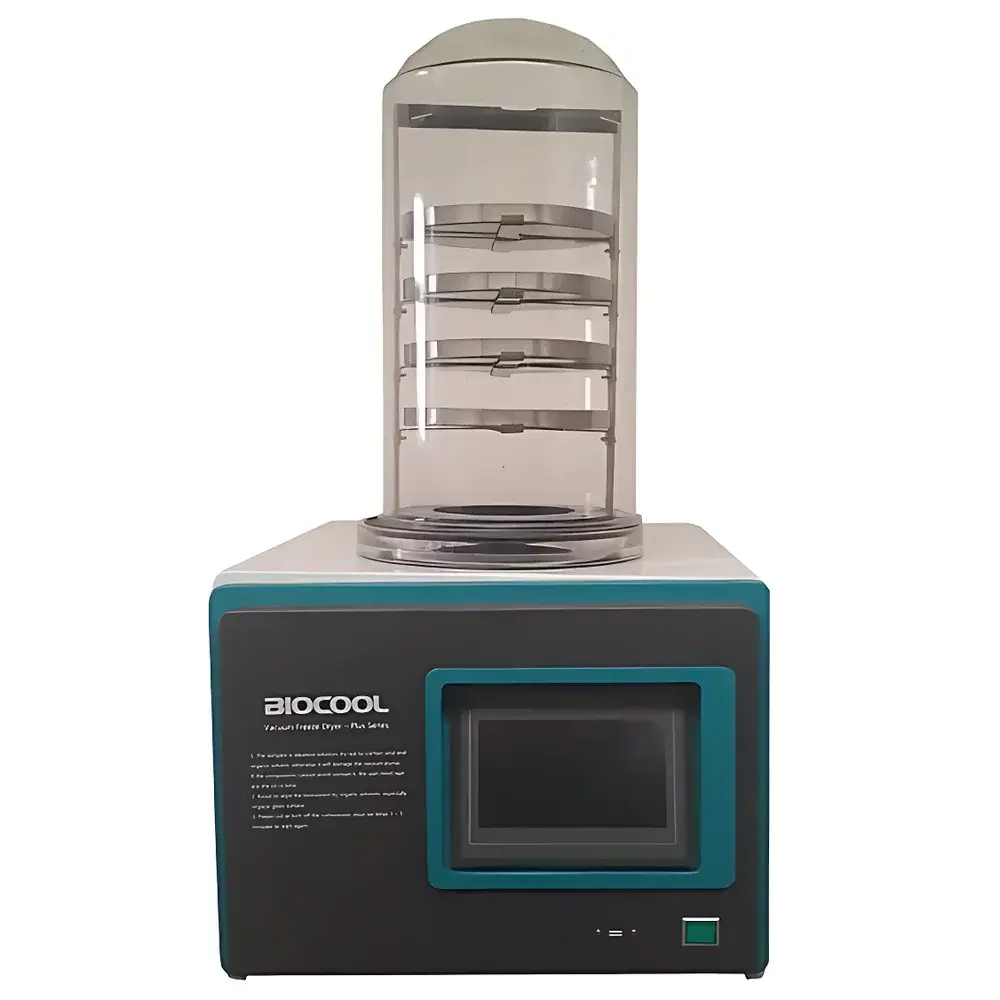
BioCoool FD-1C-80+ Benchtop Freeze Dryer
| Brand | BioCoool |
|---|---|
| Origin | Beijing, China |
| Model | FD-1C-80+ |
| Instrument Type | Standard Shelf-Type Freeze Dryer |
| Application | Laboratory-Scale Lyophilization |
| Shelf Area | 0.12 m² |
| Ultimate Vacuum | <9 Pa |
| Condenser Temperature (No-Load) | −85 °C |
| Water Capture Capacity (24 h) | 4 L |
| Control System | PLC + Touchscreen Interface |
| Defrost Method | Hot-Gas Defrost |
| Optional Features | Sample Temperature Monitoring, Lyophilization Curve Logging, USB Data Export, Inert Gas Backfilling (N₂ or Ar), External Manifold Compatibility |
Overview
The BioCoool FD-1C-80+ is a benchtop shelf-type freeze dryer engineered for reproducible, scalable lyophilization of heat-sensitive biological and pharmaceutical samples in research laboratories and early-stage development environments. It operates on the fundamental principles of sublimation under high vacuum and controlled thermal management: frozen aqueous matrices are subjected to deep condensation at −85 °C in a hermetically sealed cold trap, while pressure is maintained below 9 Pa to enable direct phase transition from ice to vapor—bypassing the liquid phase entirely. This process preserves structural integrity, bioactivity, and chemical stability of proteins, vaccines, enzymes, diagnostic reagents, and sterile formulations. The unit integrates a robust refrigeration architecture with dual-stage compression, low-noise operation, and an all-welded drying chamber to ensure leak-tight performance and long-term vacuum integrity—critical for consistent primary drying kinetics and final residual moisture control.
Key Features
- Monolithic stainless-steel drying chamber: Seamlessly formed without adhesives or gasketed joints, eliminating potential leak paths and enhancing mechanical strength and corrosion resistance.
- High-efficiency dual-stage cascade refrigeration system: Achieves stable condenser temperatures down to −85 °C (no-load), enabling rapid ice capture and efficient sublimation even for low-eutectic-point formulations.
- Cold trap pre-freezing capability: Allows sample freezing directly inside the chamber prior to vacuum initiation—eliminating the need for external ultra-low temperature freezers and reducing contamination risk during transfer.
- Real-time sample temperature monitoring: Dual Pt100 sensors mounted on shelves provide continuous, traceable temperature feedback during both freezing and drying phases.
- Lyophilization curve visualization and storage: Built-in PLC controller logs time-stamped data for shelf temperature, condenser temperature, chamber pressure, and sample temperature; curves are viewable on the touchscreen and exportable via USB drive.
- Automated hot-gas defrost system: Delivers uniform, rapid, and safe condenser defrosting without manual intervention or downtime—minimizing operator exposure and improving throughput consistency.
- Inert gas backfilling port: Equipped with original-imported solenoid valve compatible with nitrogen or argon for oxygen-sensitive product stabilization post-drying.
Sample Compatibility & Compliance
The FD-1C-80+ supports lyophilization of aqueous-based materials including protein solutions, monoclonal antibody formulations, bacterial/viral suspensions, enzyme preparations, and diagnostic assay reagents—provided their eutectic temperature exceeds −20 °C. Its 0.12 m² shelf area accommodates standard 200 mm diameter trays or stacked vials (e.g., 10–20 mL serum bottles). While not certified for GMP manufacturing, the system’s design aligns with core GLP and early-phase regulatory expectations: full audit trail capability (via timestamped data logging), programmable process parameters, and hardware-level safety interlocks (overcurrent, overload, and temperature limit protection). Optional accessories—including calibrated eutectic point analyzers, external manifold systems (T-type, 24-port), and inert gas filtration modules—support method development compliant with ICH Q5C, USP , and ISO 22057 guidelines.
Software & Data Management
The integrated PLC-based control platform features a 7-inch capacitive touchscreen with intuitive icon-driven navigation. All critical process variables are logged at user-defined intervals (default: 30 s) and stored internally for ≥100 cycles. Data export is supported exclusively via FAT32-formatted USB flash drives in CSV format—ensuring compatibility with LIMS, ELN, and statistical process analysis tools (e.g., JMP, Minitab). No cloud connectivity or remote access is implemented, preserving data sovereignty and meeting institutional IT security policies. Audit trail functionality records operator ID (manual entry), start/stop timestamps, parameter modifications, and alarm events—facilitating 21 CFR Part 11 readiness when paired with institutional electronic signature protocols.
Applications
- Stabilization of labile biologics: Monoclonal antibodies, recombinant growth factors, and viral vectors requiring extended shelf life at ambient storage conditions.
- Preparation of reference standards and calibration materials for analytical chemistry and clinical diagnostics.
- Drying of microbial cultures and environmental samples for metagenomic preservation and long-term archiving.
- Process development support: Mapping collapse temperature, optimizing primary drying rate, and validating secondary drying endpoints using real-time temperature and pressure profiling.
- Academic and industrial R&D: Enabling iterative formulation screening (e.g., cryoprotectant evaluation) under controlled, documented conditions.
FAQ
What types of samples are compatible with the FD-1C-80+?
Aqueous solutions, suspensions, and pastes with eutectic temperatures above −20 °C—including proteins, vaccines, enzymes, and diagnostic reagents.
Does the system support validation documentation for regulated environments?
Yes—the unit provides full process data logging, user-accessible audit trails, and optional IQ/OQ documentation packages aligned with ISO 9001 and ASTM F2695-17.
Can the FD-1C-80+ be used with multi-port manifolds?
Yes—T-type and 24-port external manifolds are available as factory-installed options or field retrofits.
Is the condenser temperature verified independently?
Condenser temperature is measured by dual Pt100 sensors with NIST-traceable calibration certificates available upon request.
What maintenance is required during routine operation?
Routine tasks include vacuum pump oil changes every 500 hours, cold trap cleaning after each batch, and annual verification of sensor accuracy and vacuum integrity per manufacturer SOP.



