
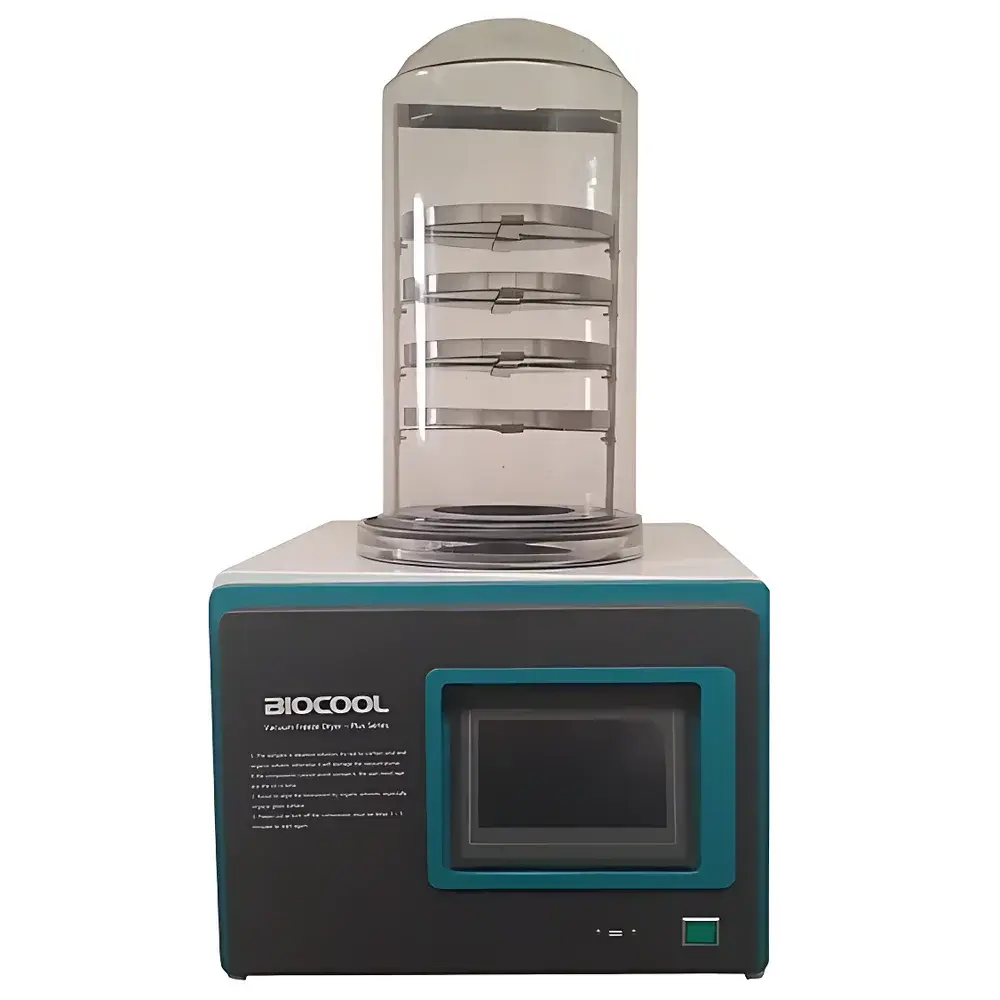
BioCoool FD-1D-80+ Benchtop Freeze Dryer
| Brand | BioCoool |
|---|---|
| Origin | Beijing, China |
| Manufacturer Type | Authorized Distributor |
| Country of Origin | China |
| Instrument Type | Stoppering (Lyophilization) Freeze Dryer |
| Application | Laboratory-Scale Lyophilization |
| Shelf Area | 0.08 m² |
| Ultimate Vacuum | <9 Pa |
| Condenser Capacity (24 h) | 4 L |
| Condenser Temperature (No-Load) | −85 °C |
| Control System | PLC + Touchscreen HMI |
| Sample Temperature Monitoring | Dual Pt100 Sensors |
| Defrost Method | Hot-Gas Defrost |
| Inert Gas Backfill Valve | Imported Solenoid Valve (N₂ or Argon Compatible) |
| Data Logging | Internal Storage + USB Export |
| Compliance | Designed for GLP-compliant workflows |
Overview
The BioCoool FD-1D-80+ is a compact, benchtop freeze dryer engineered for precise, reproducible lyophilization of heat-sensitive biological and pharmaceutical samples in research and quality control laboratories. It operates on the fundamental principles of sublimation under deep vacuum: frozen water is removed directly from the solid phase to vapor without passing through the liquid state, preserving structural integrity, activity, and stability of labile compounds such as proteins, enzymes, vaccines, and diagnostic reagents. The system integrates a high-efficiency dual-stage cascade refrigeration unit capable of achieving a no-load condenser temperature of −85 °C—critical for low-eutectic-point formulations—and maintains vacuum stability below 9 Pa using a robust 2 L/s oil-sealed rotary vane pump (standard configuration). Its stoppering-compatible chamber design enables terminal sealing of vials under inert atmosphere, minimizing post-lyophilization oxidation and moisture reabsorption.
Key Features
- Monolithic stainless-steel drying chamber: Seamless, welded construction eliminates seam leakage and ensures long-term vacuum integrity and corrosion resistance.
- High-reliability dual-stage cascade condenser: Achieves −85 °C operating temperature with rapid thermal recovery between cycles, supporting consistent ice capture during extended runs.
- Dual Pt100 sample temperature probes: Mounted on shelf and condenser for real-time, differential monitoring—enabling accurate determination of primary drying endpoint and optimization of shelf temperature ramping profiles.
- Graphical freeze-drying curve visualization: Onboard touchscreen displays and logs time-stamped curves for shelf temperature, condenser temperature, chamber pressure, and sample temperature—exportable via USB for offline analysis.
- Hot-gas defrost system: Accelerates condenser ice removal without manual intervention or chamber warming, reducing downtime and maintaining cross-contamination control.
- Inert gas backfilling capability: Integrated solenoid valve allows controlled nitrogen or argon introduction post-drying, critical for oxygen-sensitive biologics and sterile product handling.
- PLC-based control architecture: Offers programmable multi-step protocols (pre-freeze, primary drying, secondary drying, annealing), password-protected user levels, and event logging with timestamps.
Sample Compatibility & Compliance
The FD-1D-80+ accommodates standard 10–20 mL serum vials placed on its 0.08 m² shelf surface, making it ideal for small-batch formulation development, QC release testing, and stability studies. It supports aqueous solutions, suspensions, and pastes with eutectic points above −20 °C—covering common monoclonal antibodies, plasmid DNA preparations, and microbial cultures. All operational parameters—including vacuum setpoints, shelf temperature ramps, and hold durations—are fully configurable to align with ICH Q5C, USP , and ISO 22033 lyophilization validation guidelines. When paired with optional validated software (e.g., BioCoool LyoControl Suite), the system meets FDA 21 CFR Part 11 requirements for electronic records and signatures, including audit trails, user authentication, and data immutability.
Software & Data Management
Data acquisition is handled by an embedded industrial PLC with non-volatile memory retaining up to 100 complete cycle logs. Each log includes timestamped values for pressure (capacitance manometer), shelf and sample temperatures, condenser load, and alarm events. USB export enables direct transfer to laboratory information management systems (LIMS) or statistical process control (SPC) platforms. Optional PC-based software provides advanced features: comparative curve overlay, deviation alerting against master protocols, and automated report generation compliant with ALCOA+ principles (Attributable, Legible, Contemporaneous, Original, Accurate, Complete, Consistent, Enduring, Available).
Applications
- Stabilization of therapeutic proteins and peptides for preclinical evaluation
- Preparation of reference standards and calibration materials in analytical labs
- Long-term storage of bacterial and fungal strains in microbiology core facilities
- Routine lyophilization of ELISA reagents, PCR master mixes, and lateral flow assay components
- Process development support for scalable freeze-drying cycles prior to pilot-scale trials
- Education and training in pharmaceutical sciences and bioprocessing engineering curricula
FAQ
What is the maximum batch size supported by the FD-1D-80+?
With a shelf area of 0.08 m² and typical vial loading density of ~120–150 units (10 mL vials), the system handles up to ~1.2–1.5 L of frozen solution per cycle.
Can this unit be used for terminal sterilization of vials?
No—it is not a sterilizing autoclave. However, it supports aseptic processing when used downstream of sterile filtration and within ISO Class 5 environments; vial stoppering occurs under inert gas to maintain sterility.
Is the vacuum pump included in the base configuration?
Yes—the standard package includes a 2 L/s oil-lubricated rotary vane pump with integrated oil mist filter and anti-backstreaming valve.
Does the system support remote monitoring or network connectivity?
The base model features local HMI only; Ethernet or RS485 interfaces are available as factory-installed options for integration into building management or centralized lab control systems.
What maintenance intervals are recommended for optimal performance?
Vacuum pump oil should be changed every 500 operating hours; condenser coil cleaning and O-ring inspection are advised quarterly; full preventive maintenance—including refrigerant leak check and sensor calibration—is recommended annually by certified BioCoool service engineers.



