
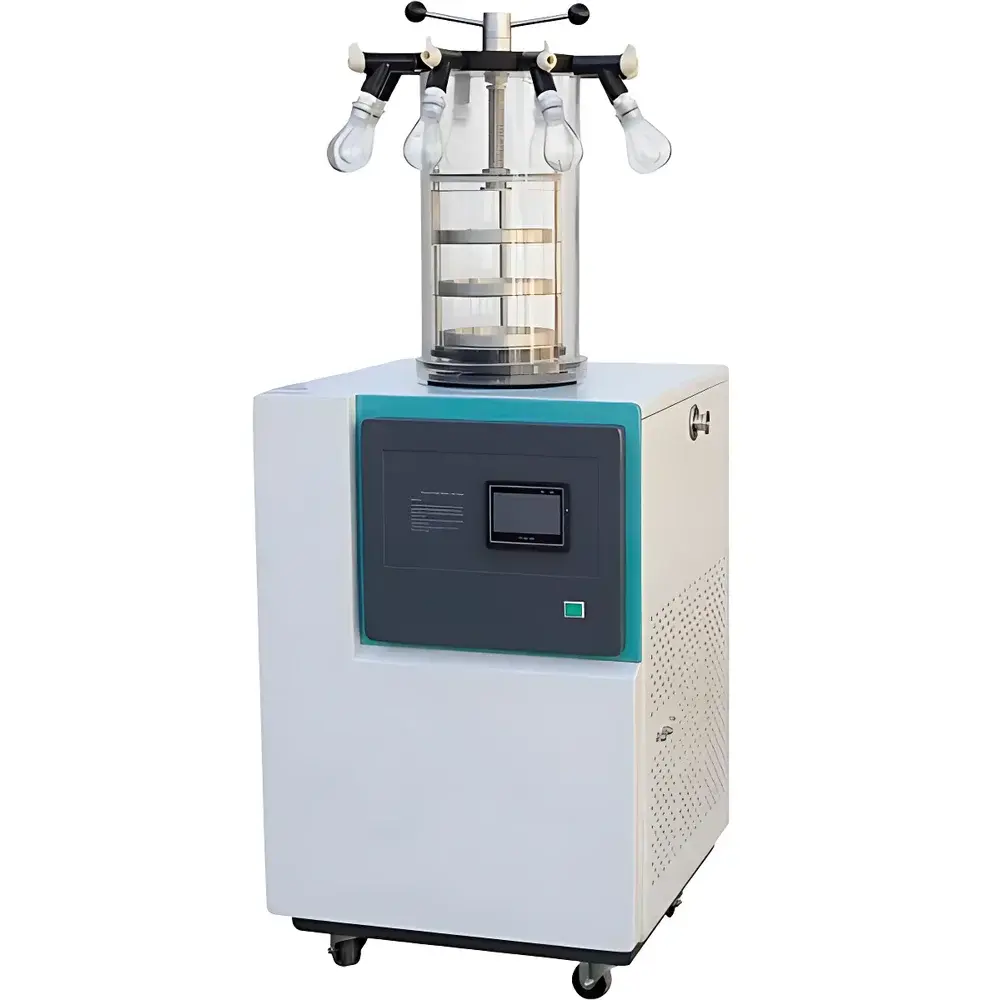
BioCoool Lab-1A-110 Benchtop Vacuum Freeze Dryer
| Brand | BioCoool |
|---|---|
| Origin | Beijing, China |
| Model | Lab-1A-110 |
| Instrument Type | Standard Shelf-Type Freeze Dryer |
| Application | Laboratory-Scale Lyophilization |
| Freeze-Drying Area | 0.12 m² |
| Ultimate Vacuum | <3 Pa |
| Condenser Temperature | −110 °C |
| Condensate Capacity (24 h) | 3 L |
| Refrigeration System | Industrial Scroll Compressor |
| Vacuum Pump | Korean-Made Rotary Vane Pump (2 L/s) |
| Control System | PLC + 7″ Industrial Touchscreen HMI |
| Data Logging | Internal Memory (3-month retention), USB Export (optional), PC Database Integration (optional) |
| Compliance | Designed for GLP-compliant workflows |
Overview
The BioCoool Lab-1A-110 is a laboratory-grade benchtop vacuum freeze dryer engineered for reproducible, high-fidelity lyophilization of heat-sensitive biologicals, pharmaceutical intermediates, and organic-solvent-based formulations. It operates on the principle of sublimation under deep vacuum—removing water or volatile solvents from frozen samples via primary drying (ice sublimation) followed by secondary drying (desorption of bound moisture). Its −110 °C condenser enables efficient capture of low-vapor-pressure solvents—including acetone, ethanol, acetonitrile, and ethyl acetate—at concentrations up to 95% (v/v), mitigating corrosion risks common in conventional −50 °C to −80 °C systems. The unit features an all-welded, seamless aviation-grade acrylic drying chamber, eliminating adhesive joints and ensuring structural integrity under repeated vacuum cycling. Integrated cold trap pre-freezing allows sample freezing directly within the chamber prior to primary drying—reducing thermal shock and improving ice crystal uniformity.
Key Features
- Deep-cold condenser (−110 °C) with 3 L/24 h condensate capacity, optimized for organic solvent trapping and extended continuous operation.
- Programmable freeze-drying control system with up to 500 user-defined or factory-stored process recipes, supporting multi-step ramp-hold profiles for shelf temperature, vacuum setpoints, and hold durations.
- Fuzzy PID-controlled shelf heating with real-time thermal monitoring (50 ms sampling interval), thermal runaway protection, and 36 V SELV-safe heating circuits.
- Non-electric auto-defrost system using controlled warm-gas purge—eliminating resistive heating elements and reducing downtime versus immersion-based methods.
- Three-mode pulse backfill system (slow/medium/fast N₂ or inert gas reintroduction) to prevent particle dispersion during final chamber pressurization.
- Industrial 7″ touchscreen HMI with intuitive icon-driven navigation; no manual required for routine operation. Supports both manual mode (for process development) and fully automated execution.
- Integrated vacuum regulation (optional) enabling dynamic pressure control during sublimation and desorption phases—critical for preventing boil-over, vial breakage, or collapse in sensitive formulations.
Sample Compatibility & Compliance
The Lab-1A-110 accommodates aqueous solutions, suspensions, emulsions, and organic-solvent-rich matrices with eutectic points above −20 °C. Its design supports lyophilization of vials (with optional stoppering), bulk trays, and external flasks via multi-port manifolds (T-type or standard configurations available). All wetted surfaces are constructed from 304 stainless steel or chemically inert acrylic. The system meets fundamental safety requirements per IEC 61010-1 (electrical safety) and ISO 22000-aligned hygienic design principles. When operated with validated software and calibrated sensors, it supports GLP documentation and 21 CFR Part 11 compliance through electronic signatures, audit trails, and data integrity controls (PC-integrated database option required).
Software & Data Management
Data acquisition occurs at 50 ms intervals across shelf temperature, condenser temperature, chamber pressure, and system status. Raw logs are stored internally (retained for ≥90 days) and exportable via USB 2.0 to CSV or proprietary binary formats. Optional PC-based database software provides long-term archival, trend analysis, deviation flagging, and PDF report generation—including full lyophilization curves (shelf temp vs. time, pressure vs. time). Calibration functions for temperature (PT100) and vacuum (capacitance manometer) are accessible via administrator mode, with traceable calibration certificate templates included. Remote monitoring (up to 1.5 km via RS485 or Ethernet) enables off-site oversight of run progress and alarm conditions.
Applications
This system serves R&D labs engaged in formulation development of monoclonal antibodies, vaccines, diagnostic reagents, probiotics, and natural extracts. It is routinely deployed for stability studies (ICH Q5C), analytical reference standard preparation, and small-batch GMP pilot runs where solvent compatibility and process scalability are critical. Academic users apply it to cryopreservation of microbial cultures, enzyme immobilization matrices, and nanomaterial aerogels. The −110 °C condenser extends utility to non-aqueous lyophilization protocols described in USP and ASTM F2370-22 for residual solvent quantification.
FAQ
What organic solvents can be safely processed in the Lab-1A-110?
Acetone, methanol, ethanol, isopropanol, acetonitrile, ethyl acetate, and tetrahydrofuran—up to 95% (v/v) concentration—can be condensed without compromising pump oil integrity or chamber seals.
Is the system suitable for sterile processing?
The Lab-1A-110 is not a Class A/B cleanroom-certified unit; however, it may be installed in ISO 5–7 environments with appropriate aseptic transfer protocols and post-lyophilization sterilizing filtration or depyrogenation steps.
Can I validate this system per FDA or EU Annex 15 guidelines?
Yes—IQ/OQ/PQ protocols are supported via optional validation packages including sensor calibration records, alarm response testing, vacuum leak rate verification (<0.1 Pa·m³/s), and temperature mapping reports.
Does the unit include built-in eutectic point detection?
Eutectic point measurement is available as an optional add-on module (Lab-EP Kit), integrating resistance thermometry and controlled impedance sweep for real-time freezing point determination.
What maintenance intervals are recommended for the vacuum pump?
The Korean rotary vane pump requires oil replacement every 500 operating hours or annually—whichever occurs first—and installation of an oil mist filter (optional accessory) is strongly advised for extended service life.



