
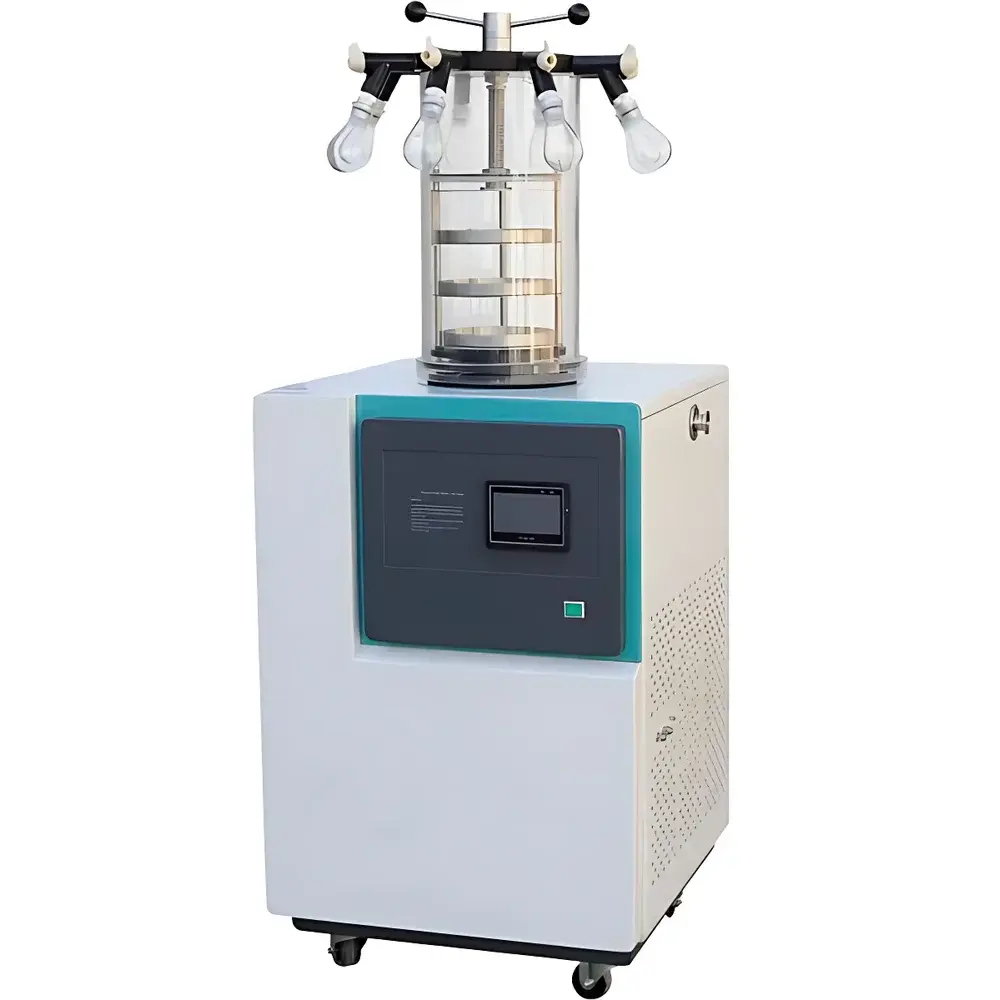
BioCoool Lab-1A-110E Benchtop Vacuum Freeze Dryer
| Brand | BioCoool |
|---|---|
| Origin | Beijing, China |
| Model | Lab-1A-110E |
| Instrument Type | Standard Shelf-Type Freeze Dryer |
| Application | Laboratory-Scale Lyophilization |
| Lyophilization Area | 0.12 m² |
| Ultimate Vacuum | <3 Pa |
| Condenser Temperature | -110 °C |
| Condensate Capacity (24 h) | 3 L |
Overview
The BioCoool Lab-1A-110E is a laboratory-grade vacuum freeze dryer engineered for reproducible, scalable lyophilization of heat-sensitive biologicals, pharmaceuticals, and organic-solvent-based formulations. It operates on the fundamental principle of sublimation under deep vacuum and cryogenic condensation: frozen samples are subjected to controlled primary drying (ice sublimation) and secondary drying (desorption of bound water), with vapor removed by a high-efficiency ultra-low-temperature condenser (-110 °C). Its design specifically addresses challenges associated with volatile organic solvents—common in peptide synthesis, small-molecule APIs, and botanical extracts—by integrating a corrosion-resistant cold trap capable of capturing solvents with boiling points up to 95 °C, thereby protecting both the vacuum system and long-term equipment integrity.
Key Features
- Ultra-low temperature condenser (-110 °C) with 3 L/24 h ice capacity, optimized for aggressive solvent capture and high-efficiency water vapor removal.
- Aerospace-grade acrylic drying chamber: seamless, leak-tight construction with zero adhesive bonding—ensuring structural rigidity, optical clarity, and long-term vacuum stability.
- Integrated pre-freezing capability: sample freezing occurs directly on shelves prior to vacuum initiation, eliminating need for external ultra-low freezers and reducing process transfer risks.
- Dual-brand refrigeration system: industrial-grade hermetic compressor (1 HP) paired with a robust Korean-made rotary vane vacuum pump (2 L/s pumping speed), delivering stable vacuum performance and low acoustic emission (<62 dB(A)).
- Intelligent shelf temperature control: PID-fuzzy algorithm with real-time thermal loop monitoring; heating elements designed for uniform thermal distribution across 0.12 m² shelf area.
- Non-electric condenser defrosting: mechanical/thermal cycling method ensures operator safety, eliminates electrical hazards near wet condensers, and reduces downtime versus immersion-based methods.
- Programmable freeze-drying control: fully customizable cycles (up to 500 stored recipes) covering freezing ramp, hold, primary drying ramp/hold, secondary drying, and inert gas backfill.
Sample Compatibility & Compliance
The Lab-1A-110E supports aqueous solutions, suspensions, emulsions, and organic-solvent-rich matrices (≤95% v/v acetone, ethanol, ethyl acetate, acetonitrile, etc.), provided their eutectic point exceeds −20 °C. Its sealed acrylic chamber and inert gas backfill option (N₂ or Ar) enable oxygen-sensitive drying and post-process storage stabilization. The system complies with core engineering requirements of ISO 22000 (food), ISO 13485 (medical devices), and supports GLP/GMP-aligned workflows via audit-trail-capable data logging. Optional eutectic point measurement module enables empirical determination of critical formulation temperatures—essential for cycle development per ICH Q5C and USP .
Software & Data Management
Equipped with an industrial 7-inch touchscreen HMI running embedded PLC firmware, the system offers intuitive operation without documentation dependency. All process parameters—including shelf temperature (±0.5 °C accuracy), chamber pressure (capacitance manometer, ±0.1 Pa resolution), and condenser temperature—are sampled at 50 ms intervals and logged internally (3-month buffer). External data export is supported via USB flash drive (FAT32 formatted) or optional PC-connected database (SQL-based, configurable retention policy). Remote monitoring (up to 1.5 km via RS485/Modbus RTU or optional Ethernet gateway) allows real-time status verification and alarm notification. Calibration functions for temperature and vacuum sensors ensure metrological traceability over extended service life.
Applications
- Pharmaceutical R&D: lyophilization of monoclonal antibodies, vaccines, and sterile drug products in vials or bulk trays.
- Biotechnology: preservation of enzymes, probiotics, stem cells, and extracellular vesicles requiring residual moisture control <1.5% w/w.
- Academic research: dehydration of plant extracts, natural polymers, and nanomaterial dispersions containing co-solvents.
- Food science: pilot-scale freeze-drying of functional ingredients (e.g., anthocyanins, polyphenols) where solvent removal precedes final drying.
- Quality control labs: validation of lyo-cycle robustness, shelf-life prediction studies, and comparative stability testing under defined residual moisture profiles.
FAQ
What types of solvents can the Lab-1A-110E safely handle during lyophilization?
It is validated for solvents with boiling points ≤95 °C—including ethanol, methanol, acetone, isopropanol, and ethyl acetate—provided concentration does not exceed 95% v/v and formulation eutectic remains above −20 °C.
Is the system compliant with FDA 21 CFR Part 11 for electronic records?
Out-of-the-box, it meets foundational ALCOA+ principles (Attributable, Legible, Contemporaneous, Original, Accurate); full Part 11 compliance requires optional PC database integration with user access controls, electronic signatures, and audit trail configuration.
Can shelf temperature be ramped independently during primary drying?
Yes—the system supports multi-step shelf temperature programming synchronized with vacuum level, enabling controlled ice interface temperature management per product-specific drying kinetics.
What maintenance is required for the vacuum pump?
The rotary vane pump requires periodic oil changes (every 500 operating hours or annually) and installation of an optional oil mist filter to prevent backstreaming contamination into the chamber.
Does the unit support IQ/OQ protocol execution?
Yes—comprehensive factory documentation includes as-built drawings, sensor calibration certificates, and test protocols suitable for installation qualification (IQ) and operational qualification (OQ) under GMP environments.



