
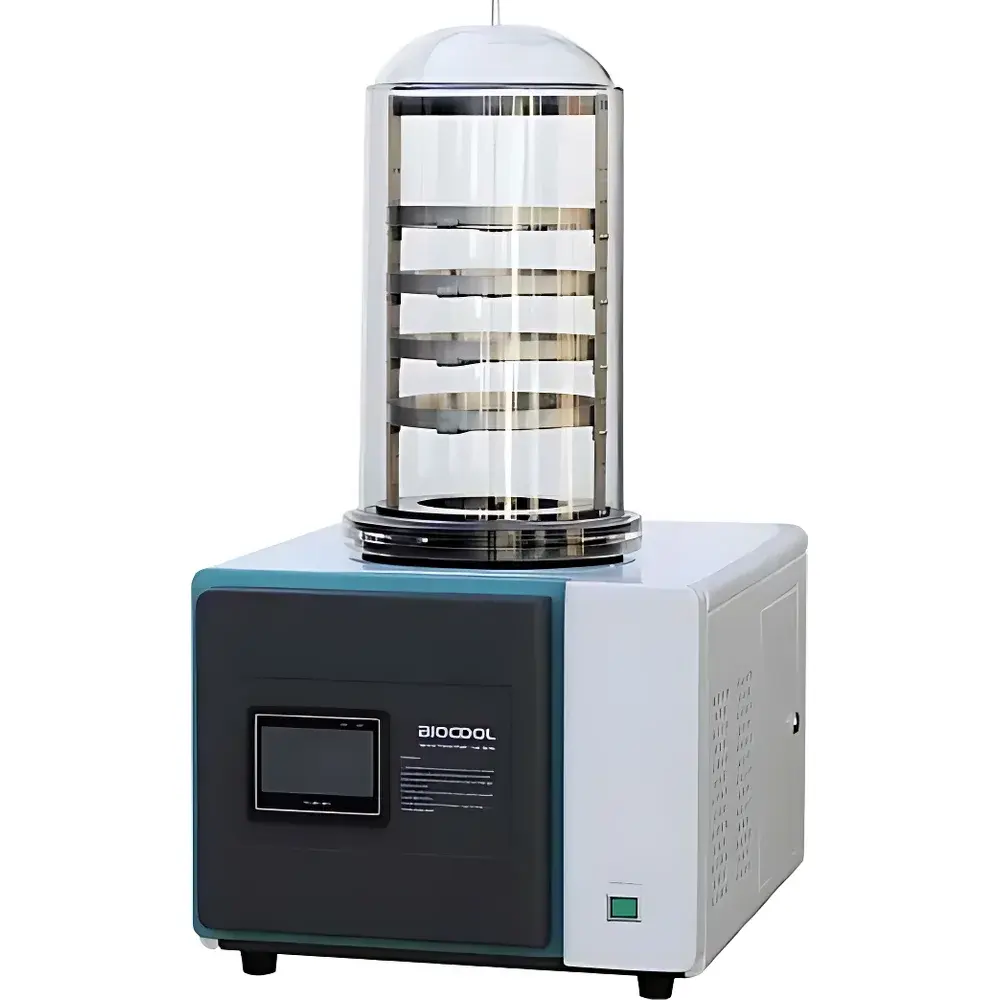
BioCoool Lab-1A-50E Benchtop Freeze Dryer
| Brand | BioCoool |
|---|---|
| Origin | Beijing, China |
| Model | Lab-1A-50E |
| Type | Standard Shelf-Type Freeze Dryer |
| Lyophilization Area | 0.12 m² |
| Ultimate Vacuum | <8 Pa |
| Condenser Capacity | 2 L/24 h |
| Condenser Temperature | -55 °C |
| Dimensions (W×D×H) | 470×600×400 mm |
Overview
The BioCoool Lab-1A-50E is a benchtop shelf-type freeze dryer engineered for precision lyophilization in academic research laboratories, pharmaceutical development labs, and quality control environments. It operates on the fundamental principle of sublimation—removing water from frozen samples under deep vacuum while maintaining structural integrity and biological activity. The system integrates a dual-stage refrigeration cycle with an industrial-grade condenser (-55 °C), enabling efficient capture of sublimated vapor without ice bridging or re-deposition. Designed for reproducible batch processing of small-to-medium volume samples (up to 0.12 m² shelf area), it supports both bulk tray drying and vial-based workflows, with optional multi-port manifold configurations for parallel sample handling. Its architecture complies with core design expectations for GLP-compliant lab instrumentation—including thermal stability, vacuum integrity verification, and traceable process parameter logging.
Key Features
- Aerospace-grade acrylic drying chamber: Seamless, bond-free construction ensures zero leakage and high mechanical strength under repeated vacuum cycling.
- Pre-freezing capability integrated into the condenser: Enables rapid sample solidification prior to primary drying without external ultra-low temperature equipment.
- High-efficiency hermetic compressor (7–8 HP) from a globally recognized manufacturer: Delivers stable cooling performance with low acoustic emission (<55 dB(A) at 1 m).
- Korean-sourced 2 L/s rotary vane vacuum pump: Engineered for long-term reliability, low oil carryover, and consistent ultimate vacuum attainment (<8 Pa).
- Intelligent shelf heating system: Independent PID-controlled temperature regulation per shelf layer, using custom thermal conductive materials and real-time thermal loop monitoring.
- Non-electric condenser defrosting mechanism: Eliminates resistive heating elements, reducing fire risk and accelerating defrost cycles by up to 40% versus immersion methods.
- Programmable freeze-drying protocol engine: Supports up to 500 user-defined or factory-stored recipes, including ramp-hold segments for freezing, primary drying, and secondary drying phases.
- Industrial 7-inch capacitive touch HMI: Intuitive interface with contextual navigation; operation possible without reference documentation after minimal orientation.
- Dual-mode operation: Manual mode permits granular intervention during process development; automatic mode executes validated protocols with single-button initiation.
- Multi-tier data recording: Internal flash memory (3-month buffer), USB mass storage (user-provided), and optional PC-based SQL database integration with timestamped metadata.
Sample Compatibility & Compliance
The Lab-1A-50E accommodates aqueous solutions, suspensions, and pastes with eutectic temperatures above -20 °C. Compatible formats include open trays, serum vials (with optional stoppering), and external flasks via multi-port manifolds (T-type configuration supports up to 24 ampoules). All wetted surfaces are electropolished stainless steel (316L) or USP Class VI-certified polymers. The system meets mechanical safety requirements per IEC 61010-1 and electromagnetic compatibility per EN 61326-1. Optional accessories—including calibrated temperature/vacuum sensors, co-located eutectic point analyzers, and inert gas (N₂/Ar) backfill modules—support compliance with ISO 22033, USP , and FDA 21 CFR Part 11 when paired with audit-trail-enabled software packages.
Software & Data Management
Embedded firmware provides real-time acquisition at 20 Hz (50 ms interval) for shelf temperature, condenser temperature, and chamber pressure. Process curves (temperature vs. time, pressure vs. time) are exportable in CSV format for post-run analysis. The optional PC remote monitoring module enables secure Ethernet/Wi-Fi access within a 1.5 km local network radius, supporting live parameter viewing and emergency pause/resume commands. Data integrity safeguards include write-once file locking, cyclic redundancy checks (CRC32), and configurable auto-backup intervals. Calibration logs—covering thermocouple offset correction and Pirani gauge linearity adjustment—are retained with digital signatures and version stamps.
Applications
This instrument serves critical roles in biopharmaceutical formulation (e.g., monoclonal antibody stabilization), microbiology (lyophilized culture preservation), analytical reference material preparation, botanical extract conservation, and university-level food science research. It is routinely deployed for developing lyophilization cycles prior to scale-up on pilot or production units, validating container closure integrity under freeze-thaw stress, and generating stable calibration standards for mass spectrometry and ELISA assays. Its modular design allows seamless transition from exploratory freeze-drying (manual mode + eutectic mapping) to GMP-aligned routine operations (auto mode + electronic batch records).
FAQ
What is the maximum sample load capacity for the Lab-1A-50E?
The unit supports up to 2 L of total water content per 24-hour cycle, with optimal loading corresponding to ~0.8–1.2 kg of typical aqueous solution across the 0.12 m² shelf area.
Is the system compatible with sterile processing requirements?
While not classified as aseptic-grade equipment, the chamber can be sterilized via vaporized hydrogen peroxide (VHP) or 70% isopropanol wipe-down; all seals and gaskets meet USP cytotoxicity criteria.
Can vacuum level be dynamically adjusted during drying?
Yes—when equipped with the optional vacuum regulation module, setpoints can be modulated between 1–50 Pa during primary drying to suppress foaming or collapse in sensitive formulations.
How is temperature uniformity verified across shelves?
Factory calibration includes thermal mapping at three axial positions per shelf under load; deviation remains ≤±1.5 °C at steady state across the operational range (-40 °C to +60 °C).
Does the system support 21 CFR Part 11 compliance?
Full compliance requires the optional PC database module with role-based access control, electronic signatures, and immutable audit trails—configured per site-specific validation protocols.



