
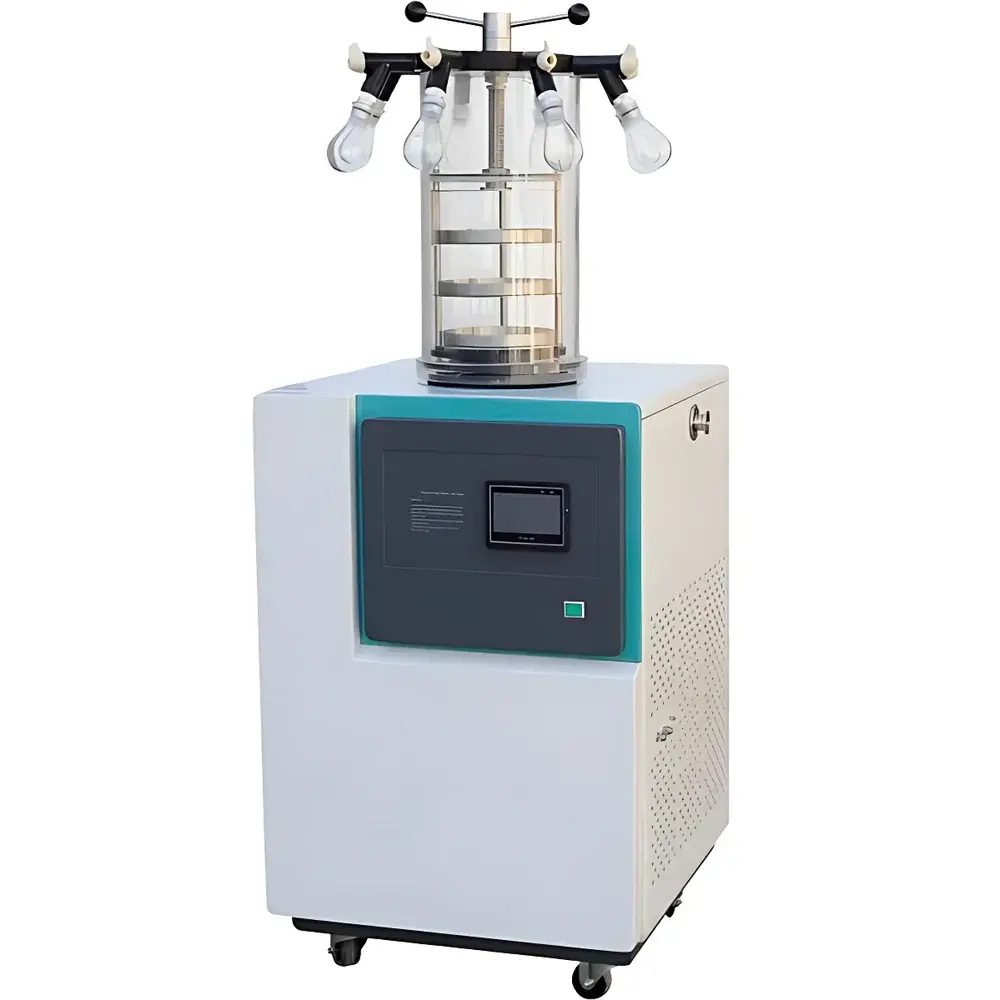
BioCoool Lab-1E-110 Multi-Manifold Laboratory Freeze Dryer
| Brand | BioCoool |
|---|---|
| Origin | Beijing, China |
| Model | Lab-1E-110 |
| Instrument Type | Multi-Manifold |
| Application Scope | Laboratory Use |
| Ultimate Vacuum | <3 Pa |
| Condenser Temperature | −110 °C |
| Condensation Capacity (24 h) | 3 L |
Overview
The BioCoool Lab-1E-110 is a high-performance multi-manifold laboratory freeze dryer engineered for reproducible lyophilization of heat-sensitive biologicals, pharmaceuticals, and organic-solvent-based formulations. It operates on the fundamental principles of sublimation under deep vacuum and cryogenic condensation—where frozen water or volatile solvents are removed directly from the solid phase without passing through liquid state. Its −110 °C ultra-low temperature condenser enables efficient capture of low-vapor-pressure solvents (e.g., ethanol, acetone, acetonitrile), making it uniquely suitable for lyophilizing samples containing up to 95% organic solvent concentration—common in peptide synthesis, small-molecule API processing, and botanical extract stabilization. The system integrates a robust refrigeration architecture with dual-stage industrial compressors and a high-speed Korean vacuum pump (2 L/s pumping speed), ensuring stable vacuum maintenance below 3 Pa across extended drying cycles.
Key Features
- −110 °C deep-cold condenser with ≥3 L/24 h moisture and solvent trapping capacity—validated for aggressive organic solvent recovery.
- Aerospace-grade acrylic drying chamber: seamless monolithic construction, zero leakage, high impact resistance, and full optical visibility for real-time process monitoring.
- Integrated pre-freezing capability within the condenser—eliminates need for external ultra-low temperature freezers and reduces sample handling contamination risk.
- PLC-based control system with 7-inch industrial touchscreen interface—supports intuitive navigation, multi-language UI, and operation without reference manuals.
- Fuzzy PID-controlled shelf heating (where applicable) with thermal loop monitoring and 36 V safety-rated circuitry—ensures precise thermal ramping and overtemperature protection.
- Non-electric, rapid defrost system—avoids thermal shock to condenser surfaces and eliminates immersion-related downtime or water ingress risks.
- Programmable freeze-drying cycles: up to 500 user-defined or factory-stored protocols with independent control over freezing rate, primary drying vacuum setpoint, shelf temperature ramping, and secondary drying hold steps.
Sample Compatibility & Compliance
The Lab-1E-110 accommodates vials, flasks, and external hanging bottles via its 10-port multi-manifold configuration—ideal for parallel processing of heterogeneous sample types including aqueous solutions, colloidal suspensions, viscous pastes, and organic-aqueous mixtures with eutectic points above −20 °C. Its inert gas backfill system (N₂ or Ar-compatible) supports oxygen-sensitive product preservation post-drying. The system meets essential design requirements aligned with ISO 22042 (freeze-drying equipment), ASTM F2476 (lyophilization process validation), and supports compliance workflows for GLP and GMP environments—including optional 21 CFR Part 11–compliant audit trail logging when paired with PC database storage. Temperature and vacuum sensors are field-calibratable per ISO/IEC 17025 traceability standards.
Software & Data Management
Data acquisition occurs at 50 ms intervals across all critical parameters (condenser temp, shelf temp, chamber pressure, elapsed time). Onboard memory retains up to three months of continuous cycle logs; USB export (FAT32-formatted drives) enables portable data transfer for offline analysis. Optional PC-integrated database software provides long-term archival, trend visualization, comparative curve overlay, and automated report generation (PDF/CSV). Remote monitoring is supported via Ethernet (up to 1.5 km range) with secure login authentication. All stored freeze-drying curves—temperature vs. time, pressure vs. time, and derivative profiles—are accessible for post-run process optimization and regulatory documentation.
Applications
- Pharmaceutical R&D: Lyophilization of monoclonal antibodies, vaccines, and sterile injectables requiring solvent removal prior to terminal sterilization.
- Biotechnology: Stabilization of enzymes, probiotics, and cell lysates where residual solvent content must be minimized to preserve activity.
- Academic & Clinical Labs: Processing of tissue homogenates, plasma fractions, and microbial cultures under controlled, documented conditions.
- Natural Product Chemistry: Dehydration of ethanol-extracted plant metabolites without thermal degradation or oxidation.
- Materials Science: Preparation of porous scaffolds and aerogel precursors requiring uniform pore structure retention.
FAQ
What types of solvents can the Lab-1E-110 safely capture?
It effectively condenses low-boiling-point organic solvents including methanol, ethanol, acetone, ethyl acetate, and acetonitrile—validated for feed concentrations ≤95% v/v.
Is the system compatible with GMP documentation requirements?
Yes—when equipped with optional PC database logging and electronic signature modules, it supports ALCOA+ data integrity principles and 21 CFR Part 11 audit trails.
Can I perform in-situ freezing without a separate ultra-low freezer?
Yes—the condenser serves as an integrated pre-freezing station, capable of reaching −110 °C and holding samples at target temperature for controlled nucleation.
What safety protections are built into the electrical and vacuum systems?
Dual overcurrent and overload protection, 36 V low-voltage heating circuits, condenser overtemperature cutoff, vacuum loss interlock, and automatic pump oil-backflow prevention are standard.
How is calibration maintained over time?
Field-accessible temperature and vacuum sensor calibration routines allow periodic verification against NIST-traceable references—supporting ISO/IEC 17025-compliant quality management systems.



