
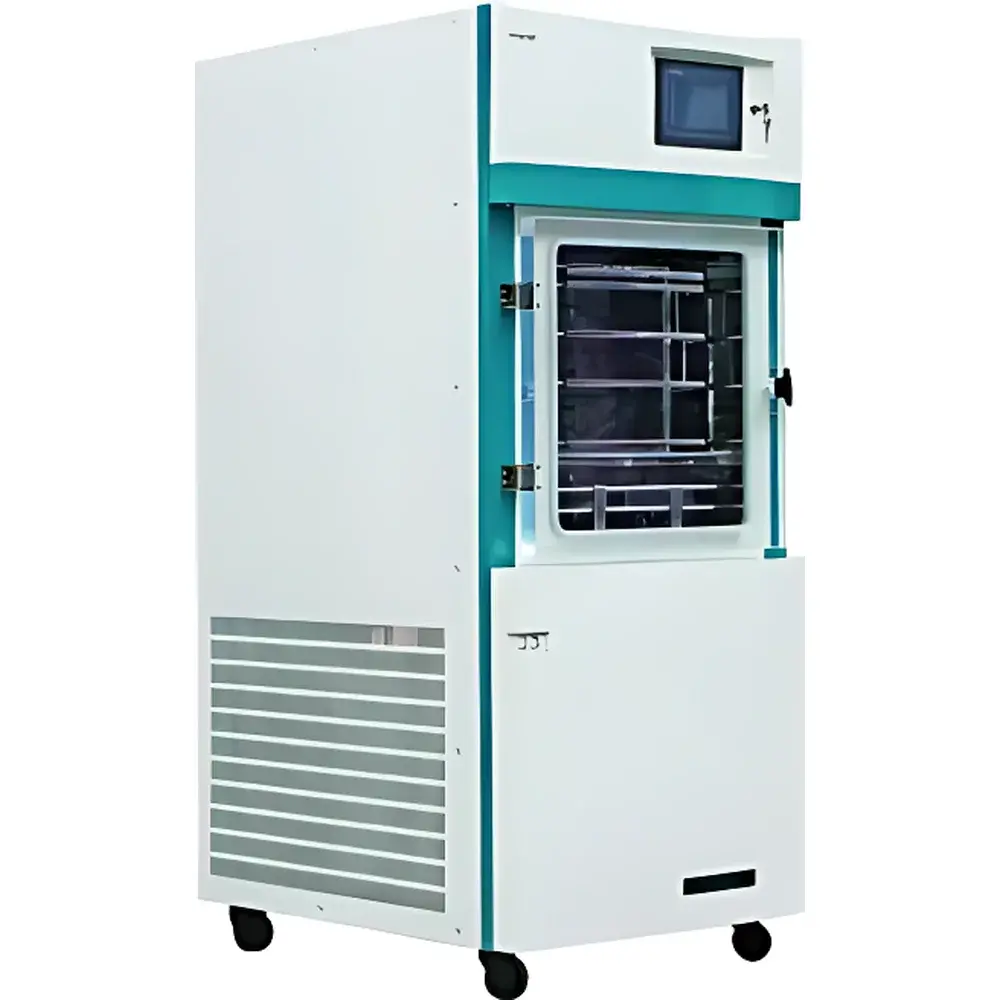
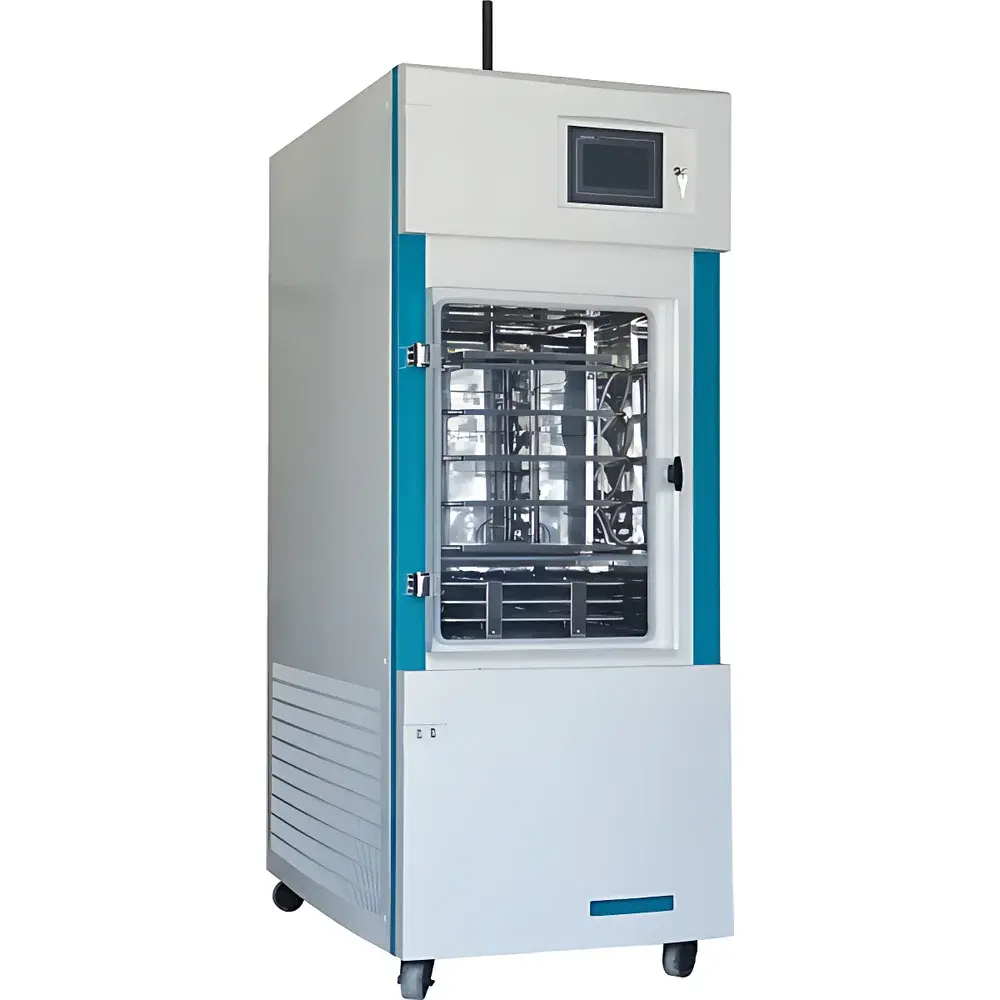
BioCoool Pilot3-6E Benchtop Pilot-Scale Freeze Dryer
| Brand | BioCoool |
|---|---|
| Origin | Beijing, China |
| Manufacturer Type | Authorized Distributor |
| Equipment Type | Standard Shelf-Type Freeze Dryer |
| Application Scale | Pilot-Scale |
| Lyophilization Area | 0.35 m² |
| Ultimate Vacuum | <3 Pa |
| Condenser Capacity | 6 kg/24 h |
| Condenser Temperature | <-80 °C |
Overview
The BioCoool Pilot3-6E is a benchtop pilot-scale freeze dryer engineered for reproducible, scalable lyophilization of heat-sensitive biopharmaceuticals, diagnostics, and research-grade formulations. It operates on the fundamental principles of sublimation under high vacuum and controlled thermal management: frozen samples are subjected to deep-cold condensation (≤ –80 °C) while maintaining a stable vacuum environment (<3 Pa), enabling direct phase transition of ice to vapor without liquid-phase intermediacy. Designed specifically for technology transfer from lab-scale development to early-stage process validation, the Pilot3-6E bridges the gap between R&D vial-based systems and production-line freeze dryers—supporting batch sizes up to 0.35 m² shelf area with full thermal and vacuum traceability.
Key Features
- Optically transparent drying chamber door fabricated from aerospace-grade acrylic—bond-free construction ensures structural integrity, zero outgassing, and leak-tight performance under prolonged vacuum cycling.
- Shelf-integrated pre-freezing capability eliminates need for external ultra-low temperature freezers; shelves cool to ≤ –40 °C prior to primary drying, ensuring uniform nucleation and crystalline matrix formation.
- High-efficiency hermetic scroll compressor (international brand) delivers stable refrigeration with acoustic noise <58 dB(A) at 1 m distance—optimized for continuous operation in shared laboratory environments.
- Oil-lubricated dual-stage vacuum pump (domestic premium grade) achieves ultimate vacuum <3 Pa within ≤25 minutes; equipped with automatic anti-suckback valve and oil mist filter for extended service life.
- Fully programmable PLC-based control system supports multi-step lyophilization cycles—including freezing, annealing, primary drying, secondary drying, and non-electric condenser defrost—with adjustable ramp rates, hold times, and pressure modulation.
- Shelf heating system employs custom-alloy resistive elements with real-time thermal feedback loop and adaptive fuzzy PID algorithm—achieving ±0.5 °C shelf temperature uniformity across full load.
- Passive condenser defrost mechanism utilizes ambient heat exchange and controlled pressure equalization—eliminating electrical heating elements, reducing fire risk, and shortening defrost cycle to <20 minutes.
Sample Compatibility & Compliance
The Pilot3-6E is validated for aqueous solutions, suspensions, and pastes with eutectic temperatures above –40 °C—commonly encountered in monoclonal antibody formulations, vaccine candidates, enzyme preparations, and diagnostic reagents. Its design conforms to core requirements of ISO 22042:2017 (freeze-drying equipment performance specification) and supports alignment with FDA 21 CFR Part 11 when configured with optional PC database logging and electronic audit trail modules. All temperature and vacuum sensors are calibrated per ISO/IEC 17025-accredited procedures; field-accessible calibration routines allow user-performed verification of shelf temperature (±0.3 °C) and chamber vacuum (±0.1 Pa) at defined intervals.
Software & Data Management
The industrial-grade 10.1″ capacitive touchscreen interface provides intuitive navigation without reference documentation—menu logic follows ICH Q5C and USP lyophilization workflow conventions. Process data—including shelf temperature, product thermocouple readings (optional), chamber pressure, condenser temperature, and elapsed time—is acquired at 50 ms resolution and stored locally in non-volatile memory (retention ≥90 days). Optional data export paths include USB 2.0 mass storage (FAT32 formatted) and secure TCP/IP connection to Windows-based SQL Server databases. Up to 500 user-defined or standard lyo-cycle protocols can be archived with version timestamps, operator ID tagging, and digital signature support for GLP/GMP-compliant environments.
Applications
- Process development and optimization of lyophilized biologics (e.g., therapeutic proteins, viral vectors, mRNA-LNPs).
- Stability studies under ICH Q1A–Q1E conditions using representative batch sizes.
- Manufacturing of clinical trial materials (Phase I–II) requiring GMP-aligned documentation and traceability.
- Academic and contract research organizations conducting formulation screening, excipient compatibility testing, and collapse temperature determination (Tg’, Tc).
- Quality control laboratories performing reconstitution time, residual moisture (via Karl Fischer titration correlation), and cake morphology assessment.
FAQ
What is the maximum sample volume per batch?
Based on 0.35 m² shelf area and typical loading density (10–15 mL per 100 cm²), the Pilot3-6E accommodates up to ~3.5–5.0 L of solution per cycle—adjustable depending on vial size, fill depth, and target residual moisture.
Does the system support PAT integration?
Yes—RS485 Modbus RTU and Ethernet TCP/IP interfaces enable connection to external probes (e.g., tunable diode laser for moisture vapor analysis) and third-party SCADA platforms for real-time critical quality attribute monitoring.
Can shelf temperature be independently controlled during primary drying?
Yes—each shelf zone (standard single-zone; optional dual-zone configuration available) supports independent setpoint programming with dynamic adjustment based on chamber pressure feedback to prevent melt-back or collapse.
Is validation documentation provided?
Factory-installed IQ/OQ protocols compliant with ASTM E2500-13 are supplied; PQ execution templates and calibration certificates for all critical sensors are included in the delivery package.
What maintenance intervals are recommended?
Vacuum pump oil change every 500 operating hours; refrigerant circuit integrity check annually; condenser coil cleaning quarterly; full system performance verification biannually per ISO 22042 Annex C guidelines.



