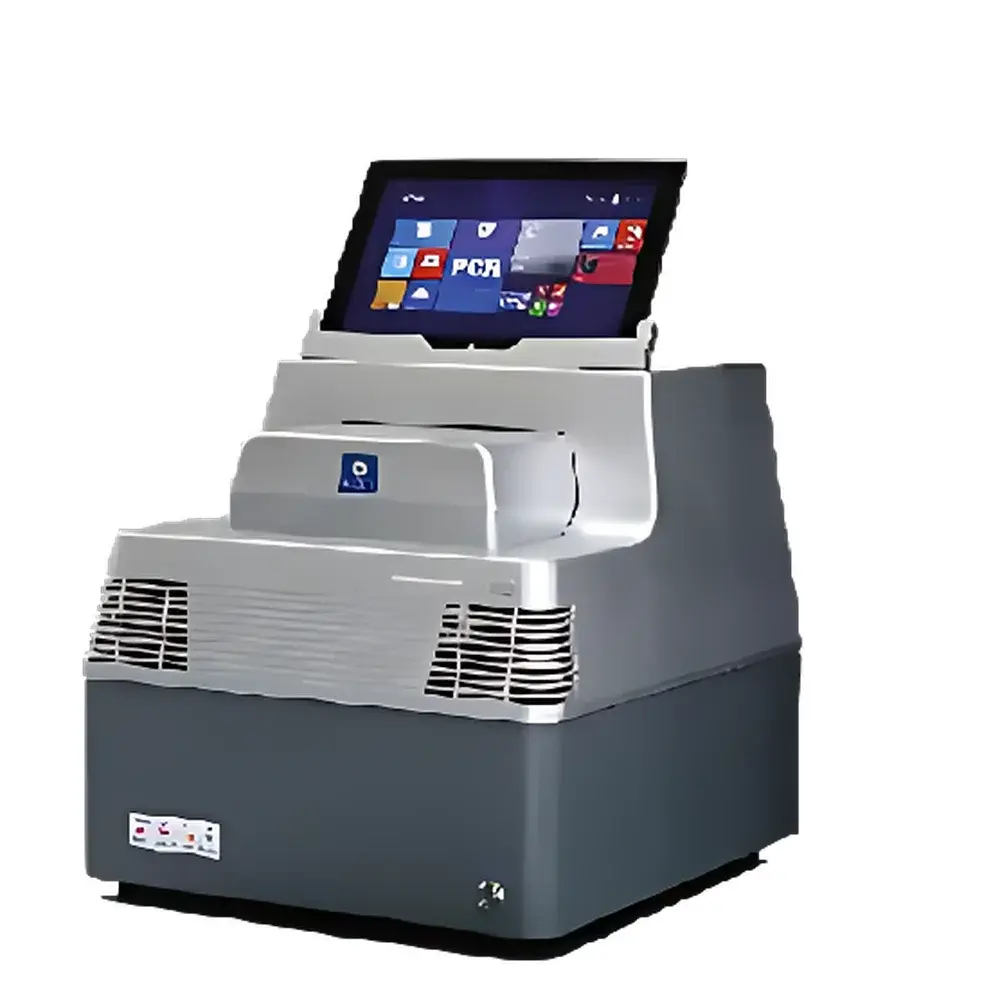
Bioer LineGene 9600 Plus Real-Time Fluorescence Quantitative PCR Detection System
| Brand | Bioer |
|---|---|
| Origin | Germany |
| Manufacturer Type | Authorized Distributor |
| Product Category | Imported Instrument |
| Model | LineGene 9600 Plus |
| Sample Capacity | 96-well plate / 12×8 strip tubes / 96×0.2 mL single tubes (transparent bottom) |
| Dynamic Range | 1–10¹⁰ copies |
| Excitation Wavelength | 300–800 nm |
| Emission Wavelength | 500–800 nm |
| Compatible Dyes | F1: FAM/SYBR Green I |
| F2 | HEX/VIC/JOE/Cy3/NED/TAMRA |
| F3 | Texas Red/ROX |
| F4 | Cy5 |
| F5 | Cy5.5 |
| F6 | Reserved channel |
| Temperature Range | 4–105 °C (0.1 °C resolution) |
| Max Heating/Cooling Rate | 5.0 °C/s |
| Temperature Accuracy | ≤ ±0.1 °C |
| Temperature Uniformity | ≤ ±0.3 °C |
| Thermal Control Modes | Block mode & Simulated Tube mode (volume-adaptive) |
| Sample Volume | 5–100 µL |
| Gradient Range | 1–36 °C |
| Heat Lid Temp | 30–110 °C (default 105 °C, auto-adjusting) |
| Fluorescence Detection Reproducibility | ≤ 5% CV |
| Full-plate Scan Time | ~5.5 s |
| Programmable Segments | Up to 20 per protocol |
| Max Cycles | 99 |
| Software Compatibility | Windows XP–8.1 |
| Minimum PC Spec | Pentium® 4 CPU, 512 MB RAM, 10 GB HDD, ≥1000 MB virtual memory |
| Power Input | 100–240 V AC, 50/60 Hz, 600 W |
| Dimensions | 410 × 386 × 352 mm |
| Interfaces | USB, RS232, Bluetooth |
| Certifications | CE, MET, RoHS2, PICC Product Liability Insurance, Ferrotec Peltier-based thermal module |
Overview
The Bioer LineGene 9600 Plus Real-Time Fluorescence Quantitative PCR Detection System is a high-performance, six-channel real-time PCR instrument engineered for precision nucleic acid quantification across research, clinical diagnostics, and public health laboratories. It operates on the principle of sequence-specific fluorescence detection during exponential amplification—leveraging intercalating dyes (e.g., SYBR Green I) or hydrolysis probes (e.g., TaqMan) to monitor amplicon accumulation in real time. The system integrates a high-stability Peltier-based thermal cycling module with dual optical paths and wavelength-tunable excitation/emission optics, enabling simultaneous detection across five validated fluorescence channels (F1–F5) plus one reserved channel for future dye expansion. Its 96-well format supports standard microtiter plates, 12×8 strip tubes, and individual 0.2 mL tubes with transparent bottoms—ensuring compatibility with widely adopted consumables and minimizing cross-platform workflow disruption.
Key Features
- High-fidelity thermal control: Achieves ≤ ±0.1 °C temperature accuracy and ≤ ±0.3 °C uniformity across the entire block, validated per ISO 13485 and ASTM E1533-22 protocols for thermal performance in molecular diagnostics instrumentation.
- Automated pressure-regulated heat lid: Eliminates manual lid actuation; dynamically maintains constant contact pressure across varying tube heights (0.2–0.5 mL), preventing evaporation and condensation artifacts during prolonged runs.
- Multi-mode thermal programming: Supports both block-based and simulated-tube thermal profiles—adaptive algorithms adjust ramp rates and dwell times based on user-defined sample volume (5–100 µL), improving reaction consistency across low- and high-volume assays.
- Full-spectrum optical architecture: Excitation range 300–800 nm and emission detection 500–800 nm enable broad compatibility with common fluorophores—including FAM, VIC, ROX, Cy5, and Cy5.5—while built-in spectral crosstalk correction minimizes inter-channel interference without requiring manual compensation matrices.
- Touch-optimized human interface: Native Windows-based OS with tablet-compatible touchscreen UI enables intuitive protocol building, real-time curve monitoring, and post-run analysis—all accessible without external peripherals.
- Regulatory-ready data handling: Audit trail functionality logs all user actions, parameter changes, and run events with timestamps and operator IDs, supporting compliance with FDA 21 CFR Part 11 and GLP/GMP documentation requirements.
Sample Compatibility & Compliance
The LineGene 9600 Plus accommodates standard 96-well PCR plates (semi-skirted/unskirted), 12×8 strip tubes, and individual 0.2 mL tubes with optically clear bottoms—ensuring seamless integration with automated liquid handlers and existing lab workflows. All consumables meet ISO 10993 biocompatibility standards and are certified free of DNase/RNase, PCR inhibitors, and human genomic DNA. The instrument itself carries CE marking under Directive 2017/746 (IVDR), MET certification for electrical safety (UL 61010-1), RoHS2 compliance, and PICC product liability insurance coverage. Its thermal module utilizes Ferrotec high-cycle-life Peltier elements rated for >500,000 thermal cycles, meeting IEC 60601-1 mechanical durability benchmarks.
Software & Data Management
Bioer’s proprietary LineGene Analysis Software v5.2 provides a unified platform for experimental design, real-time visualization, and quantitative interpretation. It supports absolute quantification (standard curve and Ct-based), relative quantification (ΔΔCt), SNP genotyping via endpoint fluorescence ratio analysis, high-resolution melting (HRM) curve differentiation, and melt-curve-based allele discrimination. Data export is native to .xlsx format compatible with Excel 2000–2012 and downstream statistical packages (e.g., GraphPad Prism, R). All raw fluorescence intensity values, thermal profiles, and metadata are stored in encrypted binary files (.lgd) with SHA-256 checksums—enabling traceable data integrity verification. Software validation documentation (IQ/OQ/PQ protocols) is available upon request for regulated environments.
Applications
- Quantitative viral load monitoring (e.g., SARS-CoV-2, HIV, HBV, HCV) in clinical virology labs adhering to CLIA and CAP requirements.
- Gene expression profiling in translational oncology and immunology studies, including multi-gene panels with endogenous reference normalization.
- Pathogen detection and antimicrobial resistance gene screening in food safety and environmental microbiology applications.
- Genotyping and copy number variation (CNV) analysis in pharmacogenomics and rare disease diagnostics.
- Validation of CRISPR editing efficiency and off-target assessment using digital droplet PCR (ddPCR)-correlated calibration curves.
- Process development and QC release testing in biomanufacturing facilities operating under current Good Manufacturing Practice (cGMP) guidelines.
FAQ
Does the LineGene 9600 Plus support FDA 21 CFR Part 11-compliant electronic signatures?
Yes—the software includes configurable user roles, password-protected access, and immutable audit trails with digital signature capability when deployed on validated Windows platforms.
Can the instrument perform HRM analysis with sufficient resolution for SNP discrimination?
Yes—its sub-0.1 °C thermal stability and high-sampling-rate fluorescence acquisition (≥20 points/°C) meet the analytical sensitivity thresholds defined in ISO/IEC 17025 for HRM-based variant calling.
Is gradient PCR functionality validated across the full 1–36 °C range?
Yes—gradient linearity and reproducibility are verified per manufacturer SOP LG-GRAD-001 using NIST-traceable thermal mapping probes and fluorescent reference standards.
What is the expected lifetime of the optical detection system?
The LED excitation sources and PMT-based detectors are rated for ≥50,000 hours of operation; annual optical calibration is recommended to maintain fluorescence linearity per ISO 15197 Annex B.
Does the system integrate with LIMS via standard communication protocols?
Yes—RS232 and USB CDC-class interfaces support HL7 v2.x and ASTM E1384 message exchange; API documentation for custom middleware integration is available under NDA.