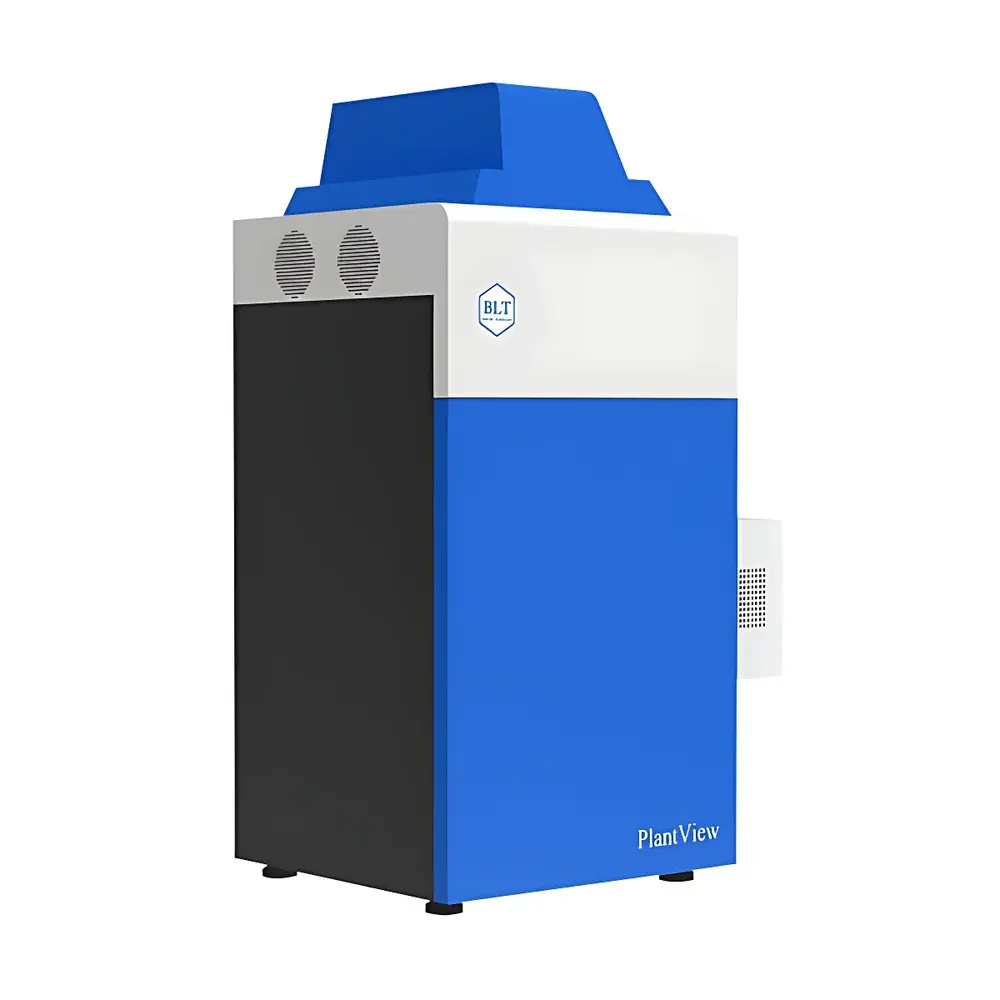
BioLight PlantView600 Plant In Vivo Imaging System
| Brand | BioLight |
|---|---|
| Origin | Guangdong, China |
| Manufacturer Type | OEM Manufacturer |
| Origin Category | Domestic |
| Model | PlantView600 |
| Price | Upon Request |
| Resolution | 2688 × 2200 |
| Pixel Size | 4.54 µm × 4.54 µm |
| Field of View | 280 mm × 230 mm |
Overview
The BioLight PlantView600 Plant In Vivo Imaging System is a dedicated, high-sensitivity optical imaging platform engineered for non-invasive, longitudinal monitoring of physiological and molecular processes in intact, living plants. It operates on the principle of bioluminescence and fluorescence detection using cooled, back-illuminated CCD technology — optimized for low-light signal capture with minimal thermal noise. The system integrates a light-tight, electromagnetically shielded imaging chamber to suppress ambient photons and cosmic ray interference, ensuring baseline stability essential for quantitative longitudinal studies. Its dual-camera architecture — comprising a top-mounted primary imager and an optional orthogonal side-view camera — enables multi-angle acquisition without sample repositioning, supporting natural growth-axis observation from seed germination through vegetative development. Designed specifically for plant science laboratories, the PlantView600 meets core requirements for reproducible, GLP-compliant imaging workflows in academic, agricultural biotechnology, and regulatory research settings.
Key Features
- Dual-camera configuration: Primary top-view camera (2688 × 2200 resolution, 4.54 µm pixel pitch) + optional side-view camera for vertical-axis growth tracking under native gravitropic conditions.
- Ultra-low-noise imaging: Thermoelectrically cooled, back-thinned CCD sensor operating at ≤ –60 °C, delivering high quantum efficiency (>95% at 600 nm) and sub-electron read noise performance.
- Uniform, stable illumination: 20 configurable narrow-band LED excitation sources (365–740 nm), each with < ±2 nm bandwidth and >10,000-hour lifetime; ring-mounted, symmetric optical layout ensures <5% intensity variation across 280 mm × 230 mm FOV.
- Modular optical path: Supports up to 10 emission filter positions (25–75 mm diameter); includes integrated background subtraction algorithm and auto-exposure optimization for dynamic range preservation.
- Growth-environment integration: Built-in programmable white-light simulation module (0–1000 µmol/m²/s PAR output) for circadian rhythm, photoperiod, and photomorphogenesis assays; standard I/O ports for external environmental controllers, X-ray modules, UV/blue transilluminators, or climate chambers.
Sample Compatibility & Compliance
The PlantView600 accommodates diverse botanical specimens including Arabidopsis thaliana seedlings, rice tillers, tomato fruit clusters, maize coleoptiles, petri dish–grown calli, and whole potted plants up to 30 cm height. Its large FOV eliminates the need for image stitching, preserving spatial fidelity and enabling pixel-level quantification across heterogeneous samples. All hardware and software components comply with ISO/IEC 17025:2017 general requirements for competence of testing and calibration laboratories. Data acquisition adheres to Good Laboratory Practice (GLP) principles: full audit trail (user ID, timestamp, parameter log), immutable raw data storage (TIFF/FITS format), and electronic signature support per FDA 21 CFR Part 11 when deployed with validated network infrastructure.
Software & Data Management
BioLight ImageStudio Plant Edition (v5.x) provides a fully localized English interface with intuitive workflow navigation. It supports automated stage positioning, multi-channel time-lapse scheduling, spectral unmixing for co-expressed fluorophores, and absolute radiance quantification in internationally standardized units (photons/s/cm²/sr). Quantitative outputs include region-of-interest (ROI) mean intensity, total flux, normalized fold-change, and kinetic curve fitting (exponential decay, logistic growth models). Raw data files are stored with embedded metadata (EXIF + custom XML schema), enabling traceability from acquisition to publication-ready figure generation. Software updates are provided free of charge for the instrument’s operational lifetime and validated against NIST-traceable light standards.
Applications
- Real-time monitoring of promoter-driven reporter gene expression (e.g., GUS, LUC, GFP fusions) across developmental stages.
- Protein–protein interaction analysis via BiFC (Bimolecular Fluorescence Complementation) and FRET-based biosensors.
- High-throughput phenotyping in forward/reverse genetic screens and CRISPR-Cas9 mutant validation.
- Circadian clock profiling using luciferase reporters under controlled photoperiods and temperature cycles.
- Chlorophyll fluorescence imaging (Fv/Fm, NPQ, ΦPSII) for photosynthetic efficiency assessment under abiotic stress (drought, salinity, heavy metals).
- In planta pathogen colonization dynamics (e.g., Pseudomonas syringae, Botrytis cinerea) tracked via luminescent or fluorescent pathogen strains.
- Root architecture analysis in transparent media using near-infrared fluorescence and transmitted-light fusion imaging.
FAQ
Does the PlantView600 support spectral unmixing for overlapping fluorophores?
Yes — the software includes linear unmixing algorithms calibrated against reference spectra acquired with the system’s 20-LED excitation array and 10-position emission filter wheel.
Can raw image data be exported in machine-readable formats for third-party analysis?
All acquisitions are saved as uncompressed TIFF or FITS files with embedded metadata; batch export to HDF5 or CSV is supported via scripting API.
Is the system compatible with existing laboratory information management systems (LIMS)?
The instrument supports DICOM-SR and ASTM E1461-compliant metadata export; RESTful API integration is available for LIMS synchronization upon request.
What is the minimum detectable photon flux under standard acquisition conditions?
At 5-minute exposure, the system achieves a detection limit of ≤ 100 photons/s/cm²/sr (measured with NIST-calibrated luminous standard at 530 nm).
Are service contracts and remote diagnostics available outside mainland China?
BioLight offers global technical support via secure remote access; certified field service engineers operate in EU, US, and APAC regions under ISO 9001-certified maintenance agreements.