
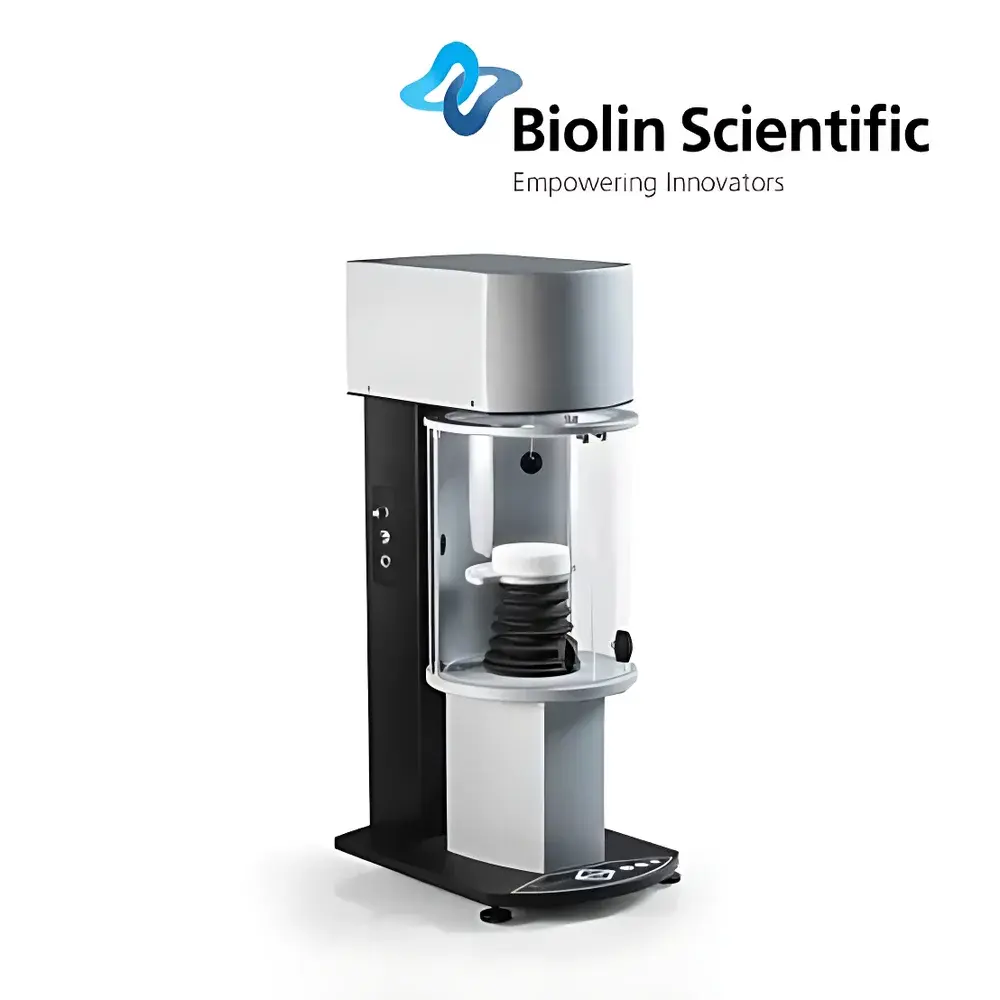
Biolin Scientific Sigma 701 Automated Surface Tensiometer
| Brand | Biolin Scientific |
|---|---|
| Origin | Finland |
| Model | Sigma 701 |
| Measurement Range | 1–2000 mN/m |
| Resolution (Surface Tension) | 0.001 mN/m |
| Accuracy (Surface Tension) | ±0.01 mN/m |
| Temperature Control Range | −20 to +200 °C |
| Temperature Resolution | 0.01 °C |
| Measurement Methods | Du Noüy Ring Method, Wilhelmy Plate Method |
| Density Range | 0–2.2 g/cm³ |
| Density Resolution | 0.0001 g/cm³ |
| Force Resolution | 0.05–0.1 µN |
| Contact Angle Range | 0–180° |
| Contact Angle Resolution | 0.01° |
| Motorized Stage Speed | 0.01–500 mm/min |
| Stage Positioning Accuracy | 0.016 µm |
| Dimensions (W×D×H) | 33.3 × 24.4 × 62 cm |
| Weight | 13–16 kg |
| Power Supply | 85–264 VAC, 47–440 Hz, 13 W |
Overview
The Biolin Scientific Sigma 701 Automated Surface Tensiometer is a high-precision benchtop instrument engineered for quantitative characterization of interfacial phenomena at liquid–air and liquid–liquid interfaces. It operates on two primary physical principles: the Du Noüy ring method—based on the maximum pull force required to detach a platinum–iridium ring from the interface—and the Wilhelmy plate method—relying on continuous force measurement as a calibrated platinum or filter paper plate is immersed into or withdrawn from the test liquid. These methods conform to internationally recognized standards including ISO 1409, ASTM D971, ASTM D1331, and ISO 6295. The Sigma 701 delivers traceable, reproducible measurements of surface tension (γLV), interfacial tension (γLI), critical micelle concentration (CMC), dynamic contact angle, surface free energy (SFE), powder wettability (via Washburn analysis), adhesion force, sedimentation kinetics, and density—all under programmable temperature control from −20 °C to +200 °C. Its modular architecture supports integration with environmental chambers, dosing units, and high-temperature cells for extended application scope in R&D laboratories, QC/QA departments, and academic surface science facilities.
Key Features
- High-stability microbalance with dual force resolution modes (0.05 µN and 0.1 µN) and integrated electromagnetic damping for vibration immunity
- Motorized, precision-guided sample stage with sub-micron positioning accuracy (0.016 µm) and programmable vertical speed (0.01–500 mm/min)
- Thermally isolated temperature-controlled sample holder compatible with Peltier and external circulation systems for stable thermal regulation (±0.01 °C stability over time)
- Open mechanical design enabling rapid interchange of accessories—including fiber holders, multi-dosing syringes, and custom-built immersion cells—without recalibration
- Full automation of CMC titration sequences, dynamic contact angle sweeps, and SFE calculations using Young–Dupré, Owens–Wendt, and van Oss–Chaudhury–Good models
- Compliance-ready architecture supporting audit trails, user access levels, electronic signatures, and data integrity protocols aligned with FDA 21 CFR Part 11 and GLP/GMP requirements
Sample Compatibility & Compliance
The Sigma 701 accommodates a broad range of sample types: low- to high-viscosity liquids (e.g., surfactant solutions, polymer melts, ionic liquids), emulsions, microemulsions, biological fluids (serum, saliva), and solid substrates (fibers, powders, thin films). For powder wettability analysis, the instrument implements the Washburn capillary rise method using standardized glass frits or packed columns. All measurement protocols adhere to ISO/IEC 17025 documentation practices. Regulatory compliance includes full traceability to NIST-traceable reference standards (e.g., ultrapure water, diiodomethane, ethylene glycol), automated calibration verification routines, and metadata-embedded raw data export (CSV, TXT, XML) for third-party validation. The system meets CE marking requirements and conforms to IEC 61010-1 safety standards for laboratory equipment.
Software & Data Management
OneAttension software serves as the unified control and analysis platform for the Sigma 701. It provides real-time visualization of force–distance curves, automatic baseline correction, and adaptive peak detection for both static and dynamic measurements. All modules—including CMC determination, contact angle hysteresis mapping, and SFE component decomposition—are fully scriptable via Python API for integration into automated lab workflows. Data files include embedded experimental metadata (operator ID, timestamp, environmental conditions, calibration history) and support version-controlled archiving in local or networked repositories. Audit trail functionality logs every parameter change, measurement execution, and report generation event with immutable timestamps—enabling full retrospective review during regulatory inspections.
Applications
- Formulation development of agrochemicals, pharmaceutical emulsions, and personal care products
- Quality control of surfactant purity, batch-to-batch consistency, and aging effects in industrial lubricants
- Surface energy mapping of polymer films, coatings, and biomedical implants for adhesion optimization
- Dynamic wetting behavior analysis of single fibers (e.g., carbon, silk, synthetic filaments) in textile and composite research
- Colloidal stability assessment via interfacial rheology coupling (with optional oscillatory module)
- Fundamental studies of protein adsorption kinetics, lipid monolayer compression isotherms, and nanoparticle–interface interactions
FAQ
What measurement methods does the Sigma 701 support?
The instrument supports Du Noüy ring and Wilhelmy plate methods for surface and interfacial tension, plus Washburn-based powder wettability, dynamic contact angle via sessile drop or captive bubble, and density determination using magnetic float or sinker techniques.
Is temperature control fully integrated and software-managed?
Yes—temperature setpoints, ramp rates, dwell times, and real-time feedback are controlled directly through OneAttension, with PID tuning options and external bath synchronization capability.
Can the Sigma 701 be validated for regulated environments?
Absolutely—the system includes IQ/OQ documentation templates, calibration certificate management, electronic signature support, and configurable user roles meeting FDA 21 CFR Part 11 and EU Annex 11 expectations.
How is data integrity ensured during long-term CMC or contact angle experiments?
Raw sensor output is continuously streamed and timestamped at ≥100 Hz; all intermediate calculation steps (e.g., baseline subtraction, tangent fitting) are preserved non-destructively in the native project file format.
Does the instrument require routine recalibration between methods?
No—mechanical alignment and force calibration are performed once per installation; method switching is software-configured without hardware intervention or recalibration cycles.



