
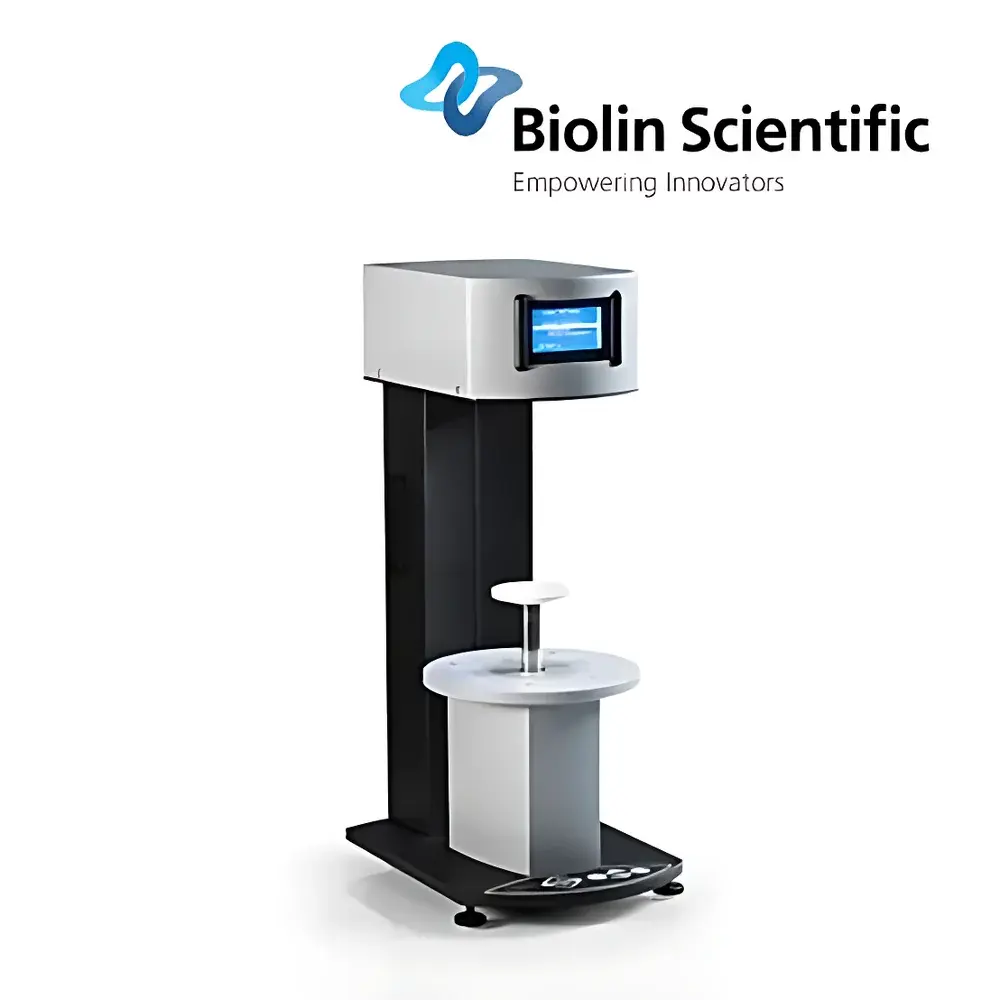
Biolin Scientific Sigma 702ET Automatic Surface and Interfacial Tensiometer
| Brand | Biolin Scientific |
|---|---|
| Origin | Finland |
| Model | Sigma 702ET |
| Measurement Range | 1–1000 mN/m |
| Resolution | 0.01 mN/m |
| Accuracy | ±0.01 mN/m |
| Temperature Control Range | −20 to +200 °C |
| Temperature Resolution | 0.01 °C |
| Measurement Methods | Du Noüy Ring Method & Wilhelmy Plate Method |
| Compliance | ASTM D971, IEC 62961 |
| Density Measurement Range | 0–2.2 g/cm³ |
| Density Resolution | 0.0001 g/cm³ |
| Force Resolution | 0.1 µN |
| Sample Stage Speed | 0.01–500 mm/min |
| Positional Accuracy | ±0.26 µm |
Overview
The Biolin Scientific Sigma 702ET is a standalone, microprocessor-controlled automatic surface and interfacial tensiometer engineered for high-precision measurement of surface tension (ST) and oil–water interfacial tension (IFT) in insulating oils—particularly transformer oils used in power transmission and distribution systems. It operates on the fundamental principles of force tensiometry, quantifying the vertical force exerted on a calibrated platinum–iridium ring (Du Noüy method) or a precision platinum plate (Wilhelmy method) as it interacts with the liquid–air or liquid–liquid interface. The instrument’s core architecture integrates a high-stability electromagnetic microbalance (0.01 mg readability), motorized Z-axis sample stage with sub-micron positional repeatability, and integrated Peltier-based temperature control. Designed explicitly for compliance-driven environments, the Sigma 702ET delivers traceable, reproducible results under standardized test conditions defined by ASTM D971 (“Standard Test Method for Interfacial Tension of Oil Against Water by the Ring Method”) and IEC 62961 (“Mineral insulating oils — Determination of interfacial tension against water”). Its self-contained operation eliminates dependency on external computing hardware during routine testing, making it suitable for QC laboratories in utilities, transformer manufacturers, and third-party certification labs requiring audit-ready instrumentation.
Key Features
- Standalone operation with built-in keypad and large-format digital display—no PC required for standard IFT/ST measurements
- Dual-method capability: fully supported Du Noüy ring and Wilhelmy plate protocols with automatic meniscus detection and force zeroing
- Integrated temperature-controlled sample stage with Peltier element and high-resolution thermal sensor (±0.01 °C resolution over −20 to +200 °C range)
- High-precision electromagnetic microbalance with 0.1 µN force resolution and <0.01 mN/m measurement accuracy
- Motorized sample stage with programmable speed (0.01–500 mm/min) and positional accuracy of ±0.26 µm
- Onboard memory for storing up to 1,000 test records with timestamp, method ID, temperature, and raw force data
- Optional Data Receiver software enables GLP-compliant data export, report generation, and long-term trend analysis
Sample Compatibility & Compliance
The Sigma 702ET is optimized for low-polarity, non-volatile liquids including mineral insulating oils, synthetic esters, silicone fluids, and hydrocarbon-based fuels. Its mechanical design accommodates standard ASTM D971 sample vials (typically 30–50 mL volume) and supports both static and dynamic IFT measurements across temperature gradients. All operational firmware and measurement algorithms are preconfigured to execute ASTM D971 and IEC 62961 procedures—including automated immersion depth calibration, peak force capture, and correction for buoyancy and wire torsion effects. The instrument meets essential requirements for ISO/IEC 17025-accredited testing laboratories, with full traceability to NIST-traceable force and temperature standards. While not inherently 21 CFR Part 11 compliant in standalone mode, Data Receiver software supports electronic signatures, audit trails, and user access controls when deployed on validated Windows platforms under GxP-regulated workflows.
Software & Data Management
The Sigma 702ET ships with two complementary software layers: (1) embedded firmware supporting real-time measurement, parameter configuration, and local result visualization; and (2) optional Data Receiver PC software (Windows 7/8/10, 64-bit recommended) for advanced data handling. Data Receiver provides CSV and PDF export, customizable reporting templates, statistical process control (SPC) charts, and batch comparison tools. It logs all user actions—including method edits, calibration events, and result overrides—with timestamps and operator IDs, satisfying basic GLP documentation needs. Raw force vs. position curves are stored for retrospective reanalysis. The software does not require network connectivity or cloud services, ensuring data sovereignty and compatibility with air-gapped lab networks.
Applications
- Routine quality control of new and in-service transformer oils per ASTM D971 and IEC 62961 specifications
- Monitoring oxidation-induced polar compound formation via progressive IFT decline over service life
- Evaluation of additive depletion kinetics and compatibility testing between oil batches
- Interfacial characterization of bio-based insulating fluids and alternative dielectric media
- Research into surfactant migration at oil–moisture interfaces in high-voltage equipment
- Supporting failure analysis investigations where reduced IFT correlates with sludge formation or dielectric breakdown risk
FAQ
Does the Sigma 702ET require external calibration certificates for ASTM D971 compliance?
No—routine verification using certified reference oils (e.g., n-decane, distilled water) satisfies ASTM D971 Section 7.2 requirements. Optional factory calibration certificates traceable to NIST are available upon request.
Can the instrument measure critical micelle concentration (CMC)?
Yes—CMC determination is supported manually via sequential dilution series and surface tension plotting; automated CMC calculation is not embedded but feasible using exported data in external analysis tools.
Is density measurement performed simultaneously with surface tension?
No—density is measured separately using the integrated analytical balance and requires manual input of sample volume or geometric parameters; it is not coupled to the tensiometric measurement cycle.
What maintenance is required for the platinum ring or plate?
Rings and plates must be cleaned ultrasonically in ethanol or acetone after each use and annealed in a Bunsen flame prior to critical measurements to remove organic residues and restore uniform wetting behavior.
Can the Sigma 702ET operate unattended overnight?
Yes—the instrument supports timed start, auto-shutdown, and continuous temperature stabilization; however, sample evaporation or contamination risks necessitate appropriate environmental controls and sealed vessel use for extended runs.



