
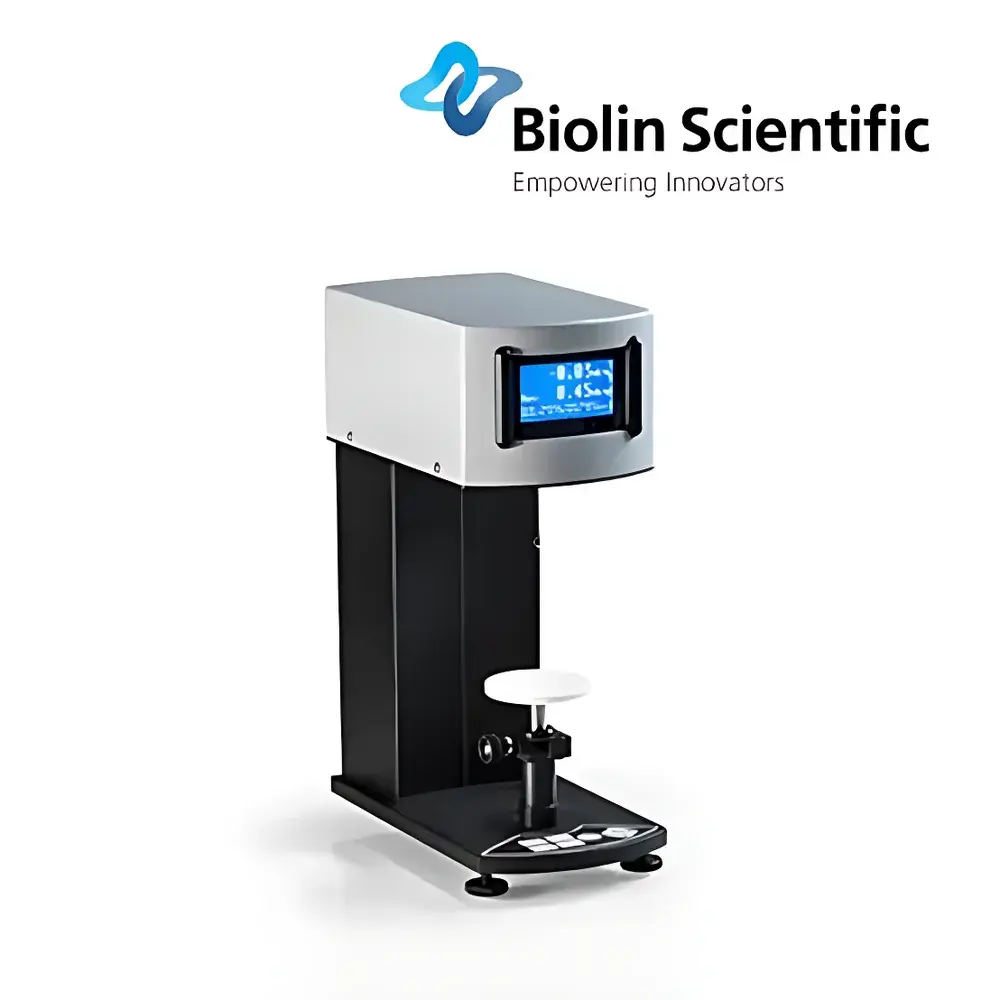
Biolin Scientific Sigma 703D Surface Tensiometer
| Brand | Biolin Scientific |
|---|---|
| Origin | Finland |
| Model | Sigma 703D |
| Measurement Range | 1–1000 mN/m |
| Resolution | 0.01 mN/m |
| Accuracy | ±0.01 mN/m |
| Temperature Display Range | −20 to +200 °C |
| Temperature Display Accuracy | ±0.01 °C |
| Measurement Methods | Du Noüy Ring Method, Wilhelmy Plate Method |
| Density Range | 0–2.2 g/cm³ |
| Density Resolution | 0.0001 g/cm³ |
| Force Resolution | 0.1 µN |
| Weight | 11 kg |
| Dimensions (W×D×H) | 33.3 × 24.4 × 62 cm |
| Power Supply | 85–264 VAC, 47–440 Hz, 13 W |
Overview
The Biolin Scientific Sigma 703D Surface Tensiometer is a benchtop, stand-alone instrument engineered for high-reproducibility measurement of surface tension, interfacial tension, and liquid density—using standardized, gravimetric force-balance principles. It operates on two internationally recognized methods: the Du Noüy ring method (ASTM D971, ISO 6295) and the Wilhelmy plate method (ISO 1409, ASTM D1331), both compliant with ISO/IEC 17025 traceability requirements when calibrated with certified reference liquids (e.g., ultrapure water, diiodomethane). The system integrates a precision microbalance with temperature-stable load cell architecture and an open-frame mechanical design optimized for manual sample handling under ambient or controlled thermal conditions. Unlike fully automated platforms, the Sigma 703D prioritizes operational simplicity and robustness—making it ideal for routine QC labs, formulation development environments, and academic teaching laboratories where reliability, ease of validation, and minimal software dependency are critical.
Key Features
- Standalone operation with integrated 5.7-inch backlit LCD display—no PC required for real-time measurement, unit conversion, or result logging
- Dual-method capability: interchangeable platinum-iridium Du Noüy rings and Wilhelmy plates (standardized geometries per ISO 1409 Annex A)
- High-resolution force detection: 0.1 µN resolution enables precise CMC endpoint identification during manual titration experiments
- Integrated Peltier-based temperature control stage (optional accessory) supports direct sample temperature monitoring from −20 °C to +200 °C with 0.01 °C digital readout and stability ≤ ±0.1 °C over 30 min
- Manual Z-axis sample stage with coarse/fine dual-drive adjustment for rapid immersion depth optimization and repeatable meniscus positioning
- Onboard memory stores up to 100 measurement records with timestamp, method ID, temperature, and raw force data
- Compliant with GLP documentation standards: all measurements include operator ID field, method parameters, and environmental metadata
Sample Compatibility & Compliance
The Sigma 703D accommodates aqueous surfactant solutions, polymer melts, ionic liquids, crude oil/water interfaces, pharmaceutical emulsions, and low-volatility organic solvents. Its open-access sample chamber allows direct integration with external thermostats, humidity chambers, or gas purging manifolds. All wetted parts—including the balance arm, hook assembly, and sample pan—are constructed from corrosion-resistant stainless steel and platinum-group alloys. Calibration follows ISO 8504-2 guidelines using NIST-traceable standard liquids; certificate of calibration includes uncertainty budget per GUM (JCGM 100:2008). Instrument design meets IEC 61010-1 safety requirements for laboratory electrical equipment and complies with CE marking directives for electromagnetic compatibility (2014/30/EU) and low voltage (2014/35/EU).
Software & Data Management
The optional Data Receiver software (v3.2+) provides USB 2.0 connectivity for live data streaming, batch export (CSV, TXT), and report generation compliant with FDA 21 CFR Part 11 Annex 11 requirements—including electronic signatures, audit trails, and role-based user access control. Raw force vs. time curves are archived with full metadata (operator, date/time, method, temperature, calibration status). Exported datasets support post-processing in MATLAB, Python (Pandas), or JMP for advanced CMC fitting (e.g., second-derivative or conductometric correlation), surface equation-of-state modeling (e.g., Szyszkowski, Langmuir), and statistical process control (SPC) charting. Software installation requires Windows 7/8/10 (32- or 64-bit), ≥2 GHz CPU, ≥4 GB RAM, ≥500 GB HDD, and ≥1920×1080 display resolution.
Applications
- Surfactant quality control: batch-to-batch consistency verification against specification limits per USP and EP 2.9.33
- Formulation optimization: wetting angle prediction via surface energy component analysis (Owens-Wendt-Rabel-Kaelble)
- CMC determination in R&D: manual stepwise dilution protocol with automatic peak-detection algorithm for inflection point localization
- Crude oil emulsion stability assessment: interfacial tension reduction kinetics at oil/water interfaces under reservoir-relevant temperatures
- Pharmaceutical excipient screening: surface activity profiling of polysorbates, lecithins, and fluorosurfactants in parenteral dosage forms
- Coating and ink development: dynamic surface tension evaluation using Wilhelmy plate immersion rate control (0.1–5 mm/s)
FAQ
What regulatory standards does the Sigma 703D support for GxP environments?
It supports audit-ready workflows per FDA 21 CFR Part 11 (with optional software), ISO/IEC 17025 method validation, and GLP-compliant record retention—including electronic signature capture, immutable audit trails, and calibration certificate linkage.
Can the Sigma 703D measure dynamic surface tension?
No—it is designed for equilibrium (static) surface and interfacial tension measurements. For dynamic analysis, Biolin’s Theta Flex or Attension Sigma 700 series are recommended.
Is temperature control built-in or external?
The base model includes digital temperature sensing only; precise thermal regulation requires the optional Peltier-controlled sample stage (Sigma TC-703) or integration with external circulating baths.
How often must the platinum ring or plate be cleaned and recalibrated?
Cleaning is required before each measurement series using chromic acid or piranha solution (with appropriate safety protocols); recalibration is recommended daily or after any physical impact, using certified reference liquids per ISO 1409 Clause 7.2.
Does the instrument support density measurement of opaque or viscous samples?
Yes—the integrated density module uses hydrostatic weighing (Archimedes’ principle) and is validated for viscosities up to 10,000 mPa·s and turbid suspensions, provided sample volume ≥10 mL and meniscus formation remains stable.



