
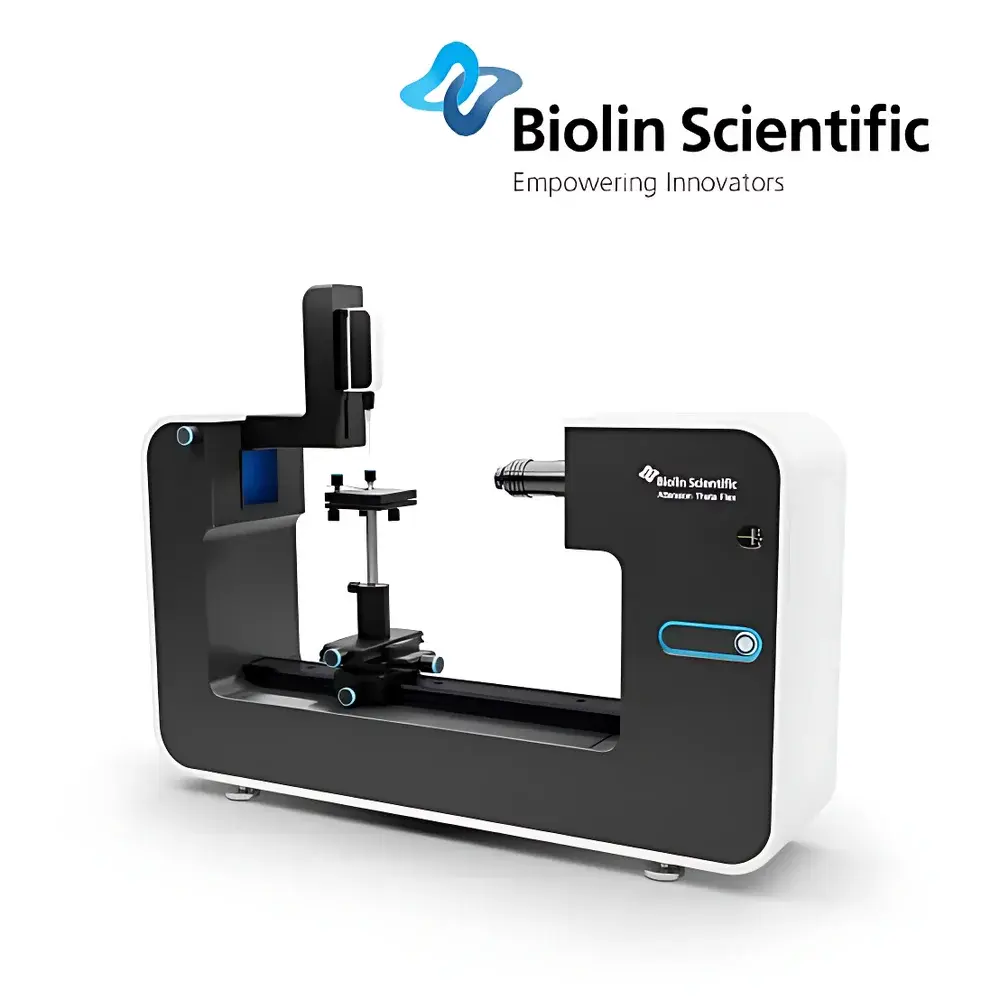
Biolin Scientific Theta Flex Optical Contact Angle Analyzer
| Brand | Biolin Scientific |
|---|---|
| Origin | Finland |
| Model | Theta Flex |
| Instrument Type | Video-Based Optical Contact Angle Analyzer |
| Contact Angle Measurement Range | 0–180° |
| Contact Angle Resolution | 0.01° |
| Contact Angle Accuracy | ±0.01° |
| Surface/Interfacial Tension Range | 0.01–2000 mN/m |
| Surface/Interfacial Tension Accuracy | ±0.01 mN/m |
| Sample Stage Dimensions | 100 mm × 320 mm |
| Maximum Sample Size (L×W×H) | 763 × 230 × 435 mm |
| Stage Load Capacity | 26 kg |
| Imaging System | USB 3.0 Digital Camera with 8× Zoom, High-Intensity Monochromatic LED Illumination |
| Image Resolution | 1936 × 1216 (optional Theta Flow high-speed camera available) |
| Compliance | Designed for GLP/GMP environments |
Overview
The Biolin Scientific Theta Flex Optical Contact Angle Analyzer is a high-precision, modular video-based instrument engineered for quantitative characterization of solid–liquid and liquid–liquid interfacial interactions. It operates on the principle of sessile drop analysis using high-resolution digital imaging and advanced edge-detection algorithms grounded in Young–Laplace equation fitting. The system enables rigorous measurement of contact angle hysteresis, dynamic wetting behavior, surface free energy distribution, and interfacial rheology—critical parameters in materials science, pharmaceutical formulation, microelectronics packaging, and enhanced oil recovery research. Its rigid optical architecture, thermally stable mechanical frame, and vibration-damped base ensure long-term measurement reproducibility (<0.1° RSD over 24 h under controlled lab conditions). As a CE-marked, ISO 9001–certified instrument manufactured in Finland, the Theta Flex meets international standards for metrological traceability and laboratory instrumentation reliability.
Key Features
- Full automation of droplet deposition, image capture, contour analysis, and data export via OneAttension software—reducing operator dependency and inter-user variability.
- Modular hardware expansion: Integrated tilt stage for advancing/receding angle and roll-off angle quantification; optional high-pressure cell (up to 400 bar / 200 °C) for reservoir fluid–rock interaction studies.
- Dual-mode interfacial rheology capability: Oscillating pendant/sessile drop module enables measurement of dilatational modulus (E’) and viscosity (E”) at gas–liquid and liquid–liquid interfaces.
- 3D topography integration: Synchronized white-light interferometry module acquires surface roughness (Sa, Sq, Sz) and correlates topographic heterogeneity with local contact angle variation—enabling Wenzel/Cassie–Baxter state discrimination.
- Pico-liter dispensing system: Motorized syringe pump with disposable tips ensures contamination-free, repeatable dosing for micro-patterned substrates and inkjet-relevant wetting evaluation.
- Environmental control compatibility: Interchangeable temperature chambers (−20 to 120 °C) and humidity modules (10–95% RH non-condensing) support standardized testing per ASTM D7334 and ISO 15989.
Sample Compatibility & Compliance
The Theta Flex accommodates flat, curved, porous, fibrous, and anisotropic samples up to 26 kg and 435 mm height. Its open-stage design permits direct mounting of industrial components (e.g., coated metal sheets, polymer films, ceramic filters, single fibers) without size-induced geometric constraints. All measurement protocols adhere to ISO 19403-2 (static contact angle), ISO 19403-3 (dynamic contact angle), and ASTM D5725 (surface energy by Owens–Wendt method). Data integrity is ensured through electronic signatures, time-stamped audit logs, and role-based user permissions—fully compliant with FDA 21 CFR Part 11 for regulated QC/QA laboratories.
Software & Data Management
OneAttension v4.x provides unified control of all hardware modules and implements ISO/IEC 17025–aligned uncertainty propagation models for contact angle and surface energy calculations. Batch processing supports statistical analysis across ≥1000 images per session, with automated outlier rejection based on curvature deviation thresholds. Raw image archives (.tiff), processed contours (.csv), and metadata (instrument settings, ambient conditions, calibration history) are stored in vendor-neutral formats. Export options include PDF reports with embedded traceable calibration certificates, Excel-compatible datasets, and direct LIMS integration via RESTful API.
Applications
- Quality control of hydrophobic/hydrophilic coatings in medical devices and implantable polymers.
- Surface energy mapping of plasma-treated packaging films to optimize adhesive bonding performance.
- Wettability screening of shale core plugs under reservoir pressure–temperature conditions.
- Formulation stability assessment of Pickering emulsions via interfacial viscoelasticity profiling.
- Characterization of self-cleaning surfaces using rolling angle and contact angle hysteresis correlation.
- Development of anti-fouling membranes through roughness-corrected contact angle modeling.
FAQ
What standards does the Theta Flex comply with for surface energy calculation?
It supports Owens–Wendt–Rabel–Kaelble (OWRK), Wu harmonic mean, and van Oss–Chaudhury–Good (vOCG) models, all implemented per ISO 19403-4 and ASTM D7490 guidelines.
Can the Theta Flex measure contact angles on vertical or inverted surfaces?
Yes—using the optional motorized tilt frame and pendant drop configuration, it quantifies contact angles on non-horizontal substrates up to ±90° inclination.
Is third-party software integration supported?
The system provides DLL libraries and documented COM interface for custom LabVIEW, Python, or MATLAB automation scripts.
How is calibration verified during routine operation?
Certified reference goniometer standards (10°, 45°, 90°, 135°) are included; automated calibration verification runs before each measurement sequence.
Does the instrument support Good Manufacturing Practice (GMP) documentation requirements?
Yes—electronic records include full audit trail, electronic signatures, and configurable retention policies aligned with Annex 11 and ALCOA+ principles.



