
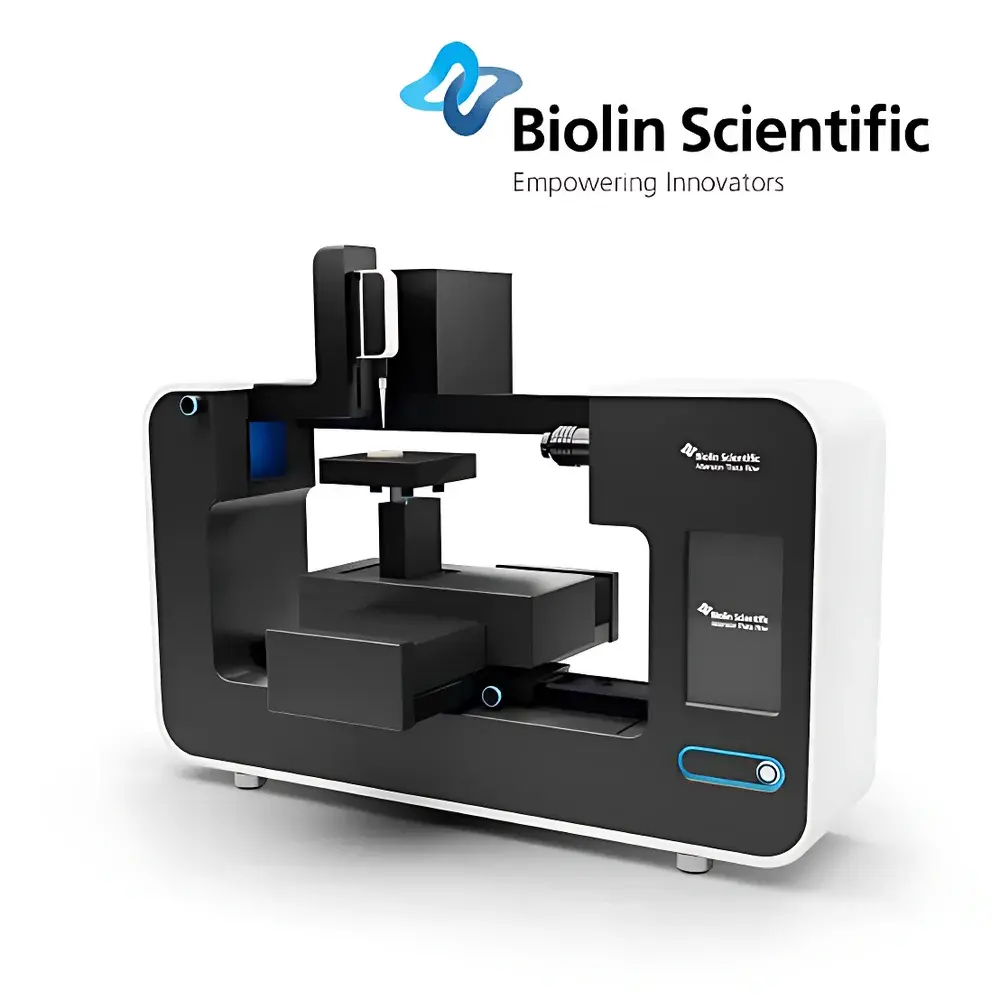
Biolin Scientific Theta Flow 3D Topography-Integrated Optical Contact Angle Analyzer
| Brand | Biolin Scientific |
|---|---|
| Origin | Finland |
| Model | Theta Flow with 3D Topography Module |
| Instrument Type | Benchtop Video-Based Optical Contact Angle Analyzer |
| Contact Angle Range | 0–180° |
| Contact Angle Accuracy | ±0.01° |
| Contact Angle Resolution | 2592 × 2048 (5.3 MP) |
| Surface Tension Range | 0.01–2000 mN/m |
| Surface Tension Accuracy | ±0.01 mN/m |
| Sample Stage Dimensions | Unlimited (L) × 100 mm (W) × 320 mm (D) |
| Max Sample Size | Unlimited (L) × 320 mm (W) × 22 mm (H) |
| Imaging Sensor | 5.3 MP CMOS, 2592 × 2048 pixels |
Overview
The Biolin Scientific Theta Flow 3D Topography-Integrated Optical Contact Angle Analyzer is an advanced benchtop instrument engineered for concurrent, spatially registered measurement of static and dynamic contact angles alongside high-resolution 3D surface topography. It operates on the principle of video-based optical goniometry combined with phase-shifted fringe projection profilometry—a non-contact, full-field 3D shape acquisition method. Unlike conventional contact angle systems that assume idealized smooth and chemically homogeneous surfaces, the Theta Flow directly addresses real-world surface complexity by acquiring topographic data (e.g., Sa, Sq, Sdr, Sdq) and wetting parameters (θadv, θrec, θapp) from the exact same region of interest. This co-localized dataset enables rigorous application of Wenzel and Cassie–Baxter wetting models, permitting quantitative separation of chemical heterogeneity from topographic amplification effects—critical for R&D in functional coatings, biomedical device surfaces, microfluidics, and additive manufacturing quality control.
Key Features
- Simultaneous acquisition of contact angle dynamics (sessile drop, tilting plate, captive bubble) and 3D topography using synchronized high-speed CMOS imaging (2592 × 2048 @ up to 330 fps) and structured light projection.
- Phase-shift fringe projection module delivering sub-micron vertical resolution (<0.5 µm) and lateral resolution down to 2.5 µm/pixel over a 10 mm × 8 mm field of view—scalable via motorized stage stitching.
- OneAttention software platform with automated, scriptable workflows: auto-droplet placement, edge detection, contour fitting, and real-time calculation of roughness-corrected contact angles (θWenzel) and surface free energy components (Lifshitz–van der Waals, Lewis acid–base) using Owens–Wendt–Rabel–Kaelble (OWRK) and Wu methods.
- Modular design supporting optional accessories: temperature-controlled stage (−20 to 120 °C), humidity chamber (10–95% RH), dispensing robot (10 nL–100 µL precision), and high-speed tilt unit (0–90° at 0.1°/s).
- Benchtop footprint (700 × 500 × 450 mm) with vibration-isolated granite base and motorized XYZ sample positioning—enabling stable measurements on large or irregular substrates up to 320 mm wide and 22 mm thick.
Sample Compatibility & Compliance
The Theta Flow accommodates diverse solid substrates including polymers, metals, ceramics, textiles, thin films, and biological tissues—regardless of opacity, reflectivity, or curvature—thanks to adaptive illumination geometry and multi-wavelength LED lighting (470 nm, 530 nm, 630 nm). Its measurement methodology aligns with ASTM D7334 (“Standard Practice for Surface Wettability of Coated Surfaces”), ISO 19403-2 (“Paints and varnishes — Contact angle measurement”), and ISO 25178-2 (“Geometrical product specifications — Surface texture — Areal — Part 2: Terms, definitions and surface texture parameters”). Data integrity is ensured through audit-trail-enabled operation compliant with FDA 21 CFR Part 11 requirements when deployed in GLP/GMP environments.
Software & Data Management
OneAttention v4.x provides a unified interface for instrument control, image processing, and metrological analysis. All raw images, topographic point clouds (.xyz, .stl), contact angle time-series (.csv), and metadata are stored in a hierarchical project structure with timestamped versioning. Built-in statistical modules support batch processing across multiple samples, outlier detection via Grubbs’ test, and uncertainty propagation modeling for derived parameters (e.g., surface free energy confidence intervals). Export formats include PDF reports (ISO-compliant templates), HDF5 for MATLAB/Python integration, and direct SQL database connectivity for LIMS interoperability.
Applications
- Quantifying the independent contributions of surface chemistry and nanoscale roughness to hydrophobicity/hydrophilicity in plasma-treated polymers and sol-gel coatings.
- Validating replication fidelity of microstructured surfaces fabricated via nanoimprint lithography or laser texturing.
- Correlating topographic anisotropy (e.g., directional Ra gradients) with contact angle hysteresis in filtration membranes and lab-on-chip channels.
- Assessing aging-induced morphological degradation (e.g., cracking, dewetting) in anti-fouling marine coatings under accelerated weathering protocols.
- Mapping spatial heterogeneity in biofunctionalized glass slides used in high-content screening assays—linking local wettability to protein adsorption density.
FAQ
How does the 3D topography module achieve sub-micron vertical resolution without physical contact?
It employs calibrated phase-shifted sinusoidal fringe projection: three or more precisely offset monochromatic patterns are projected onto the surface; their deformation is captured by a fixed-perspective camera and decoded using Fourier transform profilometry algorithms to reconstruct height maps with <0.5 µm repeatability.
Can the system measure contact angles on curved or tilted surfaces?
Yes—the motorized 6-axis stage allows precise angular alignment, and the software applies geometric correction to droplet contours based on real-time stage position feedback and surface normal vectors extracted from the topography map.
Is surface free energy calculation validated against reference standards?
Yes—Biolin provides traceable calibration kits (e.g., Diiodomethane, Ethylene Glycol, Water, Formamide) and certifies accuracy against NIST-traceable contact angle reference solids (e.g., PTFE, silicon wafer, glass slide) per ISO 19403-4.
What data security features are included for regulated industries?
Role-based user access control, electronic signatures, full audit trail (including parameter changes, manual corrections, and export events), and encrypted local storage—all configurable to meet ALCOA+ principles and 21 CFR Part 11 Annex 11 requirements.
Does the system support automated long-term aging studies?
Yes—via scheduled measurement sequences (e.g., hourly contact angle + topography scans over 72 h), environmental chamber integration, and failure-tolerant resume functionality after power interruption.
Related Products



