
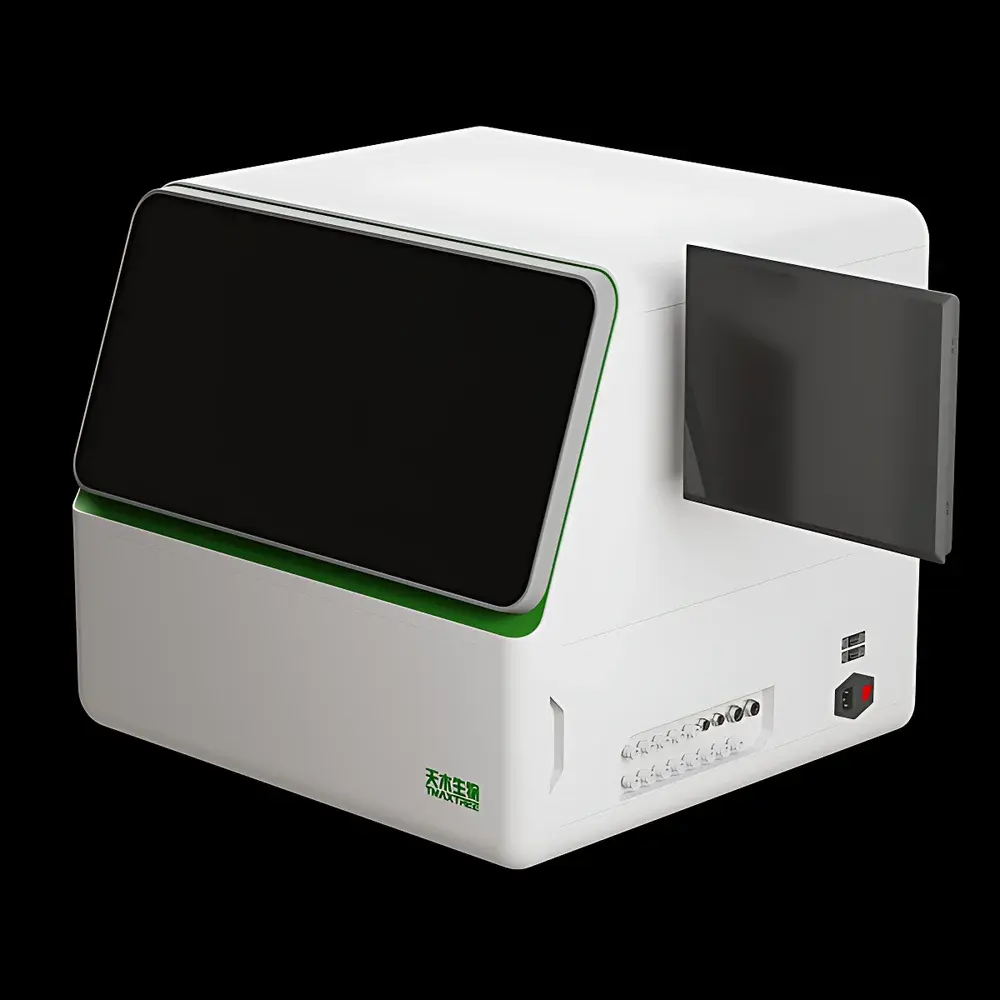
BioProcess Online Monitoring System BODS by TMAXTREE
| Brand | TMAXTREE |
|---|---|
| Origin | Jiangsu, China |
| Manufacturer Type | Direct Manufacturer |
| Instrument Type | Fully Automatic |
| Detection Method | Enzyme-Linked Electrode Sensor Array |
| Measurable Analytes | Glucose, Lactose, Galactose, Glutamic Acid, Glutamine, Lysine, Xylose, Glycerol, Lactic Acid, Ethanol, Methanol |
| Accuracy | <3% Full Scale |
| Sample Throughput | 50 samples/hour |
| Dimensions | 550 × 502 × 760 mm |
Overview
The BioProcess Online Monitoring System BODS is a fully automated, multi-analyte fermentation analyzer engineered for real-time, in-line monitoring of critical metabolites during microbial and mammalian cell culture processes. Utilizing an integrated array of highly selective enzyme-linked electrochemical sensors—each optimized for specific substrate recognition—the BODS system enables continuous, label-free quantification without sample derivatization or chromatographic separation. Its core architecture follows the principle of amperometric detection: enzymatic reactions at the sensor surface generate proportional electron transfer currents, which are linearly correlated to analyte concentration under controlled flow and temperature conditions. Designed for integration into bioreactor control loops, the BODS delivers sub-minute measurement intervals with minimal process interruption, supporting dynamic process understanding, PAT (Process Analytical Technology) implementation, and QbD (Quality by Design) compliance in cGMP biomanufacturing environments.
Key Features
- Fully automated sampling and dilution module with programmable dilution ratios (1:1 to 1:100), minimizing manual intervention and operator-induced variability.
- Low-dead-volume fluidic pathway (<80 µL from bioreactor port to sensor chamber), ensuring rapid response time (<90 s typical lag time) and representative sampling from high-cell-density cultures.
- Dedicated enzyme electrode cartridges for each analyte class—glucose oxidase, lactate dehydrogenase, alcohol dehydrogenase, and amino acid oxidase variants—pre-calibrated and field-replaceable with traceable calibration certificates.
- Integrated feedback control interface compliant with Modbus TCP and OPC UA protocols, enabling direct communication with DeltaV, Emerson DCS, or Siemens PCS7 systems for automated feed-forward and feedback nutrient feeding.
- Robust mechanical design with IP54-rated enclosure, stainless-steel wetted parts (316L), and PEEK/PTFE fluidic components suitable for repeated CIP/SIP cycles at 121°C.
Sample Compatibility & Compliance
The BODS system accommodates complex, viscous, and particulate-laden fermentation broths—including CHO, E. coli, Pichia, and Bacillus cultures—without clogging, thanks to its dual-stage filtration (5 µm pre-filter + 0.22 µm sterile-grade membrane) and pulsatile backflush capability. All sensor modules meet ISO 13485:2016 requirements for medical device manufacturing, and the software platform supports 21 CFR Part 11-compliant audit trails, electronic signatures, and role-based access control. Data integrity aligns with ALCOA+ principles (Attributable, Legible, Contemporaneous, Original, Accurate, Complete, Consistent, Enduring, Available), and validation documentation includes IQ/OQ/PQ protocols per ASTM E2500-13 and ICH Q5C guidelines.
Software & Data Management
The BODS Control Suite is a Windows-based application featuring real-time trend visualization, multi-parameter overlay plots, and configurable alarm thresholds with SMS/email notification via SMTP. Raw sensor data (current, temperature, flow rate, pH) is stored in encrypted SQLite databases with automatic daily backup to network drives. Export formats include CSV, Excel (.xlsx), and XML for LIMS integration. The system supports batch-wise metadata tagging (e.g., strain ID, passage number, medium lot), and all calibration events—including reference standard lot numbers and expiration dates—are digitally logged with timestamped operator credentials. Optional cloud synchronization enables remote monitoring across distributed manufacturing sites while maintaining on-premise data sovereignty.
Applications
- Real-time optimization of fed-batch and perfusion bioreactor operations in monoclonal antibody and recombinant protein production.
- Metabolic flux analysis during strain development and media screening studies in synthetic biology workflows.
- In-process release testing of fermentation endpoints for vaccine intermediates (e.g., pertussis toxin, diphtheria toxoid).
- Monitoring of primary carbon and nitrogen sources alongside inhibitory byproducts (e.g., lactate, ethanol, methanol) to prevent metabolic shift and improve volumetric productivity.
- Supporting regulatory filings with continuous process verification data aligned with FDA’s Guidance for Industry on PAT and EMA’s Annex 1 revision drafts.
FAQ
How often do enzyme electrodes require recalibration?
Calibration is recommended before each campaign and after cartridge replacement; stability verification checks every 8–12 hours during extended runs using certified reference standards.
Can the BODS interface with third-party bioreactor controllers?
Yes—native support for Modbus TCP, OPC UA, and analog 4–20 mA outputs enables seamless integration with Sartorius Biostat, Thermo Fisher HyClone, and Applikon DASware platforms.
Is the system qualified for use in GMP manufacturing?
Yes—the hardware, firmware, and software are designed and documented to support GMP validation; full qualification packages (IQ/OQ/PQ) are provided upon request.
What maintenance is required between batches?
Post-run cleaning consists of automated NaOH/H₂O₂ flush cycles followed by sterile water rinse; no disassembly or sensor polishing is needed.
Does the system support simultaneous measurement of all listed analytes?
Yes—up to 11 parameters can be monitored concurrently, with independent sensor channels operating in parallel and synchronized acquisition timing.
Related Products




