
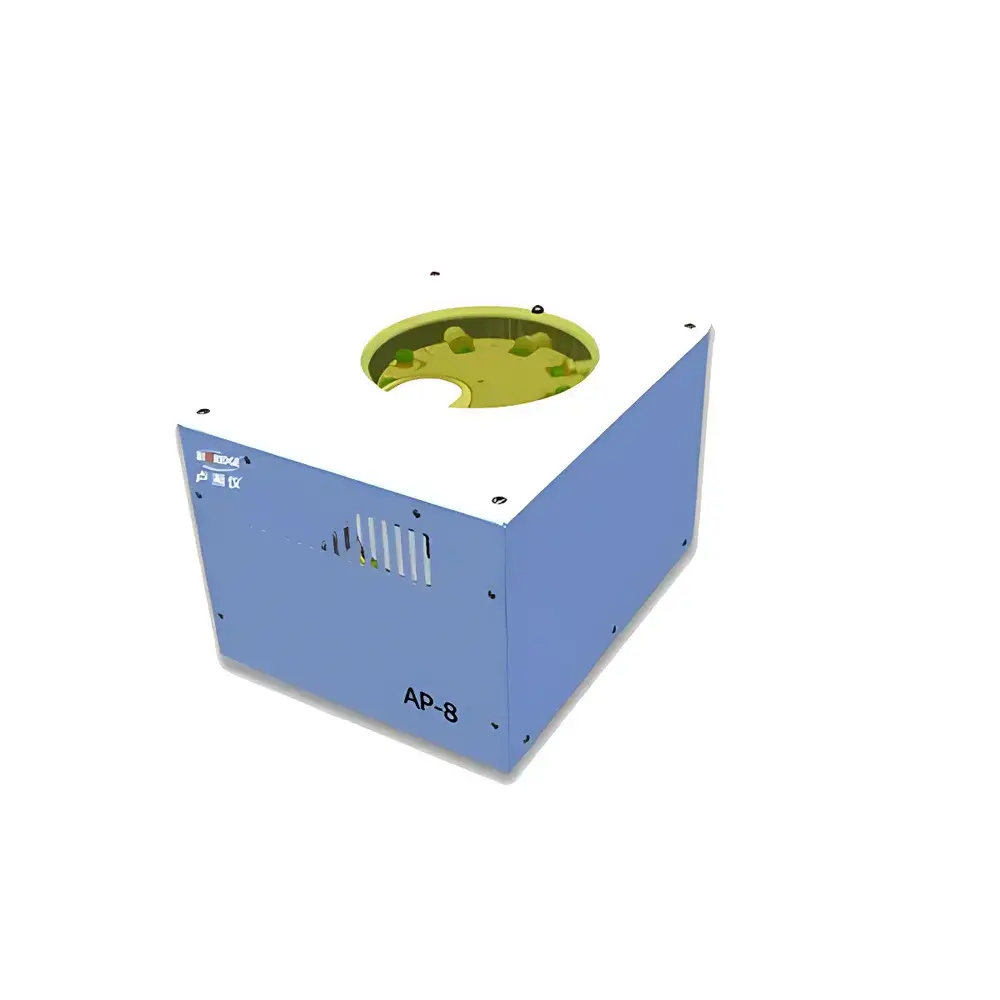
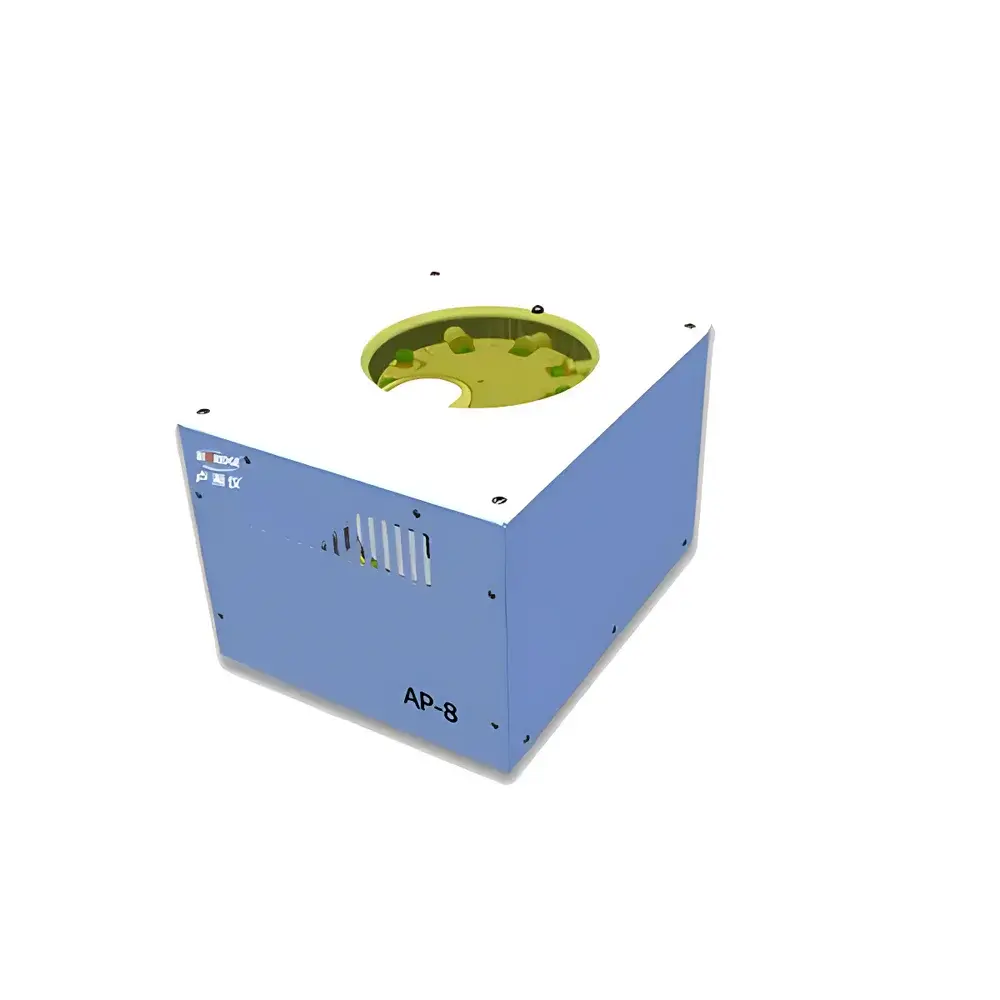
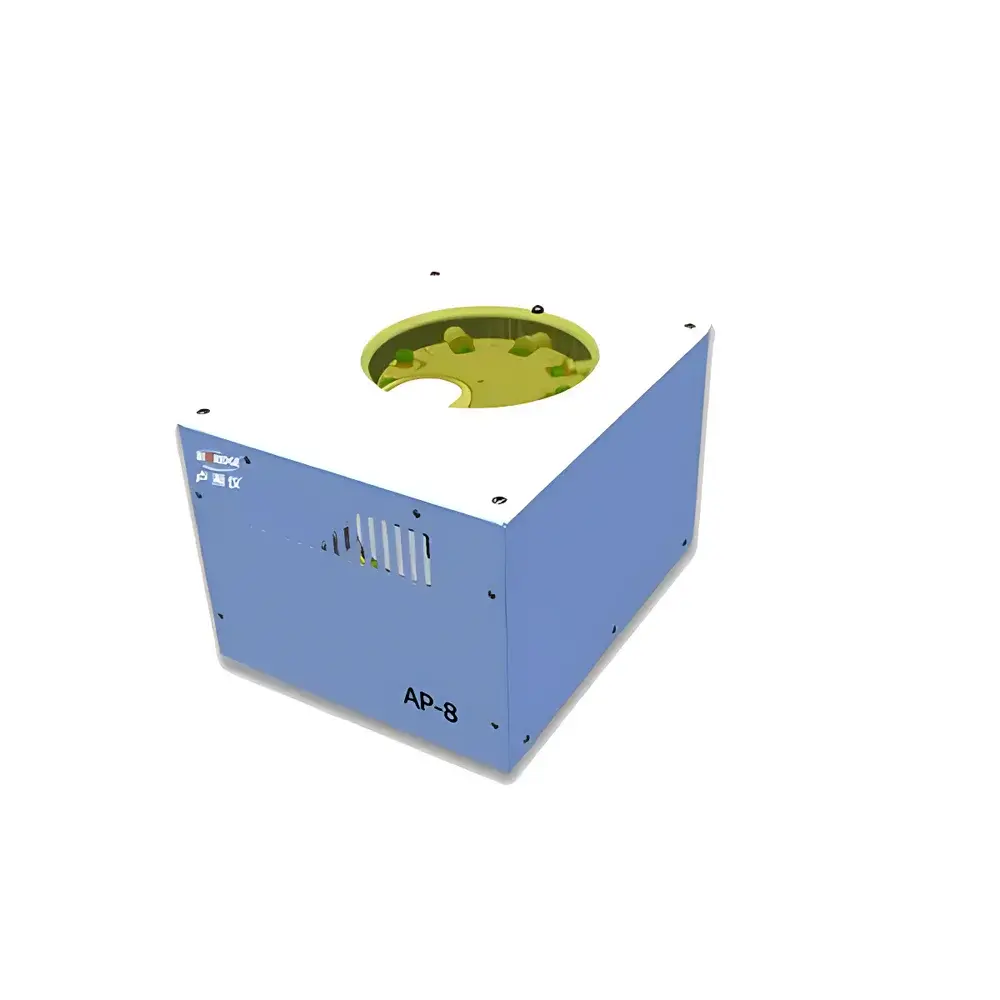
Bioridge AP-8 Automated Positioning Benchtop Centrifuge
| Brand | Bioridge |
|---|---|
| Origin | Shanghai, China |
| Model | AP-8 |
| Instrument Type | Benchtop Centrifuge |
| Speed Range | Up to 5000 rpm |
| Max RCF | 2516 × g |
| Dimensions (L×W×H) | 300 mm × 250 mm × 195 mm |
| Net Weight | 15 kg |
| Power Supply | 220 V, 50 Hz |
| Rated Power | 400 W |
| Cooling Method | Air-cooled |
| Tube Capacity | 1.5 mL / 2.0 mL microtubes |
| Control System | Microprocessor-based with automated positioning logic |
| Compliance | Designed for GLP-compliant lab environments |
Overview
The Bioridge AP-8 Automated Positioning Benchtop Centrifuge is an air-cooled, microprocessor-controlled centrifugation system engineered for precision, repeatability, and hands-free operation in routine laboratory workflows. It operates on the principle of sedimentation under controlled rotational acceleration—applying radial force to separate components based on density, size, and shape within suspended samples. With a maximum speed of 5000 rpm and a corresponding relative centrifugal force (RCF) of 2516 × g, the AP-8 is classified as a low-speed benchtop centrifuge optimized for microvolume applications involving 1.5 mL and 2.0 mL conical or round-bottom microcentrifuge tubes. Its automated positioning mechanism ensures consistent rotor alignment and lid engagement prior to each run, minimizing mechanical variance and enhancing operational safety. The unit’s compact footprint (300 × 250 × 195 mm) and 15 kg net weight make it suitable for shared instrumentation benches, biosafety cabinets, and quality control stations where spatial efficiency and vibration isolation are critical.
Key Features
- Automated positioning system with real-time rotor alignment verification prior to acceleration
- Microprocessor-based control interface with programmable time, speed, and deceleration profiles
- Air-cooling architecture eliminating need for refrigerant maintenance or condensation management
- Front-access hinged lid with interlocked safety switch and automatic brake release upon lid opening
- Low-noise brushless DC motor delivering stable torque across full speed range (0–5000 rpm)
- Integrated imbalance detection and automatic shutdown at ≥5 g deviation during operation
- Compliance-ready firmware supporting timestamped run logs exportable via USB port
Sample Compatibility & Compliance
The AP-8 accommodates standard 1.5 mL and 2.0 mL microcentrifuge tubes—including polypropylene, PCR-grade, and autoclavable variants—without requiring adapters. Its rotor geometry is validated for uniform load distribution across all six positions, ensuring reproducible pelleting in nucleic acid extraction, cell harvesting, and reagent clarification protocols. From a regulatory standpoint, the device is engineered to support Good Laboratory Practice (GLP) and ISO/IEC 17025-aligned workflows. While not inherently 21 CFR Part 11 compliant out-of-the-box, its firmware allows integration with third-party electronic lab notebook (ELN) or LIMS platforms that enforce user authentication, audit trails, and electronic signature requirements. All electrical components meet IEC 61010-1 safety standards for laboratory equipment.
Software & Data Management
The AP-8 features embedded firmware with non-volatile memory capable of storing up to 10 user-defined protocols. Each protocol retains settings for speed (rpm), run time (seconds), acceleration/deceleration ramp rates, and final brake mode (soft stop vs. fast stop). Run history—including date/time stamp, operator ID (if entered manually), rotor ID, and actual RCF achieved—is logged locally and exportable via USB mass storage mode. No proprietary software installation is required; exported CSV files are compatible with common data analysis tools (e.g., Excel, Python pandas, LabArchives). For laboratories operating under FDA-regulated environments, optional middleware solutions can be deployed to map AP-8 logs into validated digital workflow systems meeting ALCOA+ data integrity principles.
Applications
The AP-8 serves as a foundational separation tool across multiple domains: in molecular biology labs, it enables rapid pelleting of spin columns during plasmid purification or RNA isolation; in clinical diagnostics, it supports serum/plasma separation from whole blood specimens prior to immunoassay or PCR analysis; in industrial QC settings, it facilitates particulate removal from buffer solutions, enzyme preparations, or small-molecule suspensions. Its automated positioning capability significantly reduces inter-operator variability in high-throughput sample preparation pipelines—particularly when interfaced with robotic liquid handlers or track-based automation systems. The absence of cryogenic cooling makes it ideal for temperature-sensitive biomolecules where thermal denaturation must be avoided during brief centrifugation steps.
FAQ
What tube types are compatible with the AP-8 rotor?
Standard 1.5 mL and 2.0 mL microcentrifuge tubes (conical or round-bottom) made from polypropylene, polyethylene, or certified PCR-grade plastics.
Does the AP-8 support rotor calibration or speed verification?
Yes—calibration mode is accessible via service menu; users may validate rotational speed using an external tachometer traceable to NIST standards.
Is the AP-8 suitable for use inside a biosafety cabinet?
Yes, due to its air-cooled design, low acoustic emission (<55 dB at 1 m), and absence of external exhaust ducting.
Can the AP-8 be integrated into a laboratory automation system?
It supports TTL-level trigger inputs for external start/stop commands and provides dry-contact status outputs for integration with PLCs or robotic controllers.
What maintenance is required for long-term reliability?
Annual inspection of rotor threads, lid latch mechanism, and motor bearing performance is recommended; no lubrication or consumable parts are required under normal usage conditions.



