
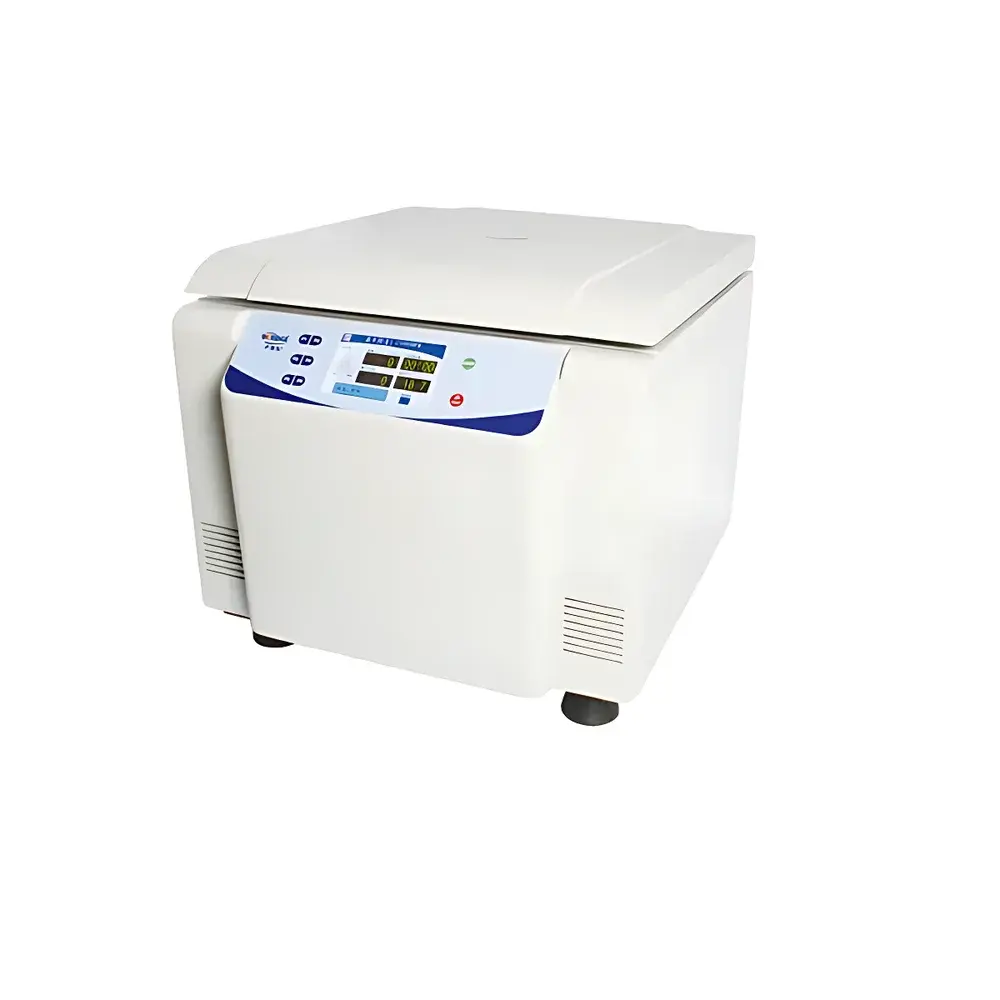
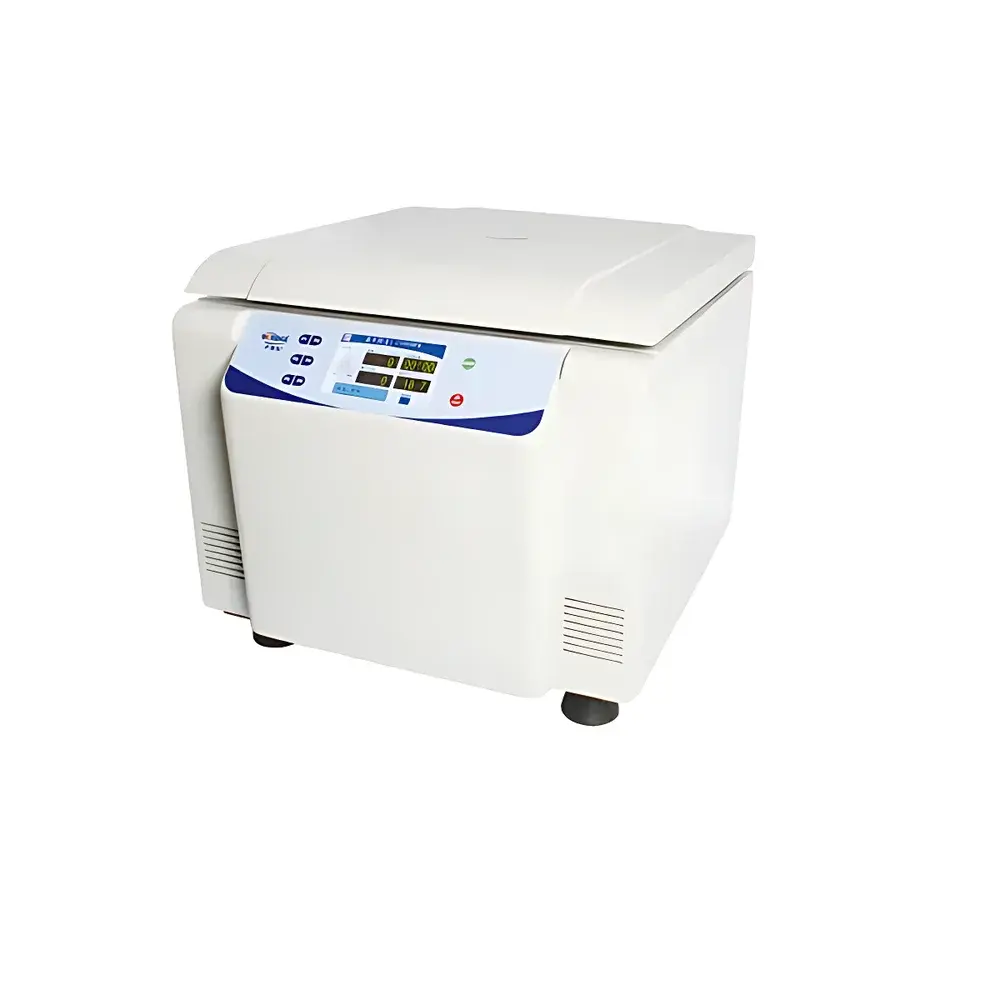
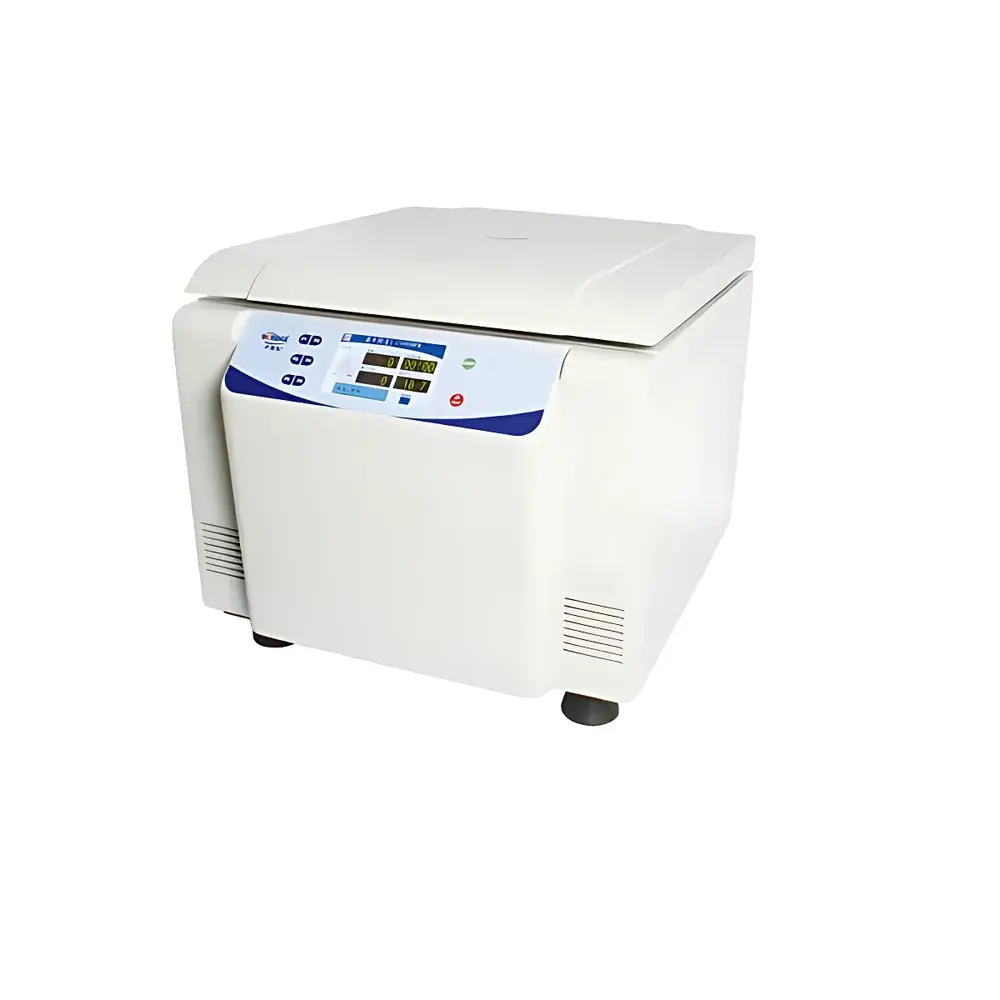
BIORIDGE TG21 Benchtop High-Speed High-Capacity Centrifuge
| Brand | BIORIDGE |
|---|---|
| Origin | Shanghai, China |
| Instrument Type | Benchtop Centrifuge |
| Speed Range | 10,000–30,000 rpm (Max. 21,000 rpm) |
| Max. Capacity | 4 × 750 mL |
| Max. RCF | 30,642 × g |
| Dimensions (L×W×H) | 495 mm × 620 mm × 445 mm |
| Weight | 60 kg |
| Speed Accuracy | ±10 rpm |
| Time Range | 1 s–99 min 59 s / 1 min–99 h 59 min |
| Noise Level | <65 dB(A) |
| Power Supply | AC 220 V, 50 Hz |
| Power Consumption | 1.2 kW |
| Rotor Recognition | Yes |
| Safety Certifications | FDA Listed, GMP-Compliant Sealing (Food-Grade Silicone Elastomer) |
Overview
The BIORIDGE TG21 Benchtop High-Speed High-Capacity Centrifuge is engineered for precision separation of biological, clinical, and industrial samples requiring both high rotational speeds and large-volume throughput. Operating on the principle of sedimentation under controlled centrifugal force, the TG21 delivers reproducible separations across diverse sample types—from cell pellets and subcellular organelles to plasma fractions, microbial cultures, and polymer suspensions. Its maximum speed of 21,000 rpm and peak relative centrifugal force (RCF) of 30,642 × g enable rapid pelleting of microorganisms, viruses, and macromolecular complexes, while its 4 × 750 mL horizontal rotor configuration supports scalable batch processing without compromising rotor balance or thermal stability. Designed for integration into regulated laboratory environments, the TG21 features a robust cast-aluminum housing, brushless DC motor architecture, and active cooling management to maintain temperature consistency during extended runs.
Key Features
- High-resolution 7-inch full-color TFT touchscreen interface with simultaneous display of set parameters and real-time operational data (speed, RCF, time remaining, temperature, acceleration/deceleration curves)
- Extensive program memory: stores up to 5,000 historical run records with timestamp, rotor ID, speed, time, temperature, and fault logs; USB port enables secure export of audit-ready CSV files
- Advanced programmability: user-definable multi-step protocols (up to 99 programs, each with up to 10 sequential segments), supporting gradient centrifugation, density cushioning, and staged pelleting workflows
- Intelligent rotor recognition system automatically detects installed rotor type and enforces speed/RCF limits—preventing unsafe parameter entry and ensuring compliance with ISO 21501-4 and IEC 61010-2-020 safety directives
- Multi-level access control: three-tier password protection (operator, supervisor, administrator) aligning with GLP/GMP documentation requirements and FDA 21 CFR Part 11 electronic record integrity guidelines
- Comprehensive safety architecture: lid interlock with mechanical and magnetic sensors, automatic imbalance detection (<0.5 mm displacement threshold), overspeed cutoff, and emergency deceleration braking
- GMP-compliant sealing: food-grade silicone elastomer door gasket certified per USP Class VI biocompatibility standards
Sample Compatibility & Compliance
The TG21 accommodates a broad spectrum of sample containers—including conical tubes (1.5–50 mL), round-bottom and conical centrifuge bottles (50–500 mL), microplates (96-well), and specialized assay tubes (vacutainers, RIA tubes, ELISA plates)—via 12 interchangeable rotors (6 angular, 6 swing-out). All rotors are dynamically balanced per ISO 1940-1 Grade G2.5 and validated for repeated sterilization (autoclave at 121°C, 20 min). The instrument complies with FDA-listed device registration (K-number on file), meets electromagnetic compatibility (EMC) requirements per EN 61326-1, and conforms to electrical safety standards IEC 61010-1 and UL 61010-1. Optional validation packages support IQ/OQ/PQ documentation for pharmaceutical QC labs operating under Annex 1 and USP analytical instrument qualification frameworks.
Software & Data Management
Embedded firmware supports traceable data governance through timestamped event logging, including rotor wear metrics, cumulative runtime, and thermal cycle history. Run data—including speed ramp profiles, deceleration curves, and error codes—is stored in non-volatile memory with write-protection against accidental overwrite. USB export functionality generates tamper-evident log files compatible with LIMS integration (e.g., LabWare, STARLIMS) and supports CSV-based import into statistical analysis platforms (JMP, Minitab). Audit trail metadata includes operator ID, session start/end times, parameter modifications, and system diagnostics—fully compliant with ALCOA+ principles (Attributable, Legible, Contemporaneous, Original, Accurate, Complete, Consistent, Enduring, Available).
Applications
- Biopharmaceutical downstream processing: clarification of monoclonal antibody harvests, virus-like particle (VLP) concentration, and plasmid DNA purification
- Clinical diagnostics: serum/plasma separation from whole blood (EDTA, heparin, citrate tubes), PBMC isolation, and exosome enrichment via differential ultracentrifugation
- Academic research: subcellular fractionation (mitochondria, lysosomes, nuclei), ribosome profiling, and nucleic acid clean-up prior to NGS library prep
- Industrial quality control: particle size distribution analysis of colloidal suspensions, catalyst recovery in fine chemical synthesis, and polymer latex stabilization testing
- Environmental microbiology: concentration of waterborne pathogens (Cryptosporidium, Giardia) from large-volume filtration eluates
FAQ
Does the TG21 meet FDA requirements for use in regulated manufacturing environments?
Yes—the instrument is FDA-listed as a Class II medical device (510(k)-exempt), incorporates hardware-locked audit trails, and supports 21 CFR Part 11-compliant electronic signatures when paired with validated third-party LIMS interfaces.
Can the TG21 be validated for GMP production use?
Absolutely. Full IQ/OQ documentation templates, calibration certificates traceable to NIST standards, and performance verification protocols (e.g., RCF accuracy per ASTM E2237, temperature uniformity per ISO 13485 Annex D) are available upon request.
What rotor configurations support high-speed pelleting of small-volume samples?
Rotor #1 (12 × 1.5/2.2 mL) achieves 21,000 rpm and 30,642 × g—ideal for RNA extraction, PCR cleanup, and proteomic digest desalting.
Is remote monitoring or network connectivity supported?
The base model operates standalone; however, optional Ethernet-enabled firmware (v3.2+) allows SNMP-based status polling and Syslog event forwarding for centralized lab infrastructure monitoring.
How is rotor lifetime managed and tracked?
Each rotor contains an embedded RFID tag storing serial number, manufacture date, and cumulative run hours. The TG21 firmware calculates remaining service life based on actual RCF exposure and alerts users at 85% duty-cycle threshold.



