
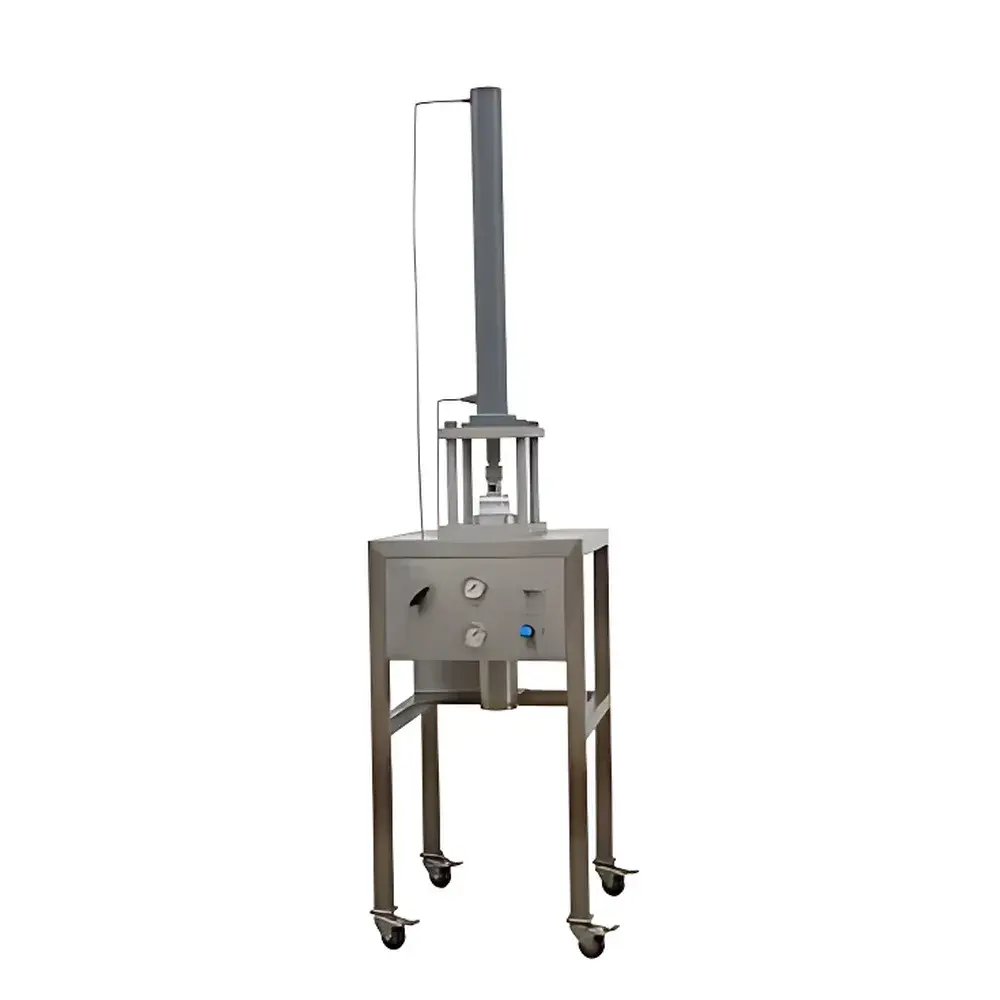
Bioseps BY-DAC100/150 Dynamic Axial Compression Column System
| Brand | Bioseps |
|---|---|
| Origin | Tianjin, China |
| Model | DAC100/150 (Single-Column Configuration) |
| Instrument Type | Dynamic Axial Compression (DAC) System |
| Sealing Technology | High-Pressure Spring-Energized PTFE-Coated O-Ring Seal |
| Column Connection | C-Clamp Quick-Release Bottom Endcap |
| Pressure Actuation | Hydraulic Jack with Pneumatic Control Option for Hazardous Environments |
Overview
The Bioseps BY-DAC100/150 is a precision-engineered dynamic axial compression (DAC) column system designed for scalable preparative chromatography applications ranging from laboratory development to pilot-scale purification. Unlike static or floating-piston compression methods—whose pressure uniformity degrades significantly above 100 mm internal diameter—the BY-DAC100/150 employs a hydraulically actuated piston mechanism that continuously adjusts axial force during operation to maintain constant, uniform bed pressure across the entire stationary phase volume. This real-time pressure regulation mitigates radial channeling, bed settling, and void formation—key contributors to peak broadening and resolution loss in large-diameter columns. The system operates on the fundamental principle of controlled mechanical compression: a servo-regulated hydraulic jack applies programmable force to the upper plunger, while a compliant spring-energized sealing assembly compensates for minor thermal or volumetric shifts in the packed bed. This architecture ensures long-term column stability under repeated loading cycles, making it suitable for GMP-aligned purification workflows where batch-to-batch reproducibility is critical.
Key Features
- Hydraulic piston drive with closed-loop pressure feedback, enabling precise and repeatable axial force application (range optimized for 100–150 mm i.d. columns)
- Zero-leakage sealing system combining spring-energized backup rings with PTFE-coated O-rings—validated per ISO 15848-1 for fugitive emission control under sustained 10–30 bar operating pressures
- Patented liquid distribution manifold with radially symmetric flow path geometry, minimizing wall effects and improving peak symmetry (Asymmetry Factor < 1.2 at 10% peak height for standard test probes)
- C-clamp quick-release bottom endcap interface—enabling tool-free column disassembly in under 90 seconds without torque calibration or gasket replacement
- Dual-mode actuation: standard hydraulic control with optional pneumatic override for Class I, Division 1 hazardous environments (ATEX-compliant air supply interface available)
- Stainless steel 316L wetted parts conforming to ASTM A276 and ASME BPE-2022 surface finish standards (Ra ≤ 0.4 µm)
Sample Compatibility & Compliance
The BY-DAC100/150 supports a broad range of stationary phases—including silica-based, polymer-based, and hybrid resins—with particle sizes from 5 µm to 100 µm and bed heights up to 600 mm. Its pressure-stable architecture accommodates both low-viscosity mobile phases (e.g., hexane/isopropanol) and high-viscosity systems (e.g., aqueous glycerol or polysaccharide-rich eluents) without compromising packing integrity. The system meets structural requirements outlined in USP <621> for preparative chromatographic columns and aligns with ISO 21501-4 for mechanical stability assessment of compression systems. When integrated with validated process analytical technology (PAT) platforms, it supports data integrity compliance under FDA 21 CFR Part 11 via electronic audit trail logging of compression force, duration, and cycle count.
Software & Data Management
While the BY-DAC100/150 operates as a standalone hardware module, its hydraulic control unit includes analog/digital I/O ports compatible with third-party SCADA and LIMS interfaces (Modbus RTU/TCP, OPC UA). Force calibration certificates are traceable to NIST standards and include full uncertainty budgets. All compression events—including initial packing, re-compression after solvent swelling, and post-run relaxation—are timestamped and exportable in CSV/Excel format. Optional firmware upgrade enables integration with Bioseps’ ChromaLog™ suite for automated method transfer between analytical, semi-preparative, and preparative scales—supporting QbD-driven process development per ICH Q5 and Q8 guidelines.
Applications
- Purification of monoclonal antibodies (mAbs) and Fc-fusion proteins using Protein A or multimodal resins
- Chiral separation of pharmaceutical intermediates on cellulose- or amylose-derived CSPs
- Downstream processing of oligonucleotides and mRNA-LNPs requiring low-shear, high-resolution fractionation
- Natural product isolation (e.g., terpenoids, alkaloids) from crude botanical extracts
- Scale-up studies bridging UHPLC method development to 150 mm i.d. production columns
FAQ
What is the maximum recommended operating pressure for the BY-DAC100/150 system?
The system is rated for continuous operation at up to 30 bar (435 psi), with short-term surge tolerance to 35 bar—validated per ASME B31.3 process piping design criteria.
Can the DAC100/150 be retrofitted to existing preparative HPLC systems?
Yes—its standardized 1/2″ NPT and ISO-KF 40 interfaces allow direct integration with most commercial preparative pumps and fraction collectors; electrical and pressure signal protocols are documented in the Integration Manual v3.2.
Does the system support automated column regeneration protocols?
While not autonomous, the hydraulic controller accepts external TTL triggers to initiate pre-programmed compression/decompression sequences synchronized with pump flow rate and UV absorbance thresholds.
Is validation documentation provided for GMP use?
A complete DQ/IQ/OQ protocol package—including risk assessment (ICH Q9), sensor calibration records, and material certifications—is supplied with each unit and updated annually per ISO 13485:2016 requirements.




