
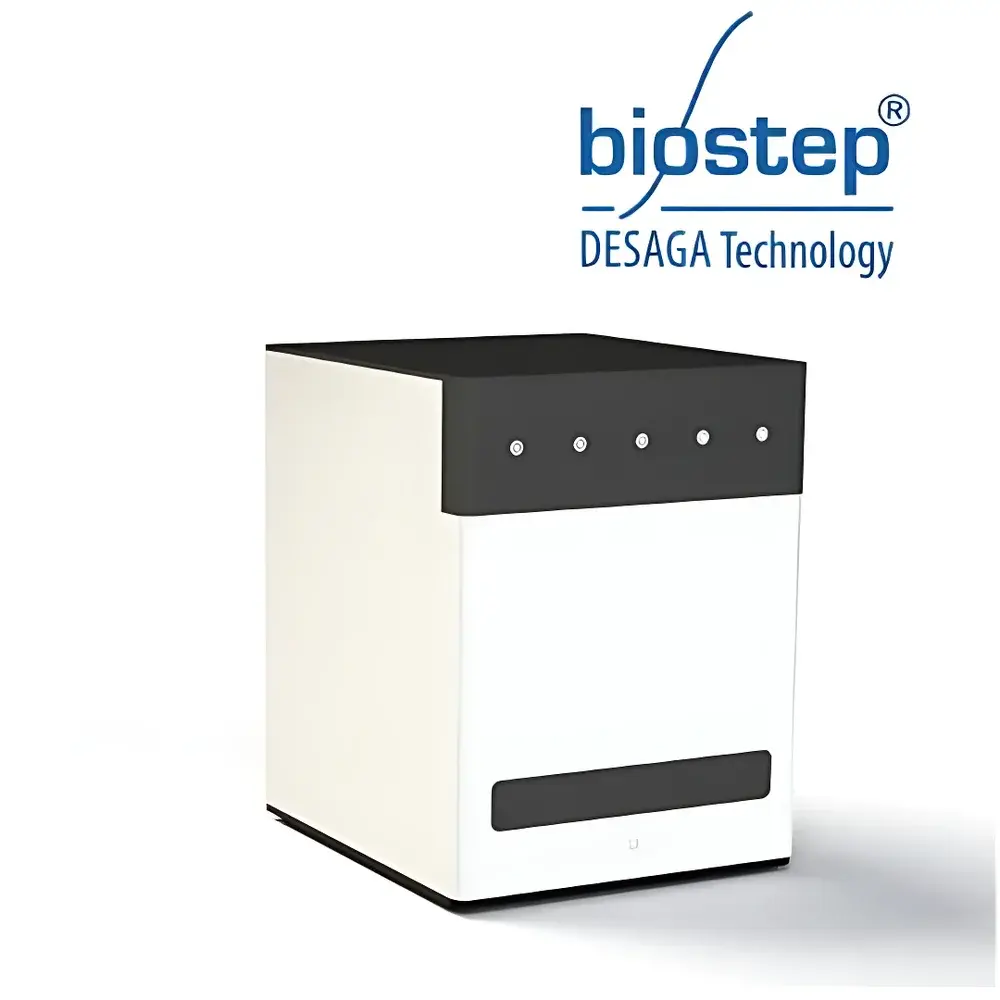
Biostep DD80 HPTLC Densitometer with Integrated TLC Imaging System
| Brand | Biostep |
|---|---|
| Origin | Germany |
| Model | DD80 |
| Instrument Type | Automated TLC Imaging & Densitometry System |
| Operation Mode | Fully Automatic |
| Detection Mode | Low-Fluorescence Substance Imaging |
| Wavelength Options | 254 nm and 366 nm UV |
| Light Sources | White LED, UV Fluorescent Lamps, UV LEDs |
| Imaging Sensor | 24-Megapixel Full-HD Digital Camera |
| Spectral Bandwidth Management | Auto Background Correction & Real-Time Image Optimization |
| Wavelength Accuracy | ±0.1 nm |
| Wavelength Repeatability | ±0.1 nm |
| Spatial Resolution | 7560-pixel RGB + IR Photometric Detection System |
| Focusing Mechanism | 19-Point Cross-Hair Autofocus Array |
| Stage Dimensions | 400 × 500 × 440 mm (W × D × H) |
| Frame Rate | 50 fps Continuous Capture |
Overview
The Biostep DD80 HPTLC Densitometer is a high-precision, fully automated thin-layer chromatography (TLC) imaging and densitometric analysis system engineered for quantitative and qualitative analysis of separated compounds on silica gel, cellulose, or aluminum-backed plates. Based on the legacy of DESAGA—the pioneer that introduced the world’s first commercial TLC scanner in the 1950s—the DD80 integrates decades of chromatographic instrumentation expertise with modern digital imaging architecture. It operates on reflectance/fluorescence densitometry principles, utilizing calibrated UV and visible illumination to excite analytes and capture high-fidelity spectral responses across defined wavelengths (254 nm and 366 nm). The system is designed for compliance-driven laboratories requiring traceable, auditable, and reproducible analytical workflows—particularly in herbal medicine authentication, food adulterant screening, forensic toxicology, and pharmaceutical QC.
Key Features
- Fully automated operation with integrated motorized stage, programmable illumination sequencing, and real-time autofocus via a 19-point cross-hair detection array
- Dual-wavelength UV excitation (254 nm and 366 nm) combined with white-light LED illumination, all housed in a light-tight chamber with patented lamp geometry to eliminate stray light and ensure uniform irradiance across the entire plate surface
- 24-megapixel full-HD digital camera with RGB + infrared photometric sensing capability, enabling simultaneous colorimetric fidelity and low-signal fluorescence quantification
- Real-time spectral bandwidth optimization: automatic background subtraction, dynamic contrast enhancement, and pixel-level noise suppression to maximize signal-to-noise ratio for weakly fluorescent or non-fluorescent analytes
- High-speed acquisition at 50 frames per second, supporting time-resolved imaging sequences and rapid multi-plate throughput
- Modular hardware architecture compatible with standard HPTLC plates (up to 20 × 20 cm), pre-coated silica, reversed-phase, and chiral layers
Sample Compatibility & Compliance
The DD80 supports a broad range of sample matrices including botanical extracts, herbal powders, dietary supplements, cosmetic formulations, food additives, forensic swabs, and pharmaceutical intermediates. Its optical design accommodates both native fluorescence and derivatization-enhanced detection (e.g., anisaldehyde, sulfuric acid charring). All hardware and software components conform to ISO/IEC 17025 requirements for testing laboratories. Data integrity is maintained through full 21 CFR Part 11 compliance—including electronic signatures, role-based three-tier user permissions (Administrator/Operator/Reviewer), immutable audit trails, and timestamped metadata logging for every image acquisition event. System validation packages support IQ/OQ protocols aligned with GMP and GLP regulatory frameworks.
Software & Data Management
The proprietary Biostep VisionScan™ software provides end-to-end control—from plate loading and illumination selection to Rf calculation, spot integration, calibration curve generation, and statistical reporting. Each acquired image retains embedded EXIF metadata: date/time stamp, operator ID, instrument serial number, exposure parameters, wavelength setting, and stage position. Users may annotate images with customizable fonts, overlay reference standards, perform side-by-side comparative analysis, and export annotated TIFF/PNG files alongside CSV-formatted densitometric data. All raw and processed data are stored in encrypted SQLite databases with optional network backup and version-controlled archiving. Software updates follow a documented change-control process compliant with FDA and EMA guidance on computerized system validation.
Applications
- Authentication and fingerprint profiling of Traditional Chinese Medicines (TCMs), herbal decoctions, and standardized botanical extracts
- Residual solvent and pesticide residue screening in food and feed matrices per AOAC and EU Commission Regulation methodologies
- Stability-indicating assays for pharmaceutical dosage forms under ICH Q1–Q5 guidelines
- Protein and nucleic acid band quantification in SDS-PAGE and 2D electrophoresis gels
- Forensic drug identification and impurity mapping in seized substances
- Quality control of cosmetic actives and preservatives in emulsions and serums
- Chemical reaction monitoring and purification tracking during synthetic chemistry workflows
FAQ
Does the DD80 support custom wavelength filters beyond 254 nm and 366 nm?
Yes—optional narrow-band interference filters (e.g., 280 nm, 312 nm, 405 nm) can be installed to extend spectral flexibility for specialized applications such as amino acid detection or post-derivatization analysis.
Can the system interface with LIMS or ELN platforms?
The VisionScan™ software includes configurable ODBC and REST API endpoints for bidirectional data exchange with laboratory information management systems (LIMS) and electronic lab notebooks (ELN), supporting HL7 and ASTM E1384 message formats.
Is hardware calibration traceable to NIST standards?
Yes—wavelength accuracy and intensity linearity are verified using NIST-traceable holmium oxide and neutral density reference standards; calibration certificates are issued upon installation and annually during preventive maintenance.
What plate sizes and backing materials are supported?
Standard support includes 5 × 10 cm, 10 × 10 cm, 10 × 20 cm, and 20 × 20 cm plates on glass, aluminum, or polyester backing; flexible stage clamping accommodates uneven or warped substrates without mechanical stress.
How is data security enforced during remote access or multi-user operation?
All network communications use TLS 1.2+ encryption; local database access requires Windows Active Directory integration or PKI-based smart card authentication; session timeouts and automatic lockout after failed login attempts are configurable per user role.



