
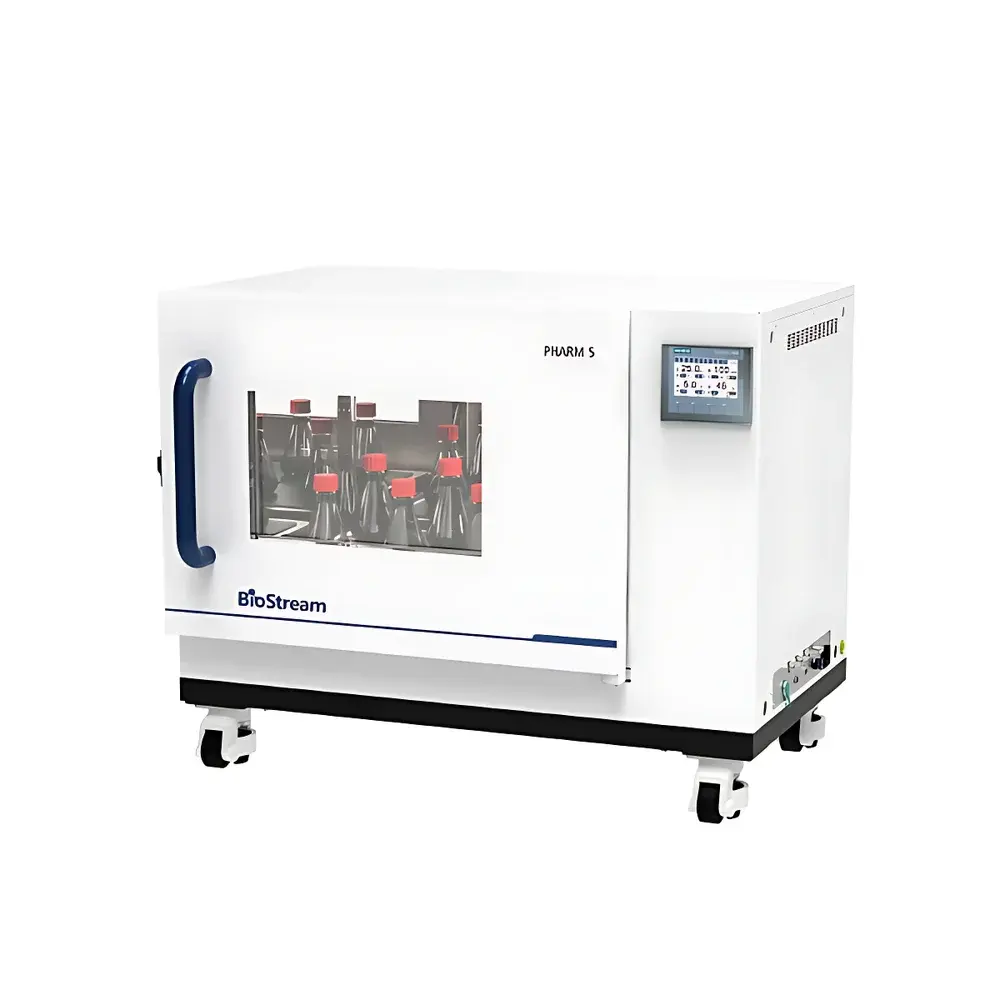
Biostream Pharm 5 Shaking Incubator
| Brand | Biostream |
|---|---|
| Origin | Netherlands |
| Model | Pharm 5 |
| Chamber Material | SS316 Stainless Steel |
| Temperature Uniformity | ±0.2°C |
| Temperature Stability | ±0.1°C |
| CO₂ Control Range | 0–20% (±1% FS) |
| Humidity Control | Direct Clean Steam Generation via 140°C SS316L Heating Plate |
| O₃ Monitoring Range | 0–100 ppm (±2% FS) |
| O₃ Generation | 4–8 g/h |
| Max Load Capacity | 35 kg per Shelf |
| Amplitude Options | 25 mm / 50 mm (microbial), 3 mm (96-well) |
| Rotation Speed Range | 20–1,000 rpm |
| Communication Protocols | RS485, RJ45 (Modbus TCP/IP), USB |
| Compliance | Designed for GMP environments, supports GLP audit trails, ozone & UV sterilization validation |
Overview
The Biostream Pharm 5 Shaking Incubator is an engineered platform for regulated bioprocess development and GMP-aligned cell and microbial cultivation. It integrates precise environmental control—temperature, CO₂, humidity, O₃, UV, and programmable illumination—with robust mechanical oscillation in a fully sealed, cleanable stainless-steel architecture. Its measurement and control architecture follows core principles of bioreactor-grade process consistency: temperature regulation employs PID algorithms with dynamic air recirculation to eliminate thermal gradients; CO₂ concentration is monitored via non-dispersive infrared (NDIR) sensing and maintained through proportional solenoid dosing; humidity is delivered as sterile molecular water vapor generated at 140°C on a passivated SS316L heating surface—eliminating condensation, biofilm formation, and reservoir-based contamination pathways. The unit operates under low-voltage magnetic drive technology, ensuring zero heat leakage into the chamber and enabling stable thermal performance even during extended high-speed shaking (up to 1,000 rpm). Designed for pharmaceutical R&D and QC laboratories, the Pharm 5 conforms to foundational requirements of ISO 13485, EU Annex 1 (for aseptic processing support), and USP <1043> for cell culture equipment qualification.
Key Features
- SS316 stainless-steel inner chamber with radius-rounded corners and seamless welds—validated for autoclave compatibility, ozone resistance (≤100 ppm), and chemical decontamination (e.g., hydrogen peroxide vapor, quaternary ammonium solutions).
- Double-layer security architecture: electronic access lock (requires RPM <20 and system confirmation before door release) + mechanical key lock (positioned centrally on left door panel).
- Siemens SIMATIC S7-1200 PLC with 7-inch capacitive touchscreen interface—displays real-time temperature, CO₂, humidity, O₃, and optional O₂ or UV dose metrics; humidity view toggles to O₂/O₃ concentration mode.
- Modular environmental control units: direct steam humidification, NDIR-based CO₂ module, UV-C germicidal irradiation (254 nm), electrochemical O₃ sensor + generator (4–8 g/h), and LED photobioreactor kit (0–200 µmol·m⁻²·s⁻¹, programmable diurnal cycles).
- Patented vibration platform: adhesive silicone-coated tray (no clamps required), full-extension rails with auto-locking mechanism, and load-rated bearings supporting up to 35 kg; compatible with 96-well plates, deep-well blocks, Erlenmeyer flasks (up to 5 L), and microcarrier suspension vessels.
- IP54-rated external enclosure with waterproof base pan—allows direct aqueous cleaning of floor surfaces without electrical risk; all moisture-sensitive electronics are externally mounted.
Sample Compatibility & Compliance
The Pharm 5 accommodates diverse sample formats under physiologically relevant conditions: mammalian cells (with CO₂ + humidification + UV pre-cycle), aerobic/anaerobic microbes (25/50 mm amplitude, 50–300 rpm), photosynthetic cultures (LED spectral tuning), and high-throughput screening (7,000+ parallel wells using 3 mm amplitude at 1,000 rpm). All wetted surfaces—including humidifier reservoir (5 L autoclavable bottle), gas filtration housings, and O₃ delivery tubing—are constructed from SS316L or PTFE and certified for repeated sterilization (121°C, 20 min). The system supports IQ/OQ documentation packages aligned with FDA 21 CFR Part 11 (electronic records/signatures), including audit-trail-enabled parameter logging (60-day onboard buffer, exportable via USB), time-stamped alarm history, and user-level permission management (admin/operator/guest tiers). Ozone sterilization cycles include automatic post-cycle decay monitoring with door interlock release only after O₃ falls below 0.1 ppm (OSHA PEL threshold).
Software & Data Management
Data integrity is maintained through embedded deterministic logging: all sensor inputs, setpoints, alarms, and user actions are timestamped and stored locally with cyclic overwrite protection. Raw data exports are CSV-formatted and include metadata (operator ID, protocol name, chamber ID, firmware version). Remote monitoring is enabled via Modbus TCP over Ethernet (RJ45), allowing integration into LabVantage, STARLIMS, or custom SCADA systems. USB port supports firmware updates and encrypted backup of calibration certificates, sensor drift logs, and maintenance records. The controller firmware includes built-in diagnostics for heater element resistance, motor current draw, CO₂ sensor baseline drift, and O₃ sensor zero stability—each accessible via service menu with traceable calibration due dates.
Applications
- Monoclonal antibody production: CHO and HEK293 suspension cultures under controlled pH (via CO₂ buffering), low-shear agitation (3 mm amplitude), and sterile humidification—reducing evaporation-induced osmolarity shifts.
- Microbial strain optimization: high-aeration bacterial fermentations (E. coli, Pseudomonas) using 50 mm amplitude at 250 rpm with real-time dissolved O₂ estimation via headspace O₂ monitoring.
- Stem cell expansion: static + shaking hybrid protocols using removable static shelves—enabling side-by-side comparison of adherent vs. suspension growth under identical environmental setpoints.
- Photomorphogenesis studies: LED spectral profiles (blue/red/far-red ratios) combined with circadian timing modules to replicate greenhouse light regimes for plant tissue culture.
- Regulatory stability testing: ICH Q5C-compliant storage of biologics intermediates under defined temperature/humidity/CO₂ stress conditions with full parameter traceability.
FAQ
Does the Pharm 5 support 21 CFR Part 11 compliance?
Yes—the system provides electronic signature capability, role-based access control, immutable audit trails, and calibrated parameter logging with operator attribution. Full validation documentation (IQ/OQ/PQ templates) is available upon request.
Can the humidification system be validated for sterility?
Yes—the stainless-steel steam generator plate operates at 140°C, achieving ≥6-log microbial reduction per EN 17178. The entire humidification train (reservoir, tubing, diffuser) is autoclavable and supports VHP cycle mapping.
What is the maximum allowable load for 96-well plate operation?
Up to 18 standard 96-well plates per shelf when used with the sterile isolation humidification box (evaporation rate <0.3% per 24 h at 37°C/95% RH).
Is ozone generation integrated or external?
Ozone is generated internally via corona discharge using medical-grade oxygen feed (1–3 L/min); the SS316L electrode and PTFE gas path ensure long-term corrosion resistance and consistent output (4–8 g/h).
How is temperature uniformity verified across the chamber?
Uniformity is confirmed per ISO 15378 Annex D using 9-point thermocouple mapping (top/middle/bottom × front/center/back) under static and dynamic (500 rpm) conditions—results consistently meet ±0.2°C tolerance across full working volume.



