
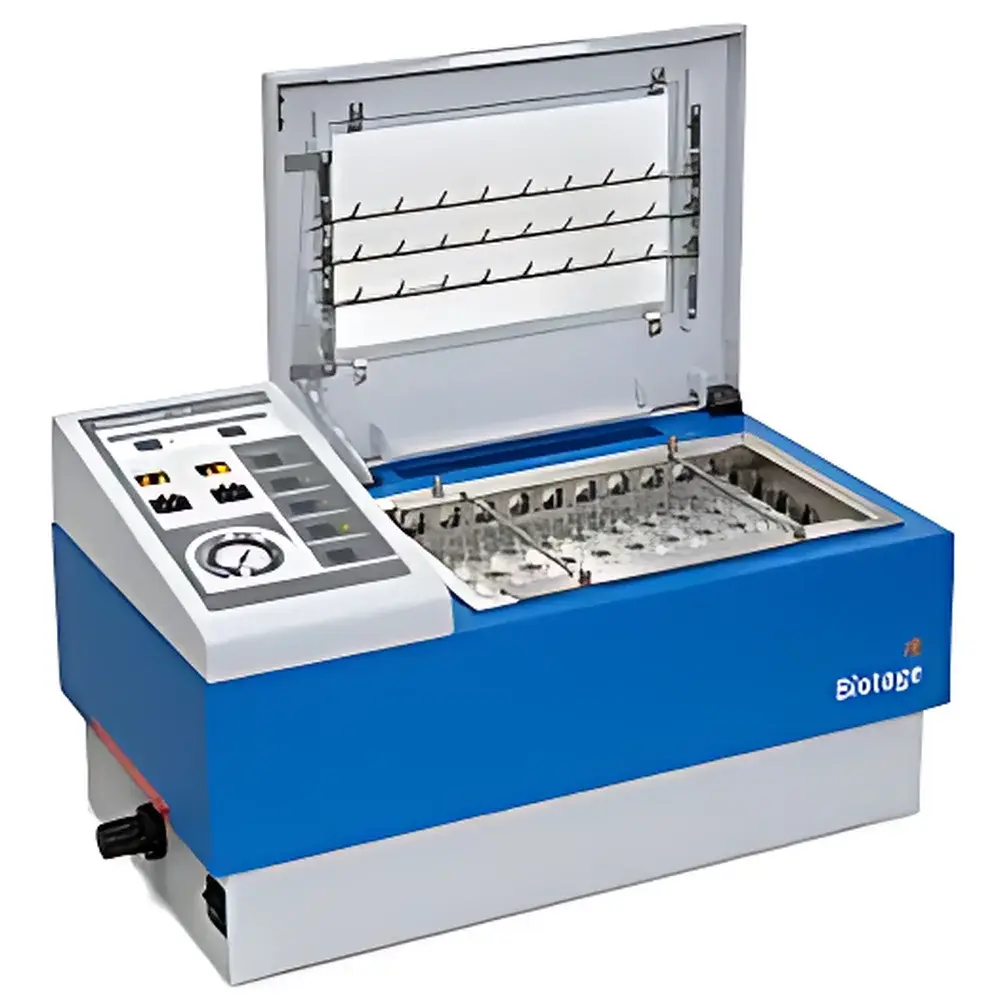
Biotage TurboVap LV Automated Nitrogen Evaporator
| Brand | Biotage |
|---|---|
| Origin | USA |
| Model | TurboVap LV |
| Type | Automated Nitrogen Evaporation System |
| Sample Capacity | Up to 50 samples per run |
| Tube Compatibility | 10×75 mm to 20×150 mm |
| Temperature Control Range | Ambient to 90 °C (±0.5 °C accuracy) |
| Gas Flow Control | Independent, digitally regulated nitrogen flow per position (0–20 L/min total) |
| Evaporation Endpoint Detection | Optical endpoint sensing (photoelectric detection of solvent meniscus) |
| Compliance | Designed for GLP/GMP environments |
Overview
The Biotage TurboVap LV Automated Nitrogen Evaporator is an engineered solution for precise, reproducible, and unattended concentration of small-volume liquid samples in analytical laboratories. It operates on the principle of controlled nitrogen gas dispersion—utilizing patented vortex gas delivery—to accelerate solvent evaporation while minimizing analyte degradation, oxidation, or foaming. Unlike vacuum-based concentrators, the TurboVap LV employs positive-pressure nitrogen flow directed tangentially across the sample surface, generating uniform turbulence that enhances mass transfer without requiring vacuum pumps, chillers, or cold traps. Its compact footprint (38 × 33 × 43 cm) eliminates dependency on fume hood space, making it suitable for benchtop deployment in QC, environmental, forensic, and pharmaceutical labs where workflow density and safety are critical.
Key Features
- Patented vortex gas delivery system ensures consistent, laminar nitrogen flow across each sample vial—reducing channeling, splashing, and cross-contamination.
- Digital, per-position gas flow regulation enables method-specific optimization for diverse solvents (e.g., dichloromethane, hexane/ethyl acetate blends, methanol/water mixtures) and analyte classes (e.g., pesticides, PAHs, pharmaceuticals).
- Optical endpoint detection provides real-time meniscus monitoring; automatically terminates gas flow upon solvent depletion—preserving sample integrity and eliminating over-evaporation.
- Programmable temperature-controlled water bath (ambient to 90 °C, ±0.5 °C stability) with rapid thermal response and uniform heat distribution across all positions.
- Modular rack system supports six interchangeable tube formats—from 10×75 mm (4 mL capacity) to 20×150 mm (30 mL capacity)—enabling seamless transition between extraction, cleanup, and concentration workflows.
- Integrated audible alarm and status LED signaling confirm endpoint completion; optional Ethernet/USB connectivity allows remote monitoring and audit-trail logging via Biotage Instrument Manager software.
Sample Compatibility & Compliance
The TurboVap LV accommodates standard borosilicate glass and polypropylene tubes, including conical-bottom and microcentrifuge variants (with compatible accessory racks). It is validated for use with common organic solvents—including chlorinated, aliphatic, and polar aprotic systems—and demonstrates high analyte recovery (>95%) for thermolabile compounds such as organophosphates and glucuronide conjugates under optimized conditions (e.g., 40 °C, 5–9 min evaporation for 2 mL aliquots in 16×100 mm tubes). The system conforms to ASTM D5845-22 (determination of volatile organic compounds in water), ISO 17025:2017 documentation requirements, and supports alignment with FDA 21 CFR Part 11 when paired with compliant software and access controls. Its closed-loop exhaust design—routing vapors through a 3-meter duct to external venting—meets OSHA PEL and ACGIH TLV exposure limits for laboratory nitrogen and solvent handling.
Software & Data Management
While the TurboVap LV operates as a standalone instrument with intuitive front-panel controls, its full traceability potential is realized through integration with Biotage Instrument Manager—a validated, Windows-based application supporting multi-user authentication, electronic signatures, and configurable audit trails. The software records time-stamped events including method parameters (temperature setpoint, gas flow rate, duration), endpoint detection timestamps, operator ID, and system diagnostics. All data are stored in encrypted SQLite databases compliant with ALCOA+ principles (Attributable, Legible, Contemporaneous, Original, Accurate, Complete, Consistent, Enduring, Available), facilitating internal audits and regulatory inspections under GLP and GMP frameworks.
Applications
The TurboVap LV is routinely deployed in regulated and research settings for sample preparation prior to GC-MS, LC-MS/MS, HPLC-UV, and ICP-MS analysis. Key use cases include: pesticide residue analysis in food matrices (AOAC 2007.01); pharmaceutical impurity profiling per ICH Q2(R2); environmental monitoring of PFAS and PCBs in wastewater (EPA Method 1613/8270); forensic toxicology screening of blood and urine extracts; and clinical biomarker quantification in plasma and CSF. Its ability to process up to 50 samples in parallel—without manual intervention—significantly reduces hands-on time and inter-operator variability, directly contributing to improved inter-laboratory reproducibility and reduced cost-per-sample.
FAQ
What types of solvents are compatible with the TurboVap LV?
The system is validated for use with low-boiling organic solvents (e.g., dichloromethane, ethyl acetate, hexane, acetonitrile) and aqueous-organic mixtures (e.g., methanol/water, IPA/water). High-boiling solvents (e.g., DMSO, glycerol) are not recommended due to extended evaporation times and potential thermal stress.
Can the TurboVap LV be used under inert atmosphere conditions?
Yes—the instrument uses nitrogen as the primary purge gas; argon or other inert gases may be substituted provided pressure and flow specifications are maintained and gas purity meets ISO 8573-1 Class 2 requirements.
Is optical endpoint detection affected by colored or turbid samples?
The photoelectric sensor is calibrated for clear-to-moderately hazy solutions. Strongly pigmented or particulate-laden samples may require method adjustment (e.g., reduced light sensitivity setting or manual endpoint override) to ensure reliable detection.
Does the TurboVap LV require routine calibration?
Temperature calibration is recommended annually using NIST-traceable reference thermometers; gas flow verification can be performed with a certified mass flow meter at installation and after major maintenance.
How is solvent vapor safely managed during operation?
Evaporated vapors are continuously extracted via integrated fan-driven exhaust and routed through the supplied 3-meter duct to an externally vented fume hood or dedicated lab exhaust manifold—ensuring compliance with local occupational health and safety regulations.
Related Products



