
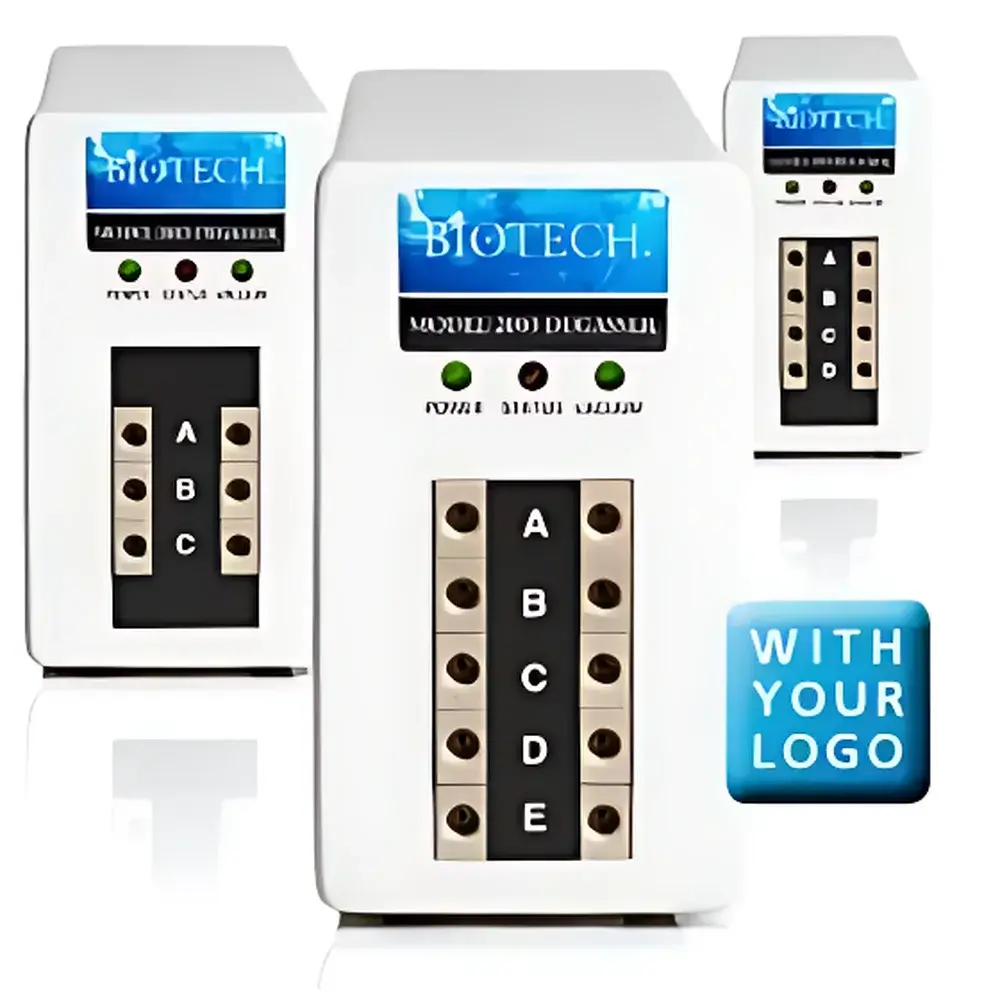
Biotech Sweden Vacuum Degasser Model 2003
| Origin | Sweden |
|---|---|
| Manufacturer Type | Authorized Distributor |
| Origin Category | Imported |
| Model | 2003 |
| Price | USD 4,200 (FOB) |
Overview
The Biotech Sweden Vacuum Degasser Model 2003 is an inline solvent degassing system engineered for high-performance liquid chromatography (HPLC) and ultra-high-performance liquid chromatography (UHPLC) applications. It operates on the principle of vacuum-mediated membrane degassing—utilizing a patented Systec AF hydrophobic fluoropolymer membrane to selectively remove dissolved gases (O₂, N₂, CO₂) from mobile phase solvents without solvent loss or contamination. Unlike traditional sparging or helium-purging methods, this technology ensures continuous, stable degassing under dynamic flow conditions, directly contributing to baseline stability, reduced detector noise (particularly in UV-Vis and fluorescence detection), and improved retention time reproducibility. Designed specifically for integration into analytical and preparative HPLC workflows, the Model 2003 meets the stringent requirements of regulated environments including pharmaceutical QC labs operating under GLP and GMP frameworks.
Key Features
- Patented Systec AF microporous membrane with 480 µL internal wetted volume—minimizes hold-up, reduces gradient delay, and enables rapid solvent switching.
- ZHCR (Zero-Hysteresis Constant Rotation) stepper motor-driven vacuum pump—eliminates pulsation-induced vacuum fluctuations, ensuring flat UV baselines even during gradient elution.
- Closed-loop vacuum control system—maintains set vacuum level (typically –85 to –95 kPa) independent of pump speed or ambient temperature variation.
- Ultra-low acoustic emission (<28 dB[A])—suitable for open-lab environments and ISO Class 5–7 cleanrooms.
- Self-diagnostic firmware with real-time leak detection and pre-failure alerting—supports predictive maintenance and audit-ready event logging.
- No purge valves or compressed gas required—reduces operational complexity and eliminates risk of back-pressure-induced column damage.
- PEEK and Systec AF contact materials—chemically inert toward common HPLC solvents (acetonitrile, methanol, water, TFA, ammonium acetate buffers) and compliant with USP Class VI biocompatibility standards.
Sample Compatibility & Compliance
The Model 2003 supports simultaneous degassing of 2–8 solvent channels (standard configuration: 4-channel), compatible with isocratic and multi-solvent gradient systems. It accepts standard 1/16″ OD PEEK tubing and integrates seamlessly with major HPLC platforms—including Waters, Agilent, Shimadzu, Thermo Fisher, and PerkinElmer—via OEM or aftermarket installation. The device conforms to IEC 61010-1 (Safety Requirements for Electrical Equipment for Measurement, Control, and Laboratory Use) and carries CE marking. Its firmware architecture supports 21 CFR Part 11-compliant data integrity features when operated with validated LIMS or CDS software (e.g., Empower, Chromeleon, OpenLab). All wetted components comply with ISO 10993-5 cytotoxicity testing and are free of leachable plasticizers or heavy metals.
Software & Data Management
While the Model 2003 operates as a standalone hardware module with no embedded touchscreen or local GUI, it provides RS-232 and optional Ethernet interfaces for remote status monitoring and control via host chromatography data systems (CDS). Vacuum pressure, pump RPM, error codes, and runtime hours are accessible through ASCII-based serial commands—enabling automated log capture, alarm escalation, and integration into lab-wide asset management databases. Audit trails generated by connected CDS platforms include timestamps, operator IDs, and parameter change history—fully traceable for FDA inspection readiness. Firmware updates are delivered via secure HTTPS download and require digital signature verification.
Applications
- Routine QC/QA of pharmaceutical actives and excipients per USP <621> and EP 2.2.46.
- Method development for LC-MS where oxygen scavenging improves ionization efficiency and reduces adduct formation.
- Stability-indicating assays requiring sub-0.5% RSD in peak area across 100+ injections.
- Trace-level environmental analysis (e.g., EPA Method 8330B) where dissolved O₂ causes oxidative degradation of analytes.
- Biopharmaceutical characterization workflows involving size-exclusion chromatography (SEC-HPLC) and ion-exchange chromatography (IEX), where bubble-induced flow interruption compromises column lifetime.
FAQ
Can the Model 2003 be retrofitted to legacy HPLC systems lacking built-in degassers?
Yes—its modular design and standard 1/16″ tubing ports allow direct integration upstream of the low-pressure mixing manifold or proportioning valve.
What is the expected service life of the Systec AF membrane under continuous operation?
Rated for ≥5 years at 25 °C and typical HPLC flow rates (0.2–5 mL/min); lifetime extends beyond 7 years when used with filtered, particulate-free solvents.
Does the degasser require periodic calibration or user-performed maintenance?
No routine calibration is needed; only annual visual inspection of tubing connections and optional membrane replacement after 5 years or upon observed baseline drift >2 mAU over 30 minutes.
Is the device compatible with aggressive solvents such as THF or chloroform?
THF is supported with caution (limited exposure duration); chloroform, DCM, and other halogenated solvents are not recommended due to potential membrane swelling and accelerated permeation decay.
How does the ZHCR pump differ from conventional diaphragm or rotary vane vacuum pumps?
ZHCR employs micro-stepped motor control with feedback-regulated torque delivery—ensuring constant angular velocity regardless of load variation, thereby eliminating vacuum ripple that manifests as 0.5–2 Hz oscillations in UV absorbance baselines.
Related Products



