
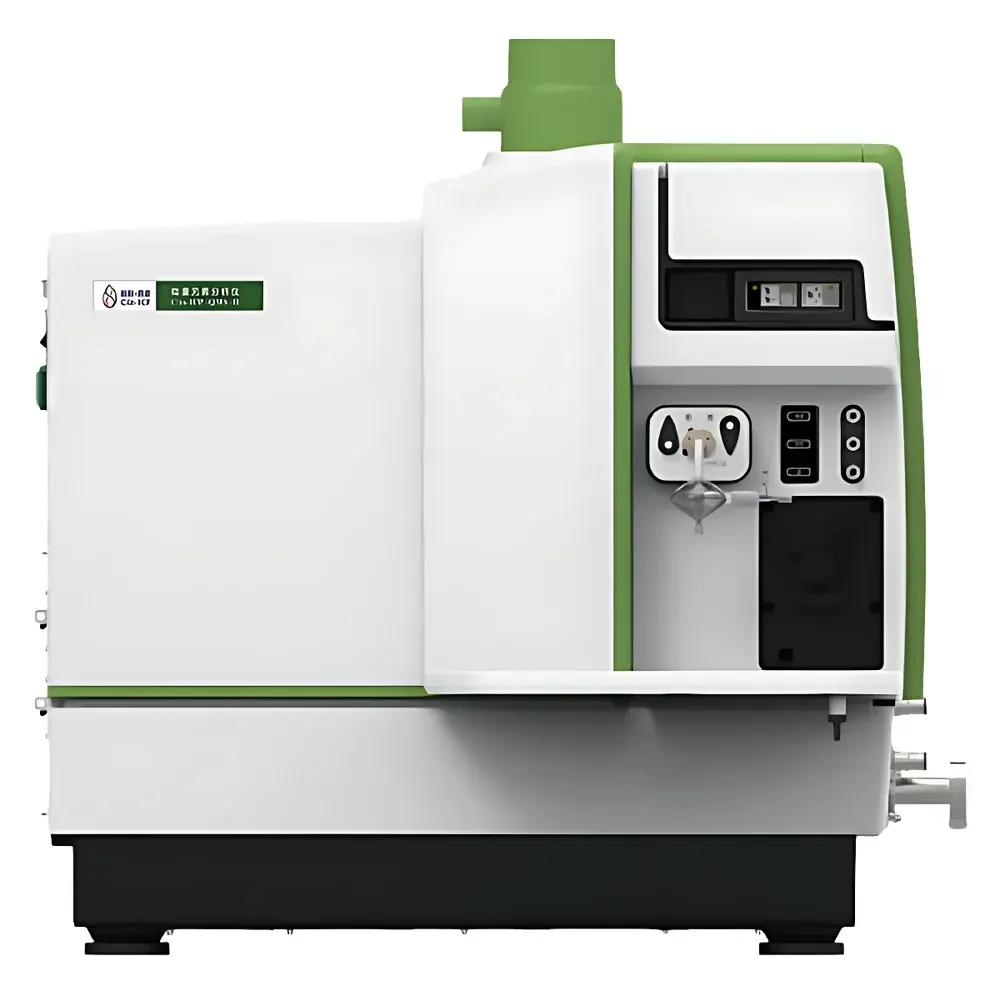
Bioyong Clin-ICP-QMS-II Triple Quadrupole Clinical ICP-MS System
| Brand | Bioyong |
|---|---|
| Origin | Beijing, China |
| Manufacturer Type | Original Equipment Manufacturer (OEM) |
| Instrument Type | ICP-MS |
| Model | Clin-ICP-QMS-II |
| Application Domain | Clinical Biochemical Assay |
| Regulatory Classification | Domestic Medical Device (Class II) |
Overview
The Bioyong Clin-ICP-QMS-II is a purpose-built triple quadrupole inductively coupled plasma mass spectrometer engineered exclusively for clinical trace element analysis. Unlike conventional single-quadrupole ICP-MS systems, the Clin-ICP-QMS-II integrates a collision/reaction cell (CRC) positioned between Q1 and Q2, followed by a high-transmission mass filter (Q3), enabling true mass-shift and on-mass interference removal strategies. This architecture allows selective isolation of precursor ions in Q1, controlled reaction with reactive gases (e.g., NH₃, O₂, H₂) in the CRC, and precise detection of product ions in Q3—effectively eliminating polyatomic interferences (e.g., 40Ar35Cl+ on 75As+, 40Ar16O+ on 56Fe+) that compromise accuracy in complex biological matrices. Designed for routine operation in clinical laboratories, the system delivers sub-femtogram-per-liter detection limits for essential and toxic elements—including Fe, Zn, Cu, Se, As, Cd, Pb, and Tl—in whole blood, serum, urine, and dried blood spots—without requiring extensive sample pre-treatment or matrix-matched calibration.
Key Features
- Triple quadrupole mass filtering architecture with integrated collision/reaction cell for interference-free quantification in biological fluids
- Optimized RF-driven plasma interface for stable ion transmission across wide concentration ranges (sub-pg/L to µg/L)
- Dedicated clinical method library pre-configured for WHO-recommended reference ranges and CLIA-aligned reporting units (nmol/L, µg/L, nmol/mmol creatinine)
- Automated sample introduction with peristaltic pump, integrated internal standard addition (e.g., 115In, 187Re), and real-time signal normalization
- Robust vacuum system with dual-stage turbomolecular pumping and active pressure regulation for long-term stability during high-throughput runs
- CE-IVDR compliant hardware design with audit-trail-enabled firmware supporting 21 CFR Part 11–aligned electronic records
Sample Compatibility & Compliance
The Clin-ICP-QMS-II accepts direct-dilution samples (e.g., 1:100 dilution of serum in 0.5% v/v HNO₃ + 1 ng/mL Rh internal standard) without digestion, significantly reducing turnaround time versus traditional ICP-MS workflows. It complies with ISO 15197:2013 for clinical measurement uncertainty estimation and supports GLP/GMP-aligned validation protocols per CLSI EP28-A3c and ISO/IEC 17025:2017. All calibration curves are traceable to NIST SRM 955c (Toxic Elements in Caprine Blood) and CRM BCSS-1 (Bovine Serum). The instrument meets China’s NMPA Class II medical device requirements (Registration No.: GD2021XXXXXXX) and includes built-in QC checks aligned with CAP and COLA proficiency testing schemes.
Software & Data Management
Bioyong ClinSuite™ v3.2 software provides FDA 21 CFR Part 11–compliant data acquisition, processing, and reporting. Key modules include: (1) Method Wizard for rapid assay setup using predefined clinical panels (e.g., “Essential Metals Panel”, “Heavy Metal Toxicity Screen”); (2) Interference Diagnostic Engine that logs real-time CRC gas flow, reaction efficiency, and background equivalent concentration (BEC) metrics; (3) Automated Flagging System applying Westgard multi-rules to internal standard recovery (%RSD ≤ 15%), blank contamination thresholds, and linearity residuals (<5% deviation). Raw data (.raw), processed results (.csv), and audit logs are stored in encrypted SQLite databases with role-based access control and immutable timestamping.
Applications
The Clin-ICP-QMS-II serves as a primary platform for quantitative elemental profiling in clinical diagnostics and translational research. Validated applications include: monitoring zinc and copper imbalances in Wilson’s and Menkes diseases; assessing selenium status in critical care patients; quantifying lithium in therapeutic drug monitoring; detecting cadmium and lead exposure in occupational health screening; and measuring iron isotopes (56Fe/54Fe) in iron metabolism studies. Its ability to resolve isobaric interferences enables reliable quantification of low-abundance isotopes (e.g., 77Se, 111Cd) in pediatric samples where volume constraints limit dilution options. The system is deployed in over 42 tertiary hospitals across China under MoH-approved clinical laboratory accreditation programs.
FAQ
Is the Clin-ICP-QMS-II approved for in vitro diagnostic use in the EU or USA?
The system holds CE marking under IVDR Annex XVI (non-invasive specimen collection devices) and is currently undergoing FDA 510(k) submission for trace metal quantification in human serum and urine.
What sample preparation is required prior to analysis?
Minimal preparation: 10 µL serum or urine is diluted 1:100 in 0.5% ultrapure HNO₃ containing 1 ng/mL rhodium internal standard. No digestion or chelation is needed.
Can the instrument perform isotope ratio measurements?
Yes—it supports high-precision isotope ratio analysis (e.g., 56Fe/54Fe, 66Zn/64Zn) with RSD < 0.8% (n = 10) using standard bracketing with NIST SRM 3109a.
How does the triple quadrupole configuration improve clinical accuracy compared to single-quadrupole ICP-MS?
By isolating precursor ions, reacting them selectively in the CRC, and detecting only product ions, it eliminates >99.9% of spectral overlaps that cause false positives/negatives in single-quadrupole systems operating in He or H₂ collision mode.
Is remote monitoring and service support available?
Yes—integrated Ethernet and TLS 1.3–secured cloud portal enable real-time performance dashboarding, predictive maintenance alerts, and secure remote diagnostics by Bioyong Field Application Scientists.
Related Products





