
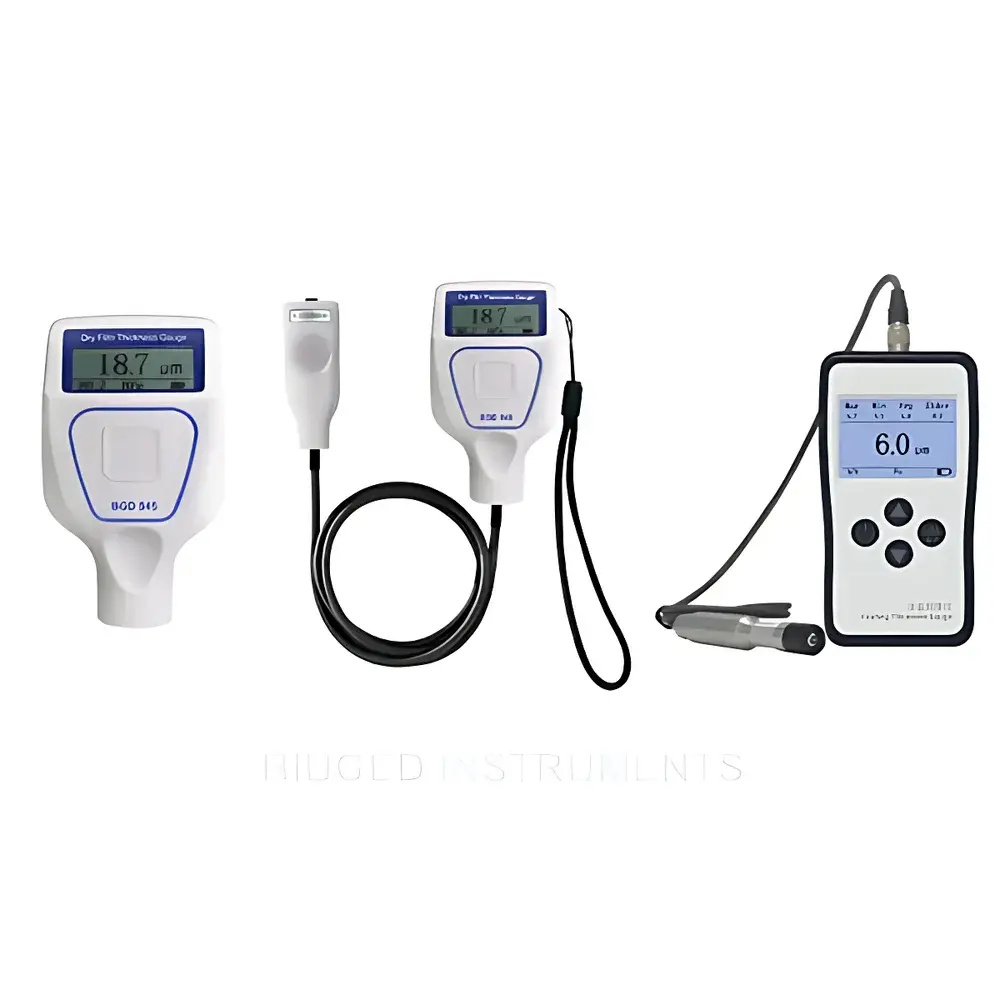
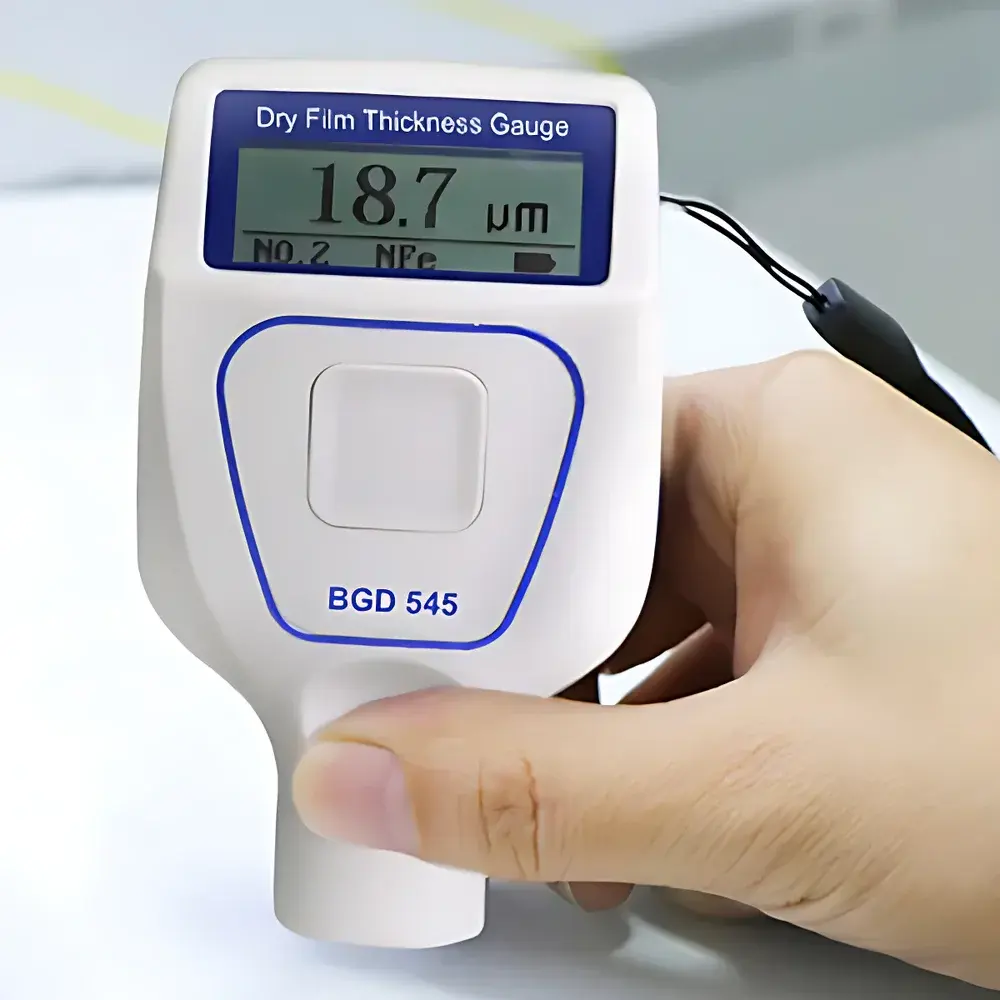
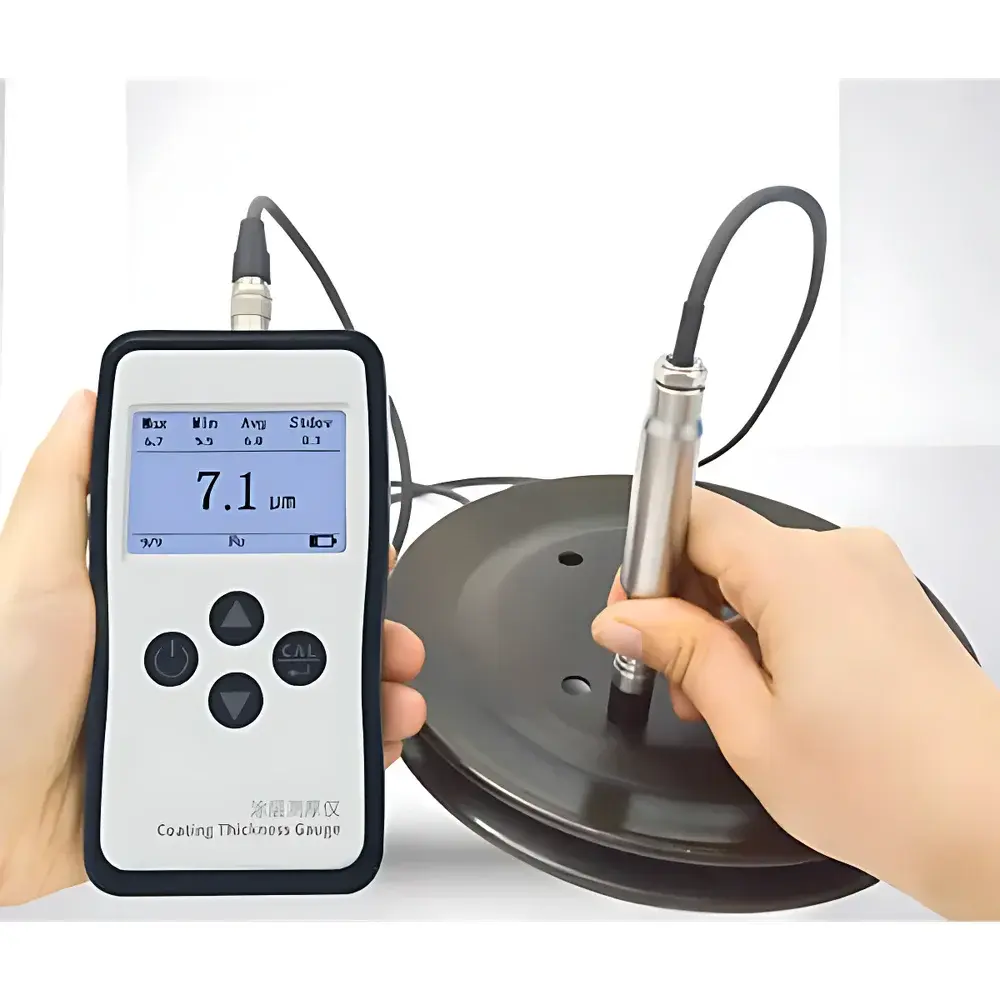
Biuged BGD 545 Electromagnetic Eddy Current & Magnetic Induction Dual-Mode Coating Thickness Gauge
| Brand | Biuged |
|---|---|
| Origin | Guangdong, China |
| Manufacturer Type | Direct Manufacturer |
| Country of Origin | China |
| Model | BGD 545 |
| Price | Upon Request |
| Measurement Principle | Dual-mode electromagnetic (magnetic induction for Fe substrates |
| Measurement Range | 0.0–5000 µm |
| Resolution | 0.1 µm (<100 µm), 1 µm (100–999 µm), 10 µm (>1000 µm) |
| Accuracy | ≤ ±(3% reading + 2 µm) |
| Minimum Substrate Thickness | 0.2 mm (Fe), 0.05 mm (NFe) |
| Minimum Curvature Radius | Convex 5 mm / Concave 25 mm |
| Minimum Measuring Area | 6 mm² |
| Probe Type | Integrated digital probe with sapphire tip |
| Display | 128 × 48 dot-matrix LCD |
| Power Supply | 2 × 1.5 V AAA alkaline batteries |
| Dimensions & Weight | 101 × 62 × 28 mm / 79 g (including batteries) |
| Units | µm and mil selectable |
| Measurement Modes | Fe, NFe, Auto (Fe/NFe) |
| Compliance | GB/T 4956–2003, GB/T 4957–2003, DIN EN ISO 2808, JJG 818–2005 |
Overview
The Biuged BGD 545 is a dual-mode handheld coating thickness gauge engineered for high-reproducibility, non-destructive measurement of non-magnetic coatings on ferrous (Fe) substrates and non-conductive or non-ferrous coatings on non-ferrous (NFe) metallic substrates. It operates simultaneously on two established physical principles: magnetic induction (per ASTM B499 and ISO 2178) for Fe-based systems, and high-frequency electromagnetic eddy current (per ASTM B244 and ISO 2360) for NFe substrates such as aluminum, copper, zinc, and stainless steel. Unlike single-principle instruments, the BGD 545 features intelligent substrate recognition logic that automatically selects the appropriate measurement mode—Fe, NFe, or Auto—within 0.5 seconds upon probe contact, eliminating manual mode selection errors and reducing operator dependency. Its integrated digital probe employs temperature-compensated oscillator circuitry and a sapphire-tipped sensing element, ensuring mechanical durability, chemical resistance, and long-term zero-point stability without drift over extended field use.
Key Features
- Dual-mode electromagnetic architecture supporting both magnetic induction and eddy current measurement in a single compact unit
- Automatic Fe/NFe substrate identification with sub-second response time (≤ 0.5 s per measurement)
- Sapphire-coated probe tip providing exceptional wear resistance and corrosion immunity for sustained metrological integrity
- Three selectable measurement modes: Fe-only, NFe-only, and fully automatic Fe/NFe discrimination
- Zero-drift digital probe design with adaptive signal conditioning—no periodic recalibration required beyond initial zeroing
- Multi-range resolution: 0.1 µm (for readings < 100 µm), 1 µm (100–999 µm), and 10 µm (≥ 1000 µm), optimized for trace-level and industrial-scale applications
- Unit toggle between metric (µm) and imperial (mil) output, configurable via on-device menu
- Robust mechanical design: IP54-rated enclosure, ergonomic form factor (101 × 62 × 28 mm), and ultra-lightweight construction (79 g with batteries)
Sample Compatibility & Compliance
The BGD 545 is validated for use on flat, curved, and irregular metallic surfaces meeting minimum geometric constraints: convex curvature radius ≥ 5 mm; concave radius ≥ 25 mm; minimum measurable area = 6 mm²; minimum substrate thickness = 0.2 mm (ferrous) or 0.05 mm (non-ferrous). It conforms to national and international standards governing coating thickness instrumentation, including GB/T 4956–2003 (magnetic method on ferrous substrates), GB/T 4957–2003 (eddy current method on non-ferrous substrates), DIN EN ISO 2808 (paint and varnish film thickness determination), and JJG 818–2005 (verification regulation for magnetic and eddy-current coating thickness gauges). While not FDA 21 CFR Part 11–compliant out-of-the-box (as it lacks audit-trail-capable software), its measurement repeatability meets GLP-aligned requirements for routine QC/QA in automotive, aerospace, and architectural coating workflows.
Software & Data Management
The BGD 545 operates as a standalone field instrument with no embedded Bluetooth, USB, or PC connectivity. All data processing—including real-time averaging, linearization compensation across full scale, and auto-zero stabilization—is performed onboard using proprietary firmware algorithms. The device stores no historical measurements; each reading is displayed and discarded upon next trigger actuation. For traceable documentation, users are advised to pair the gauge with external logging systems (e.g., paper logs, spreadsheet templates, or third-party LIMS integrations via manual entry). Calibration verification is supported through certified reference standards traceable to NIM (National Institute of Metrology, China) or equivalent NMIs. Zero adjustment is performed directly on bare substrate prior to measurement—no multi-point calibration is necessary due to factory-characterized linearity correction.
Applications
The BGD 545 serves quality control laboratories, production line inspectors, and field service technicians requiring rapid, portable, and reliable coating verification across diverse sectors. Typical use cases include measuring electroplated zinc or chromium layers on steel fasteners; anodized oxide films on aluminum extrusions; powder-coated finishes on HVAC ductwork; enamel coatings on appliance housings; and thermal-spray ceramic layers on turbine components. Its ability to maintain accuracy on small-diameter cylindrical parts (e.g., threaded rods, pins, and weld seams) makes it especially suitable for Tier-1 automotive suppliers performing incoming inspection per IATF 16949 clause 8.6.5. In R&D environments, the instrument supports comparative studies of coating uniformity, edge effects, and curing-dependent thickness evolution—provided substrate geometry remains within specified limits.
FAQ
Does the BGD 545 require annual recalibration?
No. The instrument uses a drift-compensated digital probe and factory-linearized algorithm; only zero adjustment on certified bare substrate is required before each measurement session.
Can it measure coatings on stainless steel?
Yes—provided the stainless steel grade is non-magnetic (e.g., AISI 304, 316); magnetic grades (e.g., 430, 410) must be measured in Fe mode.
What is the smallest part diameter it can measure accurately?
For convex surfaces, minimum curvature radius is 5 mm; therefore, minimum measurable diameter is ~10 mm under standard probe contact conditions.
Is the sapphire probe tip replaceable in the field?
Yes—the integrated probe assembly is a modular component designed for user-replacement without tools or service intervention.
Does it support statistical analysis or data export?
No. The BGD 545 is a real-time display instrument without internal memory, averaging functions, or interface ports; statistical evaluation requires external recording and post-processing.



