
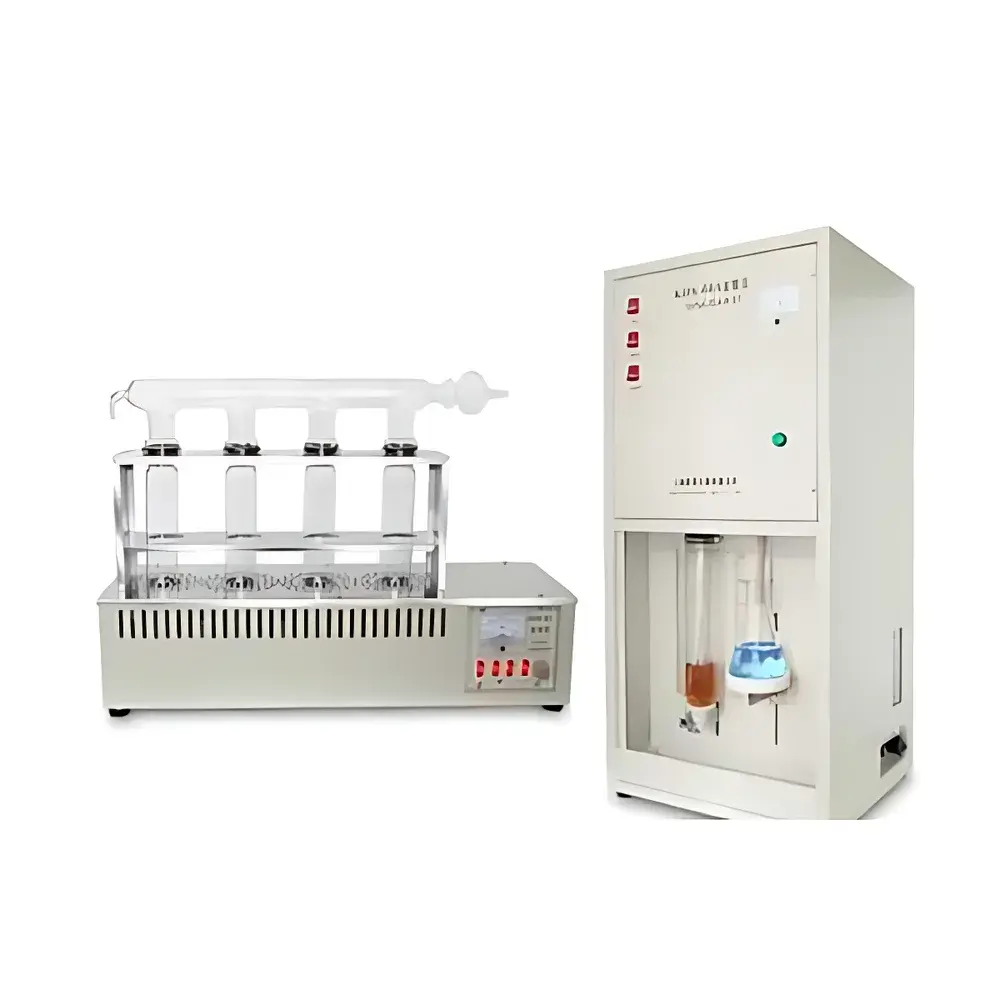
BLD-B2103 Nitrogen-Phosphorus-Calcium Analyzer
| Origin | Beijing, China |
|---|---|
| Manufacturer Type | Authorized Distributor |
| Origin Category | Domestic (PRC) |
| Model | BLD-B2103 |
| Price Range | USD 2,800 – 7,000 |
| Net Weight | 25 kg |
| Distiller Power | 800 W |
| Four-Position Digestion Block Power | 1500 W |
| Eight-Position Digestion Block Power | 3000 W |
| Four-Position Digestion Block Dimensions | 650 × 220 × 150 mm |
| Eight-Position Digestion Block Dimensions | 730 × 300 × 150 mm |
| Distiller Dimensions | 380 × 330 × 820 mm |
| Operating Voltage | AC 220 V, 50 Hz |
Overview
The BLD-B2103 Nitrogen-Phosphorus-Calcium Analyzer is a benchtop multi-element digestion and distillation system engineered for routine quantitative analysis of total nitrogen (as crude protein), total phosphorus, and calcium in agricultural and food matrices. It integrates Kjeldahl digestion, steam distillation, colorimetric phosphorus determination (vanadomolybdophosphoric acid method), and EDTA back-titration for calcium—within a single platform optimized for laboratory throughput and regulatory alignment. Unlike conventional sequential analyzers, the BLD-B2103 employs hydrogen peroxide–catalyzed oxidative digestion at programmable temperatures (150–450 °C), enabling simultaneous mineralization of organic nitrogen, phosphorus, and calcium into stable inorganic forms—ammonium sulfate, orthophosphate, and soluble Ca²⁺—in one digestion cycle. This eliminates cross-method sample reprocessing, reduces analyst handling time, and improves inter-element analytical consistency. The system conforms to core principles of ISO 5983-1 (crude protein), ISO 6498 (sample preparation), and AOAC Official Methods 984.27 (phosphorus) and 975.03 (calcium), supporting method validation under GLP-compliant workflows.
Key Features
- Programmable high-temperature digestion block with dual configurations: 4-position (1500 W) and 8-position (3000 W) options, enabling scalable batch processing without hardware modification.
- Hydrogen peroxide–based catalytic digestion replaces traditional K₂SO₄/CuSO₄ mixtures, minimizing SO₂ emissions, reducing digestion time by ~30%, and improving recovery of volatile phosphorus species.
- Dedicated steam distiller (800 W) with precise alkali dosing and condensate collection control, ensuring stoichiometric NH₃ liberation and quantitative boracic acid trapping for nitrogen determination.
- Integrated optical path design supports standardized spectrophotometric measurement at 420 nm for vanadomolybdophosphoric yellow complex formation—calibrated against NIST-traceable phosphate standards.
- EDTA back-titration module includes pH auto-adjustment to 12.5–13.5 range and endpoint detection via Eriochrome Black T (EBT) or Calcon indicator, compliant with ISO 6497 for calcium in feedstuffs.
- All wet chemistry modules operate within CE-marked electrical safety architecture and meet IEC 61010-1 requirements for laboratory equipment.
Sample Compatibility & Compliance
The BLD-B2103 is validated for solid and semi-solid matrices common in agri-food quality control: cereal grains (corn, wheat, barley), compound feeds, soybean meal, dairy powders, whey concentrates, silage extracts, and fortified beverages. Sample mass ranges from 0.5–2.0 g (dry basis), with digestion volume compatibility up to 100 mL H₂O₂/H₂SO₄ mixture. All analytical protocols align with national standard methodologies: GB/T 6432–2018 (crude protein), GB/T 6437–2018 (total phosphorus), and GB/T 6436–2018 (calcium) — fully traceable to China’s National Institute of Metrology (NIM). For international export labs, the system supports adaptation to AOAC 984.27 (phosphorus), ISO 5983-1 (nitrogen), and EN 15510 (feed calcium), with documented method equivalence reports available upon request.
Software & Data Management
While the BLD-B2103 operates as a standalone instrument with manual endpoint detection (titration, colorimetry), its procedural architecture is designed for seamless integration into LIMS environments. Each digestion/distillation cycle logs timestamp, temperature profile, reagent volumes, and operator ID via optional RS-232/USB data export. Raw absorbance values (420 nm), titrant consumption (mL), and distillate volume are structured in CSV format compatible with Excel-based QA templates or validated third-party software (e.g., Thermo Fisher SampleManager LIMS, LabVantage). Audit trails comply with FDA 21 CFR Part 11 requirements when paired with electronic signature-enabled host systems. Calibration records for photometer and burette follow ISO/IEC 17025 documentation hierarchy.
Applications
- Feed mill QC laboratories performing daily compliance checks against GB 13078 (hygienic standards) and GB/T 18868 (compound feed specifications).
- Grain inspection stations verifying protein content in wheat procurement and phosphorus levels in rice bran for animal nutrition labeling.
- R&D units developing fortified dairy alternatives, where calcium bioavailability assessment requires precise total Ca quantification prior to solubility studies.
- Contract testing labs serving export-oriented aquafeed producers requiring AOAC-aligned phosphorus reporting for EU and ASEAN markets.
- Educational institutions teaching classical wet-chemistry elemental analysis techniques with modern safety and efficiency enhancements.
FAQ
What digestion catalysts does the BLD-B2103 use instead of traditional CuSO₄/K₂SO₄?
It employs hydrogen peroxide (H₂O₂) as the primary oxidant under controlled thermal conditions—eliminating heavy metal residues and reducing SO₂ generation during organic matrix decomposition.
Can the same digest solution be used for all three analytes (N, P, Ca)?
Yes. The H₂O₂–H₂SO₄ digestion converts organic N to (NH₄)₂SO₄, organic P to PO₄³⁻, and organic Ca to Ca²⁺ in a single homogeneous digestate—enabling sequential analysis without sample splitting.
Is the 420 nm photometric measurement compliant with ISO 6437?
The optical path and filter specification meet the spectral bandwidth and stray light requirements of ISO 6437:2000; calibration verification using potassium dihydrogen phosphate reference standards is recommended before each analytical batch.
What is the maximum sample throughput per 8-hour shift?
With parallel digestion (8-position block) and staggered distillation, up to 24 samples can be processed for nitrogen, 16 for phosphorus, and 12 for calcium—assuming standard 2.5 g feed samples and full method replication.
Does the system include validation documentation for GMP environments?
Factory-installed IQ/OQ documentation packages are available as optional add-ons, including temperature mapping reports for digestion blocks, distillation recovery tests (NH₃ spike recovery ≥99.2%), and photometer linearity verification (R² ≥0.9995 across 0–1.5 mg/dL P range).





