
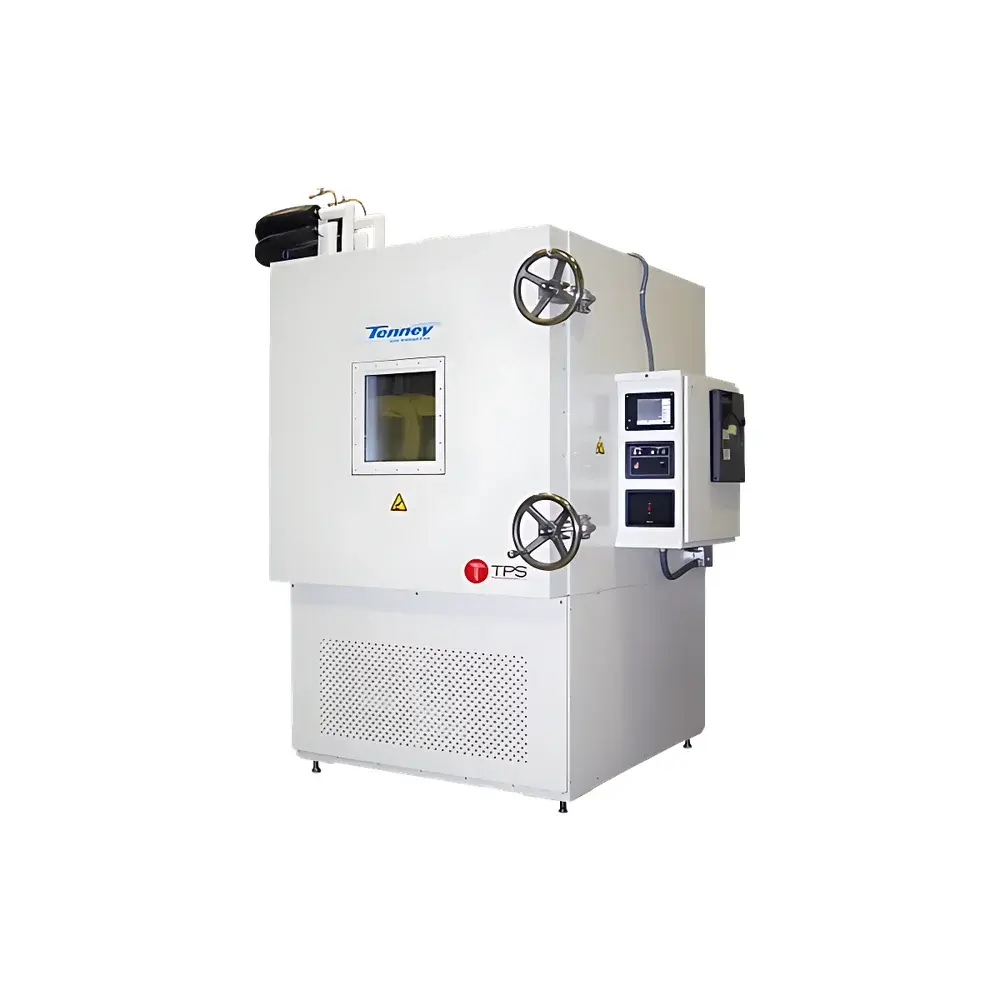
Blue M TENNEY SVO Thermal Fluid-Heated Vacuum Oven
| Brand | Blue M |
|---|---|
| Origin | USA |
| Model | SVO |
| Temperature Range | -70°C to +180°C |
| Max Operating Temperature | +150°C (standard), up to +200°C (optional) |
| Temperature Uniformity | ±1.0°C |
| Temperature Stability | ±0.5°C |
| Temperature Deviation | ±1.0°C |
| Pressure Range | Ambient (760 Torr) down to 0.169 Torr (equivalent to ~200,000 ft altitude) |
| Internal Chamber Dimensions (W×H×D) | 1016 mm × 2057 mm × 2007 mm to 1626 mm × 2616 mm × 2515 mm |
| Heating Method | Immersed electric heater with thermal fluid circulation |
| Vacuum Control | Auto-regulated solenoid valves for precise altitude simulation |
| Controller | Synergy Quattro touchscreen (320×240 color LCD), PID with auto-tuning, dual-channel capability, real-time clock, USB/RS-232/Ethernet (10/100) connectivity |
| Compliance | Designed for ASTM D573, D865, ISO 188, USP <121>, and GLP/GMP-relevant data integrity requirements (audit trail, user access control, electronic signatures via optional software modules) |
Overview
The Blue M TENNEY SVO Thermal Fluid-Heated Vacuum Oven is an engineered environmental test chamber designed for accelerated thermal aging, outgassing validation, moisture removal, and altitude-simulated stress testing of materials under controlled low-pressure and elevated-temperature conditions. Unlike conventional convection ovens, the SVO employs a closed-loop thermal fluid heating system—where electrically heated silicone oil or glycol-based fluid circulates through jacketed walls and door assemblies—to deliver exceptional temperature uniformity and thermal inertia resistance across large-volume chambers. Its vacuum architecture integrates programmable solenoid valve sequencing to emulate atmospheric pressure profiles from sea level (760 Torr) down to 0.169 Torr—corresponding to altitudes up to 200,000 feet—enabling rigorous compliance testing per ASTM D573 (rubber degradation), ISO 188 (heat aging of vulcanized rubber), and USP <121> (vacuum drying of pharmaceutical excipients). The system operates within a certified temperature range of –70°C to +180°C, with standard thermal aging configurations rated to +150°C and optional configurations extending to +200°C.
Key Features
- Thermal fluid heating system with immersed electric heaters and insulated circulation loop—eliminates hot spots and ensures ±1.0°C chamber uniformity even at maximum setpoints.
- Synergy Quattro controller featuring a 320×240 color touchscreen interface, English-language prompts, real-time clock, and support for unlimited multi-step programs with automatic PID tuning.
- Dual-channel control logic dynamically adjusts heating/cooling output based on load mass and thermal mass characteristics—critical for reproducible aging cycles across variable sample configurations.
- Integrated vacuum regulation via motorized solenoid valves and a variable-capacitance pressure transducer, enabling repeatable altitude profile replication without manual intervention.
- Modular vacuum system options: single-stage or two-stage oil-sealed rotary vane pumps; optional GN2 backfill, molecular sieve traps, and cold vapor traps for ultra-low outgassing environments.
- Comprehensive I/O architecture including RS-232, 10/100 Ethernet (TCP/IP), USB host port, and removable PCMCIA flash memory—designed for seamless integration into automated test networks and 21 CFR Part 11-compliant data acquisition workflows.
- Redundant safety systems: independent over-temperature limiter (Tempguard IV), door interlock, and pressure-relief venting compliant with ASME BPVC Section VIII standards.
Sample Compatibility & Compliance
The SVO accommodates diverse sample geometries—from printed circuit boards and aerospace composites to polymer films and pharmaceutical dosage forms—within its scalable chamber volumes (61 L to 1,800 L). Its vacuum-compatible interior finish (electropolished stainless steel) minimizes particulate generation and facilitates cleaning validation. The system supports test protocols requiring trace moisture reduction (<10 ppm residual H₂O), volatile organic compound (VOC) extraction, or thermal desorption kinetics. It meets key regulatory expectations for data integrity: audit-trail-enabled operation logs, user-level access control (administrator/operator/guest), electronic signature capability (via LinkTenn 32 software), and time-stamped parameter recording—all aligned with GLP, GMP, and FDA 21 CFR Part 11 Annex 11 principles. Calibration documentation follows ISO/IEC 17025 traceability pathways through NIST-traceable reference standards.
Software & Data Management
Synergy Quattro firmware provides native program storage on internal flash memory and external media (USB, PCMCIA). Test sequences—including ramp-soak-vacuum hold profiles—are exportable as CSV or XML for third-party analysis. Optional LinkTenn 32 software enables remote monitoring, historical trend visualization, alarm event correlation, and automated report generation (PDF/Excel) compliant with 21 CFR Part 11 electronic record requirements. The controller’s embedded Windows CE OS supports secure firmware updates and diagnostic self-tests. All communication interfaces (Ethernet, RS-232, USB) permit bidirectional command-and-control integration with MES, SCADA, or LabVantage platforms—facilitating full traceability from test initiation to final certificate issuance.
Applications
- Accelerated aging of elastomers, adhesives, and encapsulants per ASTM D865 and MIL-STD-883.
- Vacuum bake-out of MEMS devices, optical components, and space-grade electronics prior to hermetic sealing.
- Residual solvent removal from battery electrode coatings and thin-film photovoltaic layers.
- Stability testing of lyophilized biologics and sterile drug products under low-humidity, low-oxygen conditions.
- Outgassing characterization (RGA-compatible) for spacecraft material qualification per ECSS-Q-ST-70-02C.
- Thermal cycling validation of automotive wiring harnesses and EV battery modules under simulated high-altitude thermal stress.
FAQ
What vacuum levels can the SVO achieve, and how are they controlled?
The SVO achieves pressures from ambient (760 Torr) down to 0.169 Torr using auto-regulated solenoid valves and a calibrated capacitance manometer. Pressure profiles are programmed directly in the Synergy Quattro interface and maintained with ±0.02 Torr repeatability.
Is the thermal fluid system serviceable in situ?
Yes—the fluid reservoir, circulation pump, and heater elements are fully accessible without chamber disassembly. Fluid change intervals are tracked via controller maintenance logs.
Can the SVO be integrated into a centralized lab automation system?
Absolutely. Standard Ethernet (TCP/IP), RS-232, and Modbus TCP support enable direct integration with LIMS, MES, or custom Python/Node-RED orchestration frameworks.
Does the system comply with FDA 21 CFR Part 11 for electronic records?
When configured with LinkTenn 32 software, audit-trail logging, role-based access, and electronic signature modules, the SVO satisfies Part 11 technical controls for electronic records and signatures.
What cooling options are available for sub-ambient operation?
Liquid nitrogen (LN2) or cascade refrigeration systems may be factory-integrated upon request—consult engineering for thermal load modeling and condensation mitigation specifications.



