
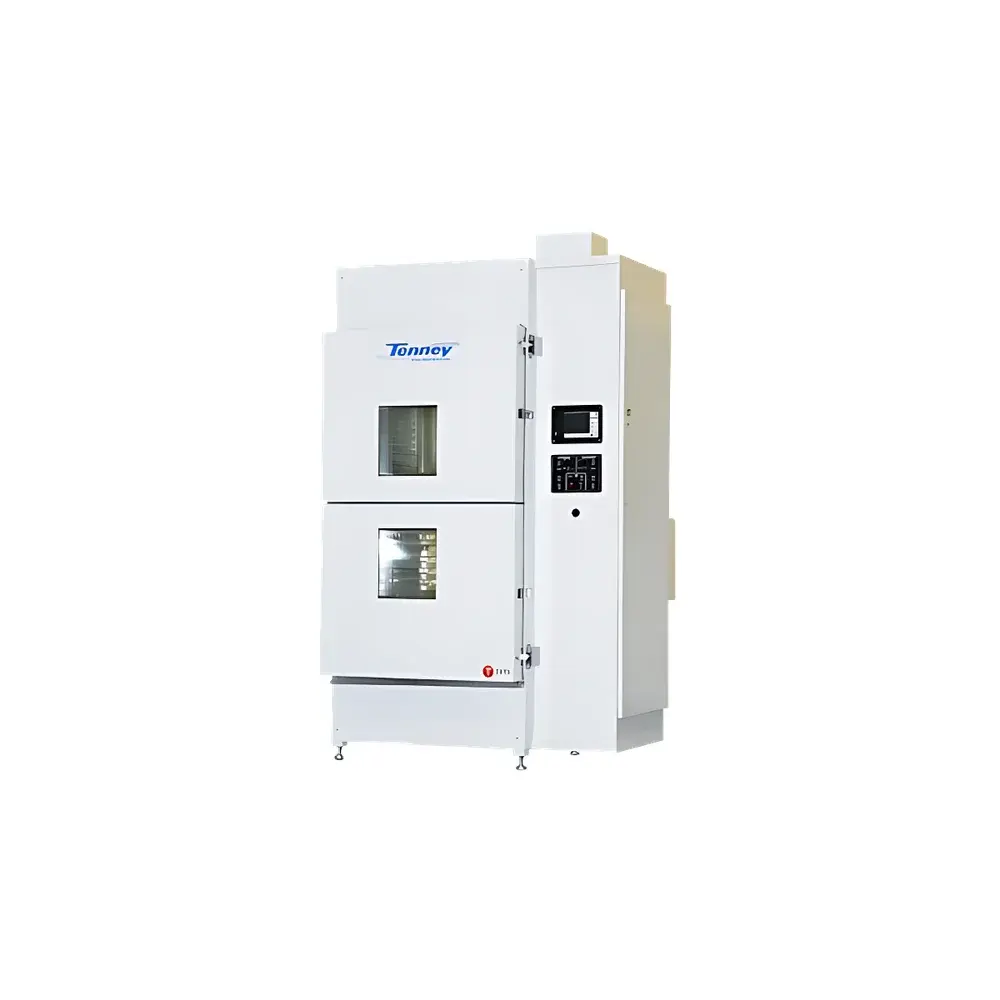
Blue M TENNEY WSP Air-to-Air Thermal Shock Test Chamber
| Brand | Blue M |
|---|---|
| Origin | USA |
| Model | WSP |
| Temperature Range | -70°C to 180°C |
| Temperature Uniformity | ±1.0°C |
| Temperature Fluctuation | ±0.5°C |
| Temperature Deviation | ±1.0°C |
| Heating Rate | Ambient to 180°C |
| Chamber Dimensions (W×H×D) | 1016 mm × 2057 mm × 2007 mm – 1626 mm × 2616 mm × 2515 mm |
| Cold Zone Range | -75°C to 0°C |
| Hot Zone Range | +85°C to +215°C |
| Internal Chamber Volume per Zone | 2.1 ft³ (≈59.5 L) |
| Transfer Time | ≤10 s |
| Cooling Medium | Liquid Nitrogen (LN₂) |
| Purge Gas | Dry Nitrogen |
| Defrost Heater | Integrated in Cold Zone |
| Compliance | MIL-STD-202F Method 107G (Conditions A, B, C, F), MIL-STD-883 Method 1010.7 (Conditions A, B, C, F) |
Overview
The Blue M TENNEY WSP Air-to-Air Thermal Shock Test Chamber is an industrial-grade, fully automated thermal cycling system engineered for high-reliability qualification testing of electronic components, aerospace hardware, automotive modules, and advanced materials. It operates on the principle of rapid air-to-air thermal shock—utilizing two physically isolated, independently controlled temperature zones (hot and cold) and a pneumatically actuated transfer mechanism to move test specimens between them in ≤10 seconds. This architecture eliminates thermal mass lag inherent in single-chamber systems and ensures precise, repeatable exposure to extreme temperature transitions. The chamber is designed to meet stringent environmental stress screening (ESS) and accelerated reliability test requirements defined in military and aerospace standards, including MIL-STD-202F Method 107G and MIL-STD-883 Method 1010.7. Its dual-zone configuration supports both Condition A (low-to-high transition) and Condition F (high-to-low transition) protocols, enabling full compliance with qualification-level thermal shock test plans.
Key Features
- Fully automated shuttle mechanism with pneumatic actuation and stainless-steel mesh transport baskets (6 units, 10″ × 10″ × 1″) for consistent specimen positioning and minimal thermal inertia.
- Dual independent chambers: hot zone (85–215°C, ±1.0°C) and cold zone (-75–0°C, ±1.0°C), each with dedicated LN₂-cooled finned coil assemblies and ceramic-insulated NiCr heating elements.
- Dry nitrogen purge system integrated into the hot chamber to suppress oxygen content and prevent condensation or oxidation on metallic test samples during low-temperature exposure.
- Integrated defrost heater in the cold zone, programmable via Synergy Quattro controller, to maintain long-term operational stability during extended test cycles.
- Synergy Quattro touchscreen controller featuring a 320 × 240 color LCD interface, English-language prompts, real-time clock, and PID control with adaptive tuning—supporting up to 999 programs and 999 steps per program.
- Advanced I/O architecture with standalone Olympic controller for machine diagnostics, RS-232 serial communication, 10/100 Ethernet (TCP/IP), USB data logging, and PCMCIA flash card support for offline program backup and traceable data export.
Sample Compatibility & Compliance
The WSP accommodates a broad range of sample geometries and mounting configurations within its standardized internal volume (2.1 ft³ per zone). Specimens are typically mounted on PCB carriers, DUT trays, or custom fixtures compatible with the 10″ × 10″ basket footprint. The chamber’s horizontal airflow design ensures uniform temperature distribution across the test space, meeting ASTM E145 Class A uniformity requirements for thermal test equipment. All electrical and safety subsystems comply with UL 61010-1 and CSA C22.2 No. 61010-1. Firmware and controller logic are validated for GLP/GMP-aligned audit trails, including timestamped event logs, alarm history, and user-access-controlled parameter modification records. Optional Tempguard IV overtemperature protection and LinkTenn 32 software provide additional layers of process integrity for regulated environments subject to FDA 21 CFR Part 11 or ISO/IEC 17025 accreditation.
Software & Data Management
The Synergy Quattro control platform runs on Microsoft Windows CE and supports comprehensive test lifecycle management. Users can define multi-segment thermal profiles—including dwell times, ramp rates, and transition triggers—with built-in validation checks against physical limits. Real-time data acquisition captures setpoint vs. actual temperature at configurable intervals (1–60 s), stored internally on flash memory or exported via USB to CSV or Excel-compatible formats. Remote monitoring and control are enabled through standard TCP/IP Ethernet, allowing integration into centralized facility monitoring systems (e.g., LabVIEW, SCADA, or MES platforms). The controller maintains encrypted, tamper-evident logs compliant with 21 CFR Part 11 for electronic signatures, audit trail retention (>30 days), and role-based user authentication (admin/operator/viewer).
Applications
- Qualification testing of semiconductor packages (QFN, BGA, CSP) per JEDEC JESD22-A104 and A106.
- Thermal fatigue evaluation of solder joints, conformal coatings, and encapsulants in avionics and defense electronics.
- Material compatibility assessment for adhesives, elastomers, and composite laminates under cyclic thermal stress.
- Reliability screening of battery cells and power modules subjected to automotive thermal cycling (AEC-Q200).
- Validation of hermetic seal integrity in MEMS devices and medical implant housings.
- Process development support for reflow profiling, burn-in, and preconditioning protocols in contract manufacturing facilities.
FAQ
What is the minimum achievable transfer time between hot and cold zones?
The WSP achieves specimen transfer in ≤10 seconds under standard loading conditions, verified per MIL-STD-202F 107G Annex A.
Does the system support LN₂ consumption monitoring?
Yes—integrated pressure transducers and flow meters feed real-time LN₂ usage data to the Synergy Quattro controller for predictive maintenance and cost tracking.
Can the chamber be configured for humidity-controlled thermal shock?
No—the WSP is a dry air-to-air system; humidity control is not supported. For combined thermal/humidity shock, consider the TENNEY HST series.
Is remote firmware update capability available?
Firmware updates require local USB or PCMCIA media insertion; network-based updates are disabled by default for security and regulatory compliance.
What safety interlocks are implemented?
Dual-channel solid-state over/under-temperature protection, door position switches per chamber, LN₂ supply pressure monitoring, and emergency stop circuitry compliant with ISO 13850.



