
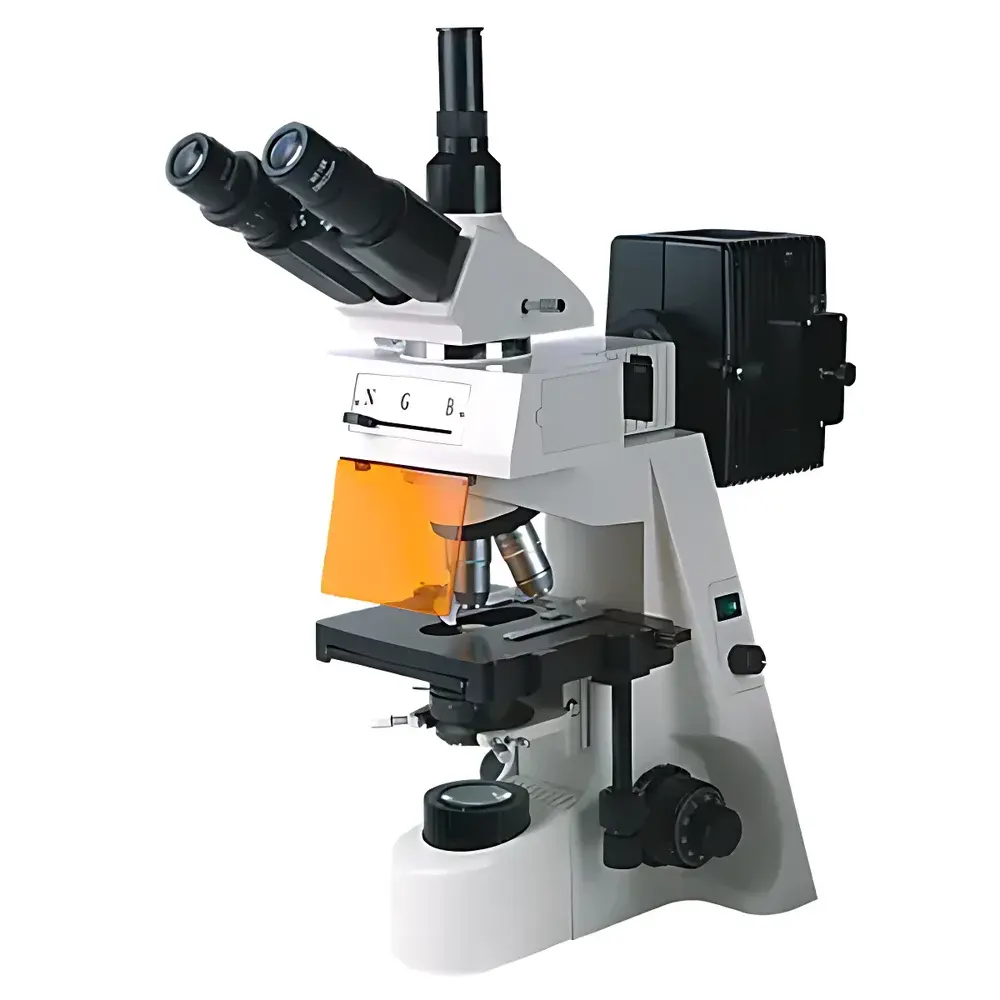
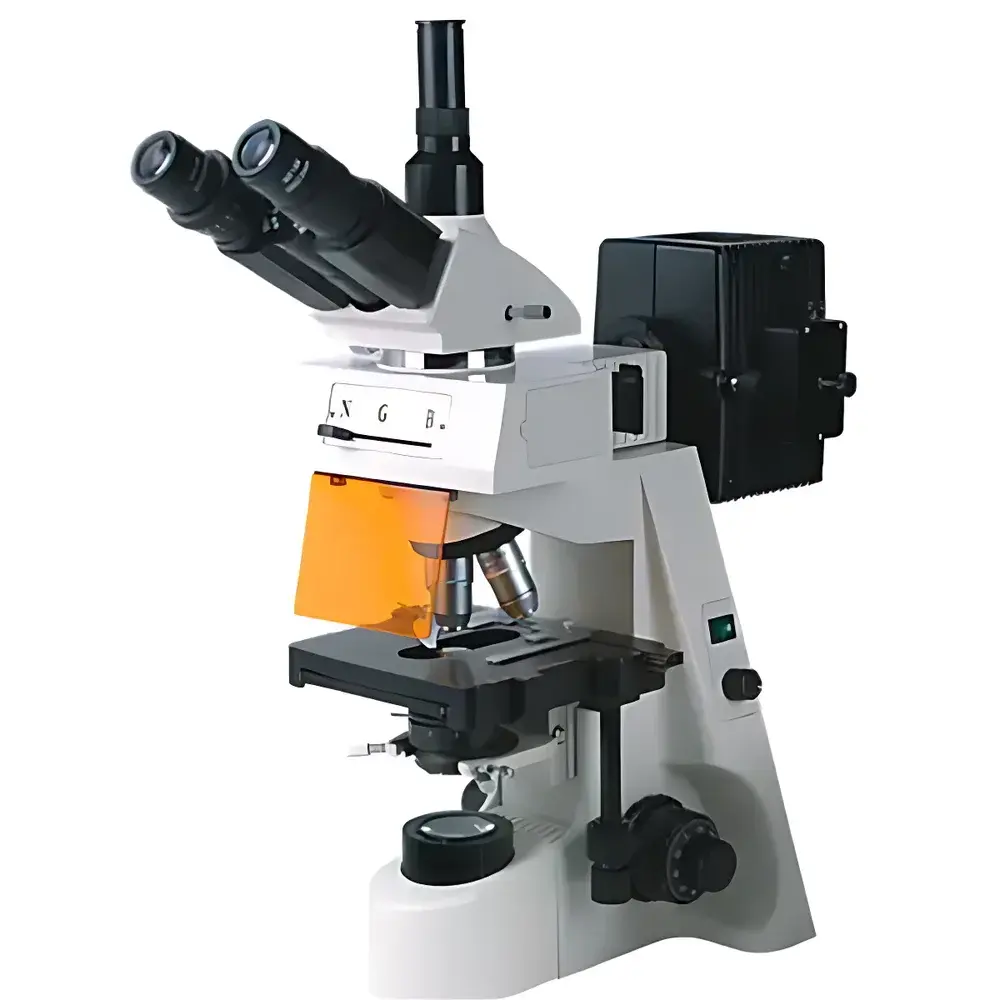
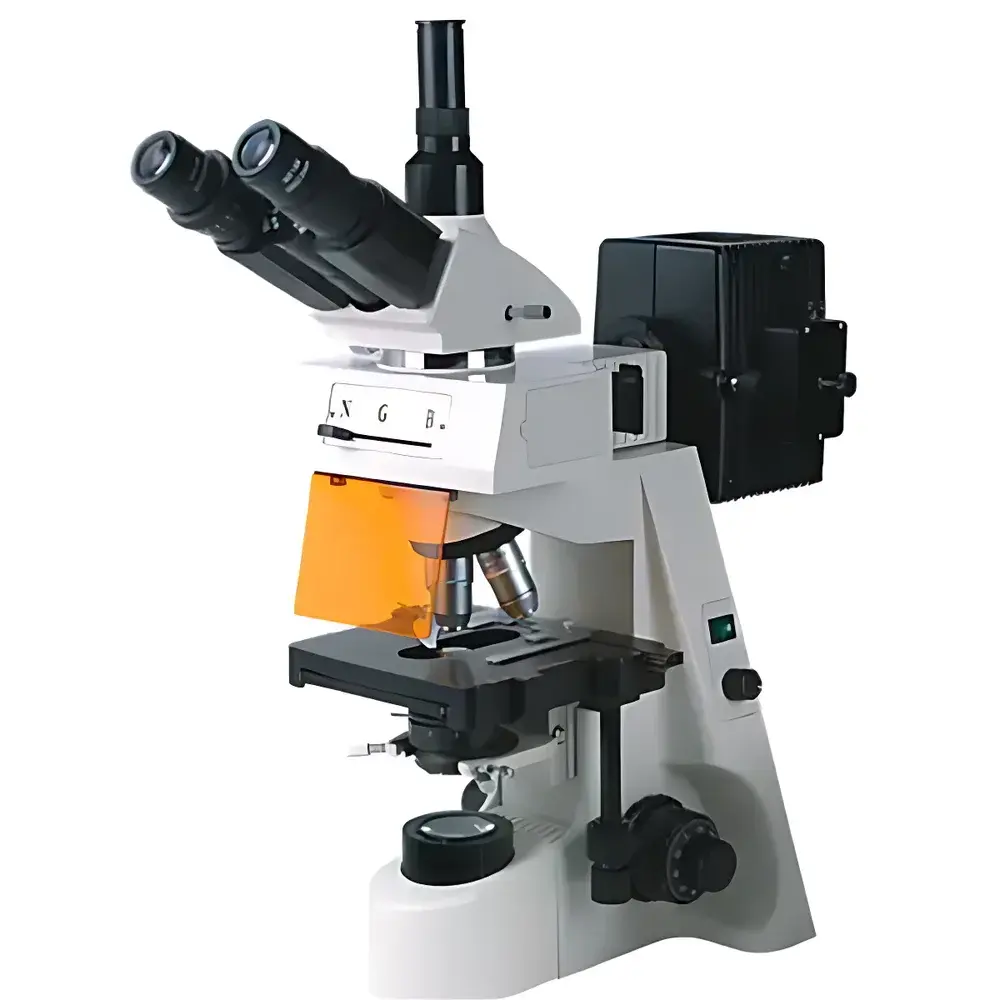
BM-19AY Fluorescence Microscope by BM (Shanghai)
| Brand | BM |
|---|---|
| Origin | Shanghai, China |
| Model | BM-19AY |
| Instrument Type | Upright Fluorescence Microscope |
| Excitation Source | 100 W High-Pressure Mercury Lamp |
| Observation Head | Trinocular, 30° Inclined, 360° Rotatable |
| Eyepieces | Wide-Field Plan Eyepieces (10×/Φ22 mm) |
| Objectives | Infinity-Corrected Fluorescence Plan Achromatic Objectives (4×, 10×, 40×, 100× oil) |
| Illumination | Epi-Fluorescence (U, V, B, G filter sets) + Transmitted Köhler Illumination (12 V/30 W Halogen) |
| Focusing | Coaxial Coarse/Fine Manual Focus (30 mm Travel, 0.002 mm Fine Graduation) |
| Stage | 180 × 150 mm Mechanical Stage with 75 × 50 mm Travel and 0.1 mm Vernier Scale |
| Tube Lens Focal Length | 200 mm |
| Optical System | Infinity-Corrected (∞) |
| Regulatory Status | Not a Medical Device |
Overview
The BM-19AY Fluorescence Microscope is an upright, research-grade optical instrument engineered for high-fidelity epifluorescence imaging in life science laboratories. Designed around an infinity-corrected optical architecture with a 200 mm tube lens focal length, the system ensures precise chromatic and spherical aberration correction across all magnifications—critical for quantitative fluorescence analysis. It employs standard immunofluorescence and histofluorescence protocols to visualize subcellular structures, nucleic acid distribution (DNA/RNA), acidic mucopolysaccharides, and antigen localization with high specificity and contrast. The microscope’s epi-illumination path integrates a 100 W high-pressure mercury lamp with standardized U, V, B, and G excitation filter sets, enabling multi-channel detection of common fluorophores including DAPI, FITC, TRITC, and Alexa Fluor dyes. Its transmitted halogen illumination (12 V/30 W) supports simultaneous brightfield or phase contrast correlation, facilitating multimodal sample assessment without stage repositioning.
Key Features
- Infinity-corrected optical pathway with 200 mm tube lens, optimized for fluorescence throughput and minimal stray light
- Trinocular observation head with 30° inclination and full 360° rotation—designed for ergonomic operation and seamless integration with digital cameras or photomultiplier modules
- Wide-field plan eyepieces (10×/Φ22 mm) providing extended field of view and flat image plane; optional 16× wide-field eyepieces available for higher magnification screening
- Full set of fluorescence-optimized plan achromatic objectives: 4× (NA 0.10), 10× (NA 0.25), 40× (NA 0.65), and 100× oil immersion (NA 1.25), each corrected for fluorescence transmission and minimal autofluorescence
- Coaxial coarse/fine focusing mechanism with 30 mm vertical travel, adjustable tension lock, and 0.002 mm fine graduation—ensuring reproducible Z-stack acquisition and critical focus stability during time-lapse imaging
- Large mechanical stage (180 × 150 mm) with calibrated 75 × 50 mm XY travel and 0.1 mm vernier scale—supporting precise coordinate mapping for serial sectioning or multi-well plate scanning
- Dual illumination system: Mercury-based epi-fluorescence with four-band excitation (U/V/B/G) and Köhler-transmitted halogen illumination with continuous brightness control
Sample Compatibility & Compliance
The BM-19AY accommodates standard glass slides (up to 1.2 mm thickness), coverslips (0.13–0.17 mm), and Petri dishes (via optional stage adapters). Its optical design complies with ISO 8578:2017 (microscope mechanical tube length and parfocality standards) and adheres to IEC 61000-6-3 for electromagnetic compatibility in laboratory environments. While not classified as a medical device per FDA 21 CFR Part 809 or EU MDR Annex XVI, the system meets general laboratory equipment requirements under ISO/IEC 17025 for method validation in non-clinical research settings. All filter sets conform to ISO 10934-1 spectral bandwidth tolerances, ensuring consistent excitation/emission separation across user-defined channels.
Software & Data Management
The BM-19AY is fully compatible with third-party scientific imaging platforms—including NIS-Elements (Nikon), ZEN Blue (Zeiss), and open-source solutions such as MicroManager and Fiji/ImageJ—via standard C-mount (1×) or CS-mount (0.5×) camera interfaces. Digital capture supports TIFF, PNG, and multi-channel OME-TIFF formats with embedded metadata (objective ID, exposure time, filter position, gain). When paired with audit-trail-enabled acquisition software compliant with FDA 21 CFR Part 11 (e.g., MetaMorph with electronic signature module), the system supports GLP/GMP-aligned documentation workflows for preclinical assay development and quality control applications.
Applications
- Cell biology: Nuclear morphology analysis, mitotic staging, organelle tracking using fluorescent probes (e.g., MitoTracker, Hoechst)
- Immunocytochemistry: Localization of membrane receptors, cytoskeletal proteins, and intracellular signaling molecules via primary/secondary antibody conjugates
- Histopathology research: Fluorescent staining of tissue sections for biomarker expression profiling and spatial co-localization studies
- Microbiology: Detection of bacterial biofilms, fungal hyphae, and viral inclusion bodies using viability dyes (e.g., SYTO 9/PI)
- Developmental biology: Live embryo imaging (with environmental chamber integration) and lineage tracing in model organisms (zebrafish, C. elegans)
- Material science: Fluorescent nanoparticle distribution analysis in polymer matrices and hydrogel scaffolds
FAQ
Is the BM-19AY suitable for live-cell imaging?
Yes—when equipped with temperature/humidity/CO₂ control accessories and low-phototoxicity acquisition protocols, it supports short-term live-cell fluorescence observation. However, long-term time-lapse requires external environmental stabilization.
Can I use LED illumination instead of the mercury lamp?
The system is designed for mercury arc excitation, but third-party LED retrofit kits with collimated U/V/B/G output and C-mount coupling are mechanically and optically compatible.
What is the maximum usable magnification with the 100× oil objective?
With 10× eyepieces and 1× tube factor, total magnification reaches 1000×—within the practical resolution limit (~200 nm lateral) governed by visible-light diffraction and NA.
Does the microscope support DIC or phase contrast?
No—DIC and phase contrast require dedicated condensers and prisms not included in the standard configuration; however, the transmitted halogen path enables brightfield and basic darkfield observation.
Is service and calibration support available outside China?
BM provides international distributor networks with certified technical training; on-site calibration services are available through authorized partners in North America, Europe, and Southeast Asia under annual service agreements.



