
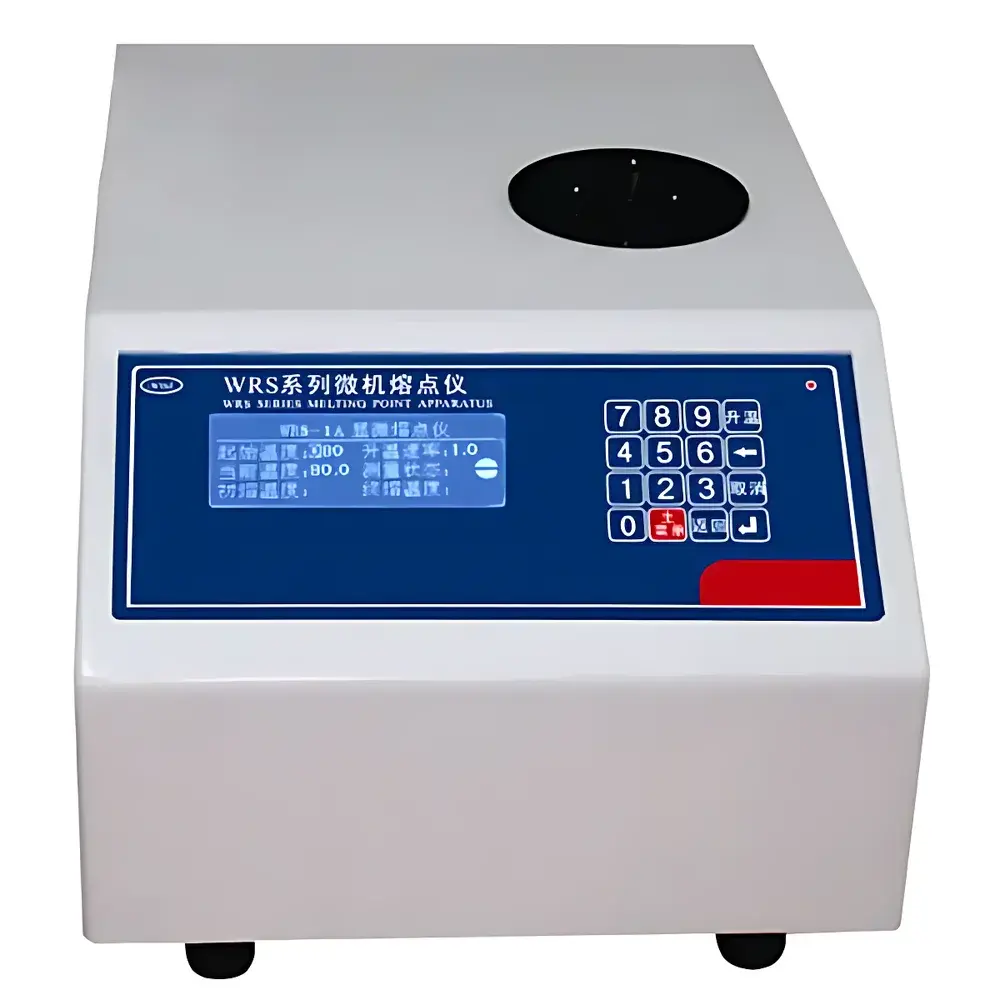
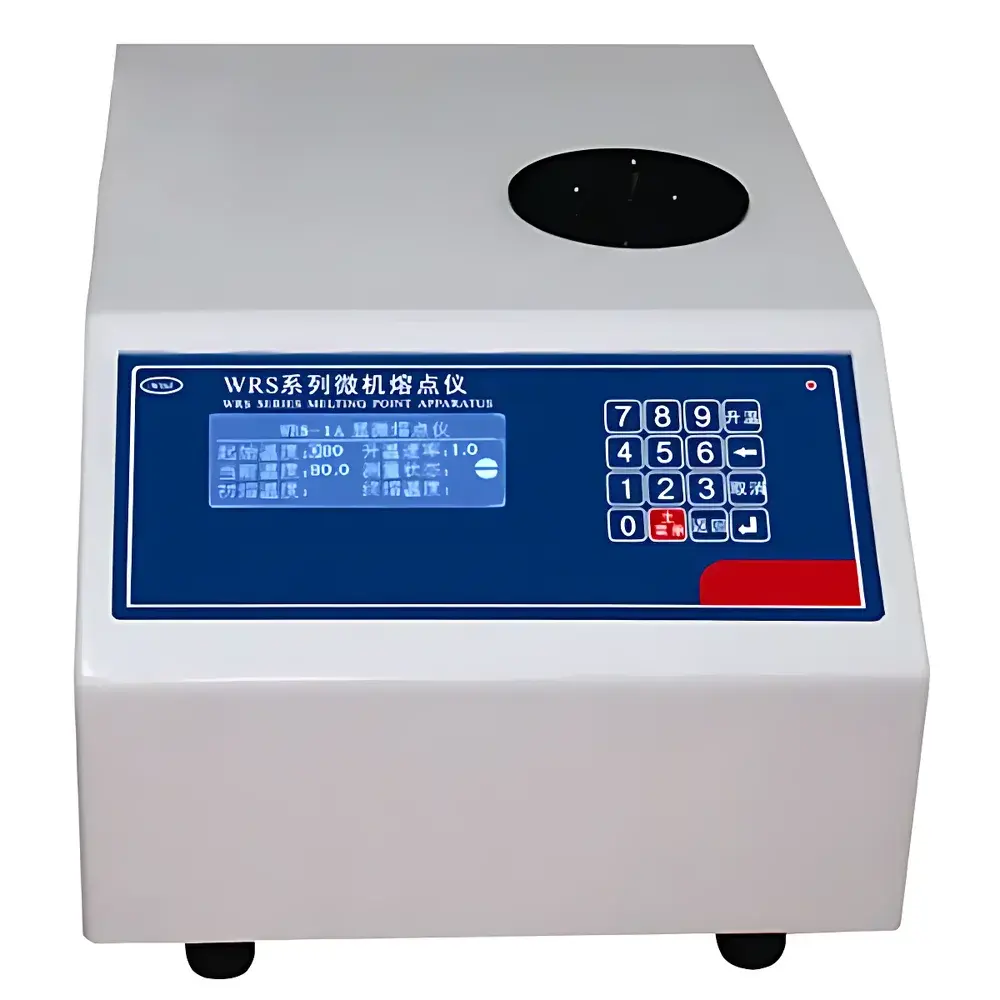
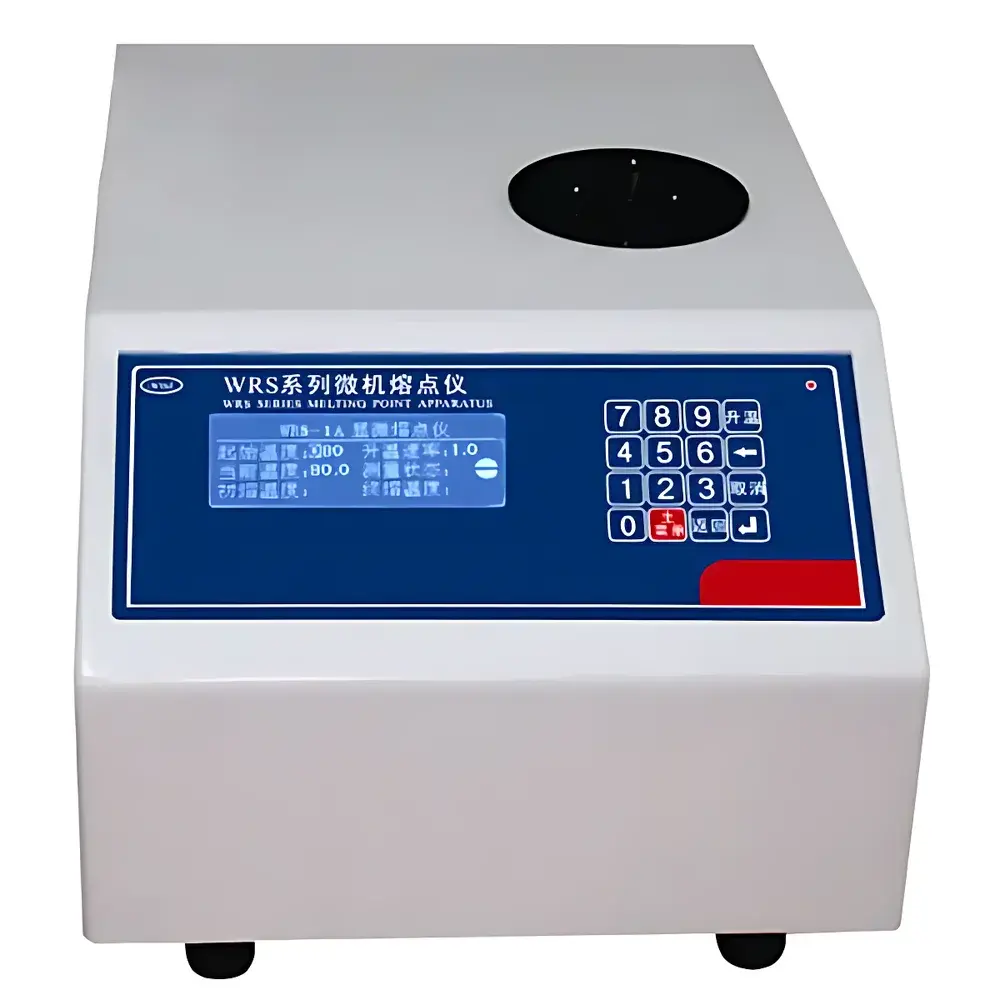
BM WRS-1 Microprocessor-Based Melting Point Apparatus
| Brand | BM |
|---|---|
| Origin | Shanghai, China |
| Model | WRS-1 |
| Temperature Range | 50–320 °C |
| Heating Rates | 0.2, 0.5, 1.0, 1.5, 2.3, 4.5 °C/min |
| Temperature Repeatability | ±0.2 °C (at 0.2 °C/min), ±0.3 °C (at 1.0 °C/min) |
| Temperature Accuracy | ±0.5 °C (<200 °C), ±0.8 °C (≥200 °C) |
| Capillary Dimensions | OD 1.4 mm, ID 1.0 mm |
| Temperature Resolution | 0.1 °C |
Overview
The BM WRS-1 Microprocessor-Based Melting Point Apparatus is a precision thermal analysis instrument engineered for reliable, repeatable determination of solid-phase transition temperatures in organic and pharmaceutical compounds. It operates on the principle of optical detection—utilizing a high-contrast photodiode array to monitor light transmission through a capillary tube containing the sample as it undergoes phase change. As the sample melts, its optical transmittance increases sharply; the instrument automatically detects both onset (initial melting) and clear point (complete melting) based on real-time photometric signal thresholds. Temperature control is achieved via a digitally regulated Peltier-heated block with closed-loop feedback, ensuring stable ramp profiles across the full 50–320 °C operating range. Designed for laboratories requiring regulatory-compliant, cost-effective routine testing—especially QC/QA environments in generics manufacturing, academic teaching labs, and contract research organizations—the WRS-1 delivers metrological performance aligned with pharmacopeial standards without the complexity or cost of high-end differential scanning calorimeters.
Key Features
- Digital microprocessor-controlled heating system with six selectable linear ramp rates (0.2–4.5 °C/min), each calibrated to within ±2% of setpoint
- High-resolution 0.1 °C temperature display and internal resolution, supporting traceable calibration verification
- Integrated 128×64 dot-matrix LCD showing simultaneous readouts: set start temperature, selected ramp rate, real-time block temperature, operational status, and final melt interval (onset/clear)
- Optimized optical path with fixed-focus illumination and photodetector alignment, minimizing drift and enhancing signal-to-noise ratio for low-mass samples
- Capillary holder designed for standardized 1.4 mm OD × 1.0 mm ID glass tubes—compatible with USP & EP-compliant sample preparation protocols
- Front-panel membrane keypad with intuitive menu navigation; no external software required for basic operation
Sample Compatibility & Compliance
The WRS-1 accepts standard 1–3 mg crystalline or powdered organic solids loaded into thin-walled capillaries per ICH Q5A and USP <741> guidelines. Its optical detection method eliminates interference from coloration, opacity, or decomposition onset—making it suitable for APIs, excipients, polymers, and natural product isolates. While not a GLP-certified instrument out-of-the-box, its documented temperature accuracy (±0.5 °C below 200 °C), repeatability (≤0.3 °C at 1.0 °C/min), and digital audit trail capability (via optional RS232/USB models) support alignment with ISO/IEC 17025 method validation requirements. The absence of mechanical stirring or pressure dependency ensures compliance with monograph-based melting point tests referenced in Ph. Eur. 2.2.17 and JP 2.60.
Software & Data Management
The WRS-1R (RS232) and WRS-1U (USB) variants interface with Windows-based host software for extended functionality. This application enables real-time visualization of transmittance vs. temperature curves, manual or algorithmic onset detection, multi-sample batch reporting, and export of ASCII/CSV data files. All measurement records include timestamp, operator ID (user-configurable), instrument serial number, and environmental metadata—facilitating integration into LIMS or electronic lab notebooks. The software supports FDA 21 CFR Part 11-compliant user access controls when deployed on validated IT infrastructure, including electronic signatures and immutable audit logs for QC documentation.
Applications
- Routine identity confirmation and purity assessment of active pharmaceutical ingredients (APIs) per USP-NF monographs
- Stability-indicating testing during accelerated and long-term storage studies
- Batch release testing in non-GMP and GMP-light manufacturing settings
- Teaching laboratory experiments in organic chemistry, medicinal chemistry, and materials science curricula
- Pre-screening of polymorphic forms prior to XRD or DSC characterization
- Verification of reference standard integrity prior to use in analytical method development
FAQ
What capillary specifications are required for optimal performance?
Standard 1.4 mm outer diameter × 1.0 mm inner diameter borosilicate glass capillaries—filled to 3–5 mm height with dry, finely powdered sample—are recommended for consistent heat transfer and optical detection.
Is calibration traceable to national standards?
Yes; users may perform two-point calibration using NIST-traceable reference standards (e.g., pure indium, tin, or bismuth) at defined temperatures. Calibration coefficients are stored in non-volatile memory.
Can the WRS-1 meet pharmacopeial requirements for melting point determination?
It satisfies the instrumental criteria outlined in USP <741>, Ph. Eur. 2.2.17, and JP 2.60 for manual and automatic optical methods—including specified ramp rates, temperature accuracy, and repeatability thresholds.
Does the base WRS-1A model support data export?
No—the WRS-1A provides only local display and manual recording. For electronic data capture, the WRS-1R (RS232) or WRS-1U (USB) configurations are required.
What maintenance is required to ensure long-term accuracy?
Annual verification using certified reference materials is advised. Optical windows should be cleaned with lint-free wipes and ethanol; no lubrication or mechanical adjustment is needed due to solid-state thermal design.



