
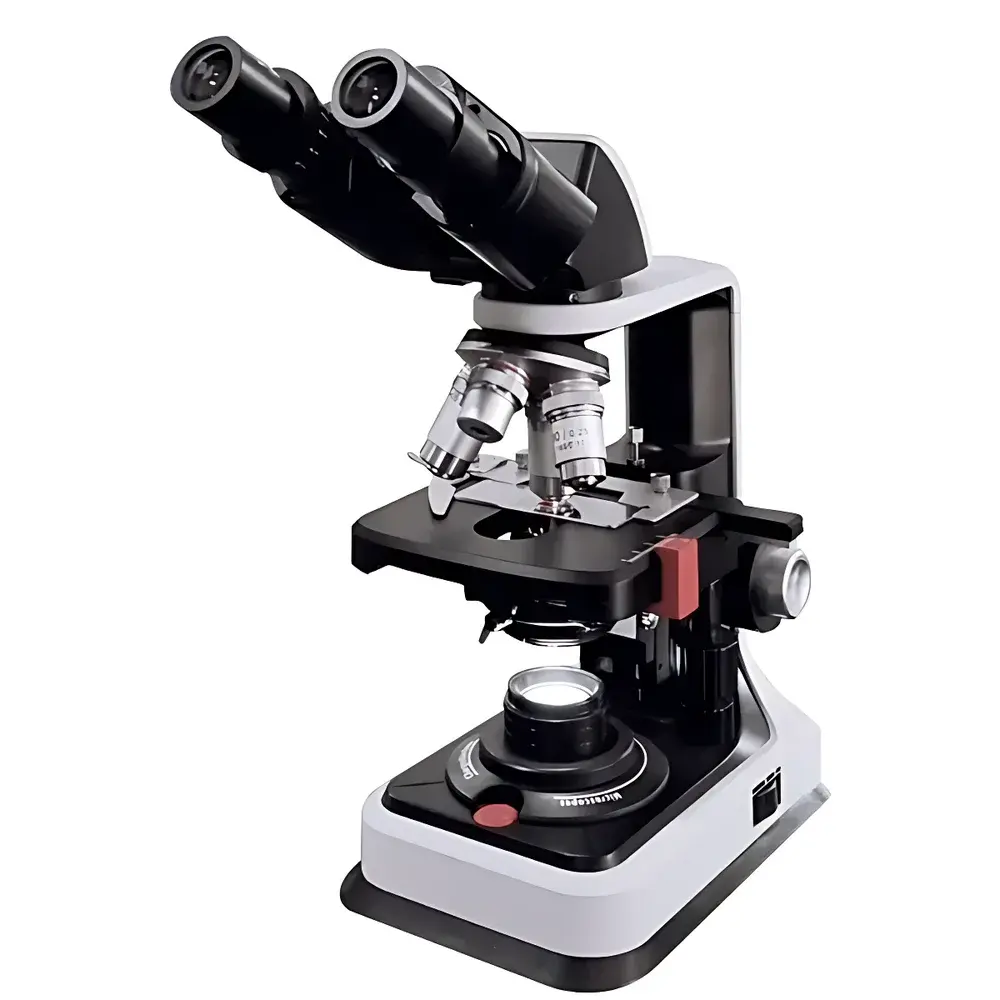
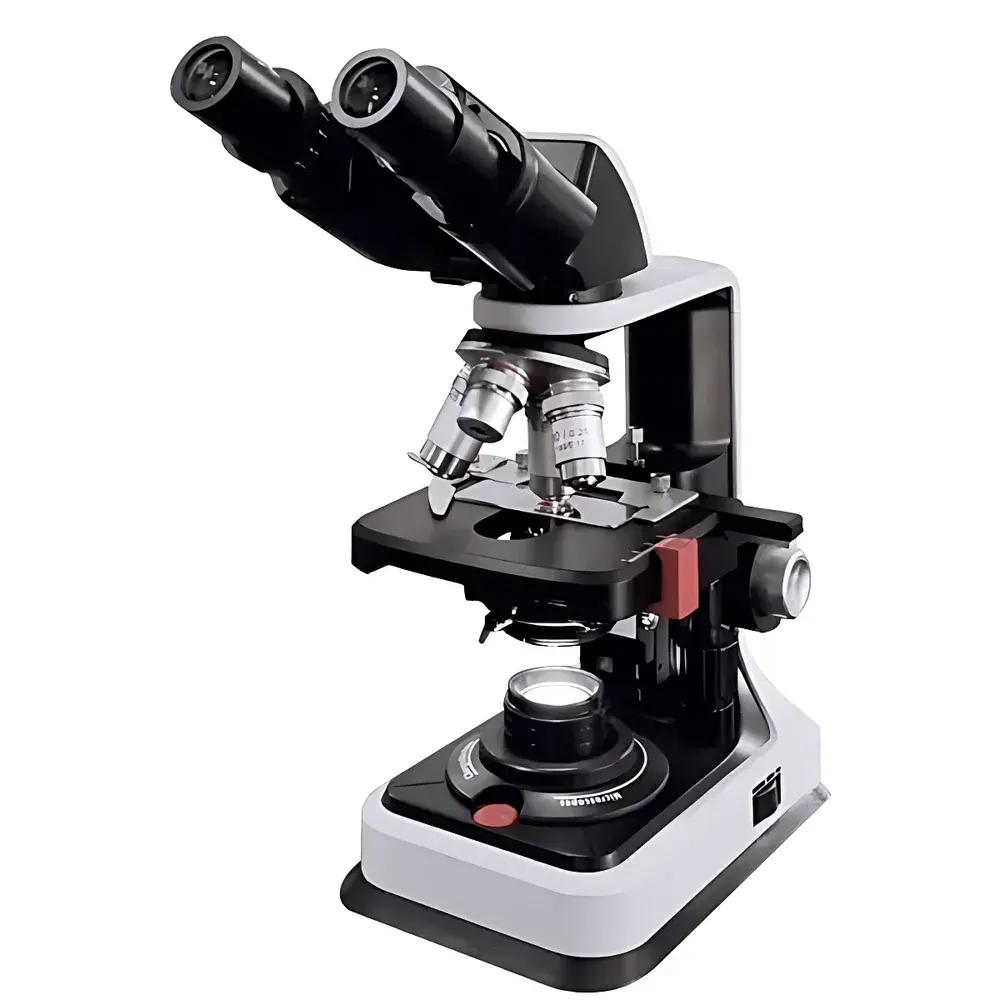
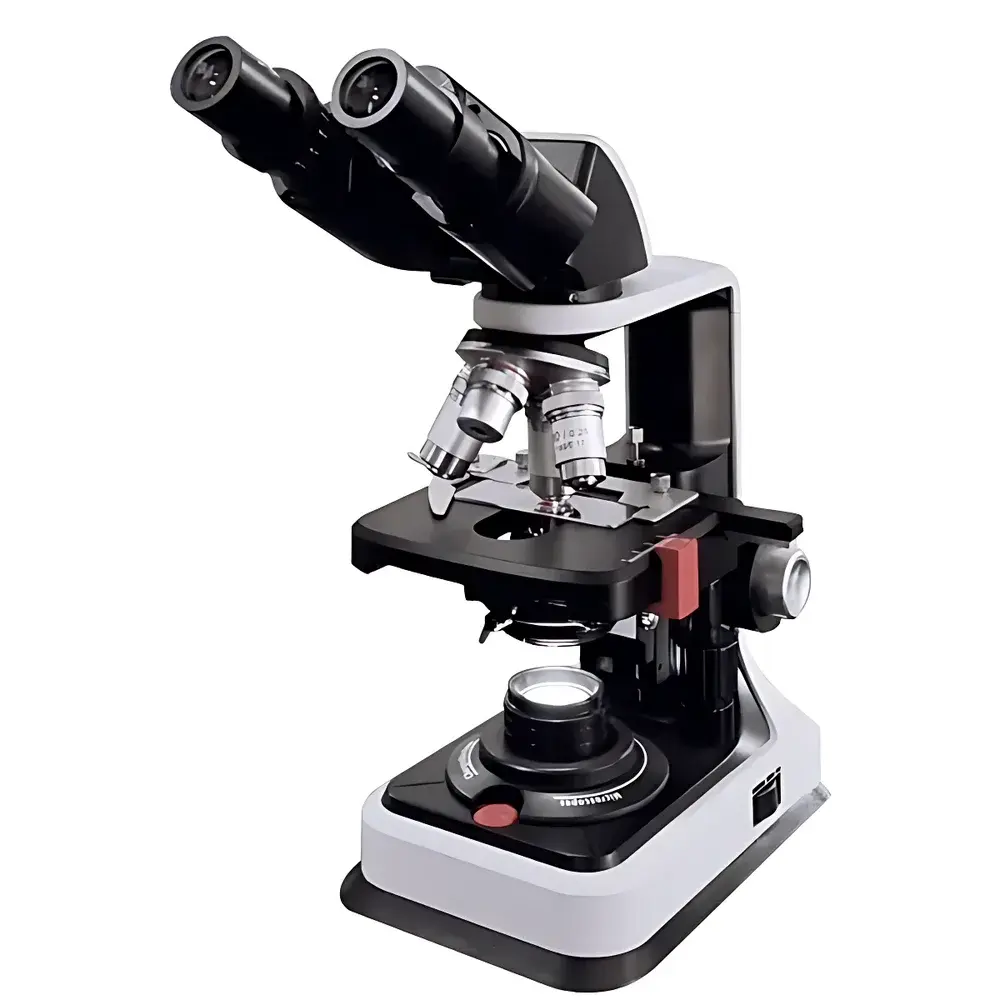
BM XSP-BM-6C Biological Microscope
| Brand | BM |
|---|---|
| Origin | Shanghai, China |
| Microscope Type | Upright Biological Microscope |
| Eyepiece Configuration | Binocular |
| Mechanical Tube Length | 160 mm |
| Objective Lenses | 4× (NA 0.10, WD 37.5 mm), 10× (NA 0.25, WD 7.31 mm), 40× (NA 0.65, WD 0.63 mm), 100× Oil (NA 1.25, WD 0.18 mm) |
| Eyepieces | Widefield 10×/Φ18 mm (standard), optional 16×/Φ11 mm |
| Total Magnification Range | 40×–1600× |
| Stage | Dual-layer mechanical stage (110 × 120 mm, travel 70 × 30 mm) |
| Interpupillary Adjustment | 50–75 mm |
| Focus Mechanism | Coaxial coarse/fine focusing, fine focus graduation 0.02 mm |
| Condenser | Abbe condenser, NA 1.25, adjustable iris diaphragm |
| Filter | Blue filter included |
| Illumination | Adjustable-intensity LED light source with integrated Type-C rechargeable power module and onboard cable management |
Overview
The BM XSP-BM-6C Biological Microscope is an upright, transmitted-light optical microscope engineered for routine and instructional applications in life science laboratories. Designed in accordance with standard finite-conjugate optical architecture (mechanical tube length 160 mm), it employs achromatic objective lenses and widefield eyepieces to deliver consistent image fidelity across the full magnification range of 40× to 1600×. Its LED-based Köhler-compatible illumination system ensures stable, flicker-free brightness with continuous intensity control—critical for prolonged observation sessions and quantitative photometric consistency. The 45° inclined, 360° rotatable binocular head accommodates varied user ergonomics and collaborative viewing, while the coaxial coarse/fine focusing mechanism provides precise Z-axis positioning with a 0.02 mm fine-focus graduation—enabling reliable depth discrimination during histological section analysis or live-cell morphology assessment.
Key Features
- Upright finite-conjugate optical design compliant with ISO 8578 and JIS B 7151 standards for biological microscopy
- Four-position rotating nosepiece accommodating 4×, 10×, 40×, and 100× oil immersion achromatic objectives (NA up to 1.25)
- Binocular observation head with interpupillary adjustment (50–75 mm) and ±5 diopter compensation per eyepiece
- Dual-layer mechanical stage (110 × 120 mm) with calibrated X-Y translation (70 × 30 mm range) and low-profile controls for vibration-damped specimen manipulation
- Abbe condenser (NA 1.25) with centering screws and iris diaphragm for optimized contrast and resolution via Köhler illumination setup
- Integrated high-efficiency white LED illuminator (6 V DC, 1 W) with dimming potentiometer; powered via USB-C interface with internal battery management and onboard cable retention bracket
- Standardized DIN 2324 mounting threads on objectives and eyepieces ensure compatibility with third-party accessories including phase contrast sliders, polarizers, and digital camera adapters
Sample Compatibility & Compliance
The XSP-BM-6C supports standard 1 mm-thick glass microscope slides and coverslips (0.13–0.17 mm), enabling routine examination of stained tissue sections (e.g., H&E, Gram), blood smears, microbial cultures, and fixed cell monolayers. Its 100× oil-immersion objective is validated for use with Type A cedarwood oil (refractive index nD = 1.515), satisfying ASTM E287–22 requirements for high-resolution diagnostic imaging. The instrument conforms to IEC 61010-1:2010 safety standards for laboratory electrical equipment and meets CE marking requirements for electromagnetic compatibility (EN 61326-1). While not certified for GLP/GMP-regulated production environments, its mechanical stability, repeatable focus calibration, and traceable optical alignment make it suitable for educational validation protocols and non-critical QC workflows under ISO/IEC 17025-aligned lab practices.
Software & Data Management
The XSP-BM-6C is hardware-ready for integration with third-party digital imaging systems. Its trinocular port (optional adapter required) accepts C-mount or 23.2 mm eyepiece-tube cameras supporting USB 3.0 or HDMI output. When paired with compliant acquisition software (e.g., Ocular Image Capture Suite v4.2+, or open-source alternatives such as MicroManager 2.0), users can generate time-stamped TIFF/ND2 stacks with embedded metadata—including objective ID, magnification, exposure time, and illumination intensity. Audit-trail functionality is enabled through external software logging; however, the microscope itself does not include onboard storage or FDA 21 CFR Part 11-compliant electronic signature capability. All firmware and driver updates are distributed via BM’s authorized regional support channels—not through embedded OTA mechanisms.
Applications
This microscope serves core functions across academic, clinical, and industrial settings: undergraduate histology labs utilize its robust mechanical stage and parfocal objectives for comparative tissue identification; hospital hematology departments deploy it for peripheral blood film review and differential leukocyte counts per CLSI H20-A2 guidelines; pharmaceutical QA units apply it to verify particle morphology in lyophilized formulations; and biotech startups employ it for rapid prototyping of microfluidic device interfaces. Its LED illumination stability (<±2% intensity drift over 4 h at 80% brightness) supports semi-quantitative brightfield densitometry when used with calibrated neutral density filters and NIST-traceable reference slides.
FAQ
Is the XSP-BM-6C compatible with phase contrast or fluorescence accessories?
The base configuration lacks built-in phase annuli or excitation/emission filter cubes; however, the standardized DIN mount and available aftermarket condenser upgrades permit retrofitting for basic phase contrast. Fluorescence capability requires external epi-illumination and is not supported natively.
What is the expected service life of the integrated LED light source?
Rated for ≥25,000 hours at nominal current, with luminous flux degradation <15% over 10,000 hours under continuous operation at 70% intensity.
Does the microscope include calibration documentation traceable to national standards?
A factory-issued Certificate of Conformance accompanies each unit, listing measured mechanical stage linearity (±0.05 mm over full travel) and objective parfocality deviation (≤0.03 mm between 10× and 40×), verified against GB/T 29878–2013 metrological procedures.
Can the Type-C power module be replaced in the field?
No—the rechargeable Li-ion module is potted and non-user-serviceable; BM recommends authorized service center replacement using part number BM-PWR-C3-RM-2024.
Are replacement objectives and eyepieces available through international distributors?
Yes—BM maintains ISO 9001-certified spare parts logistics in EMEA and APAC regions; all optical components carry serialized batch IDs for traceability and comply with RoHS 2011/65/EU directives.




