
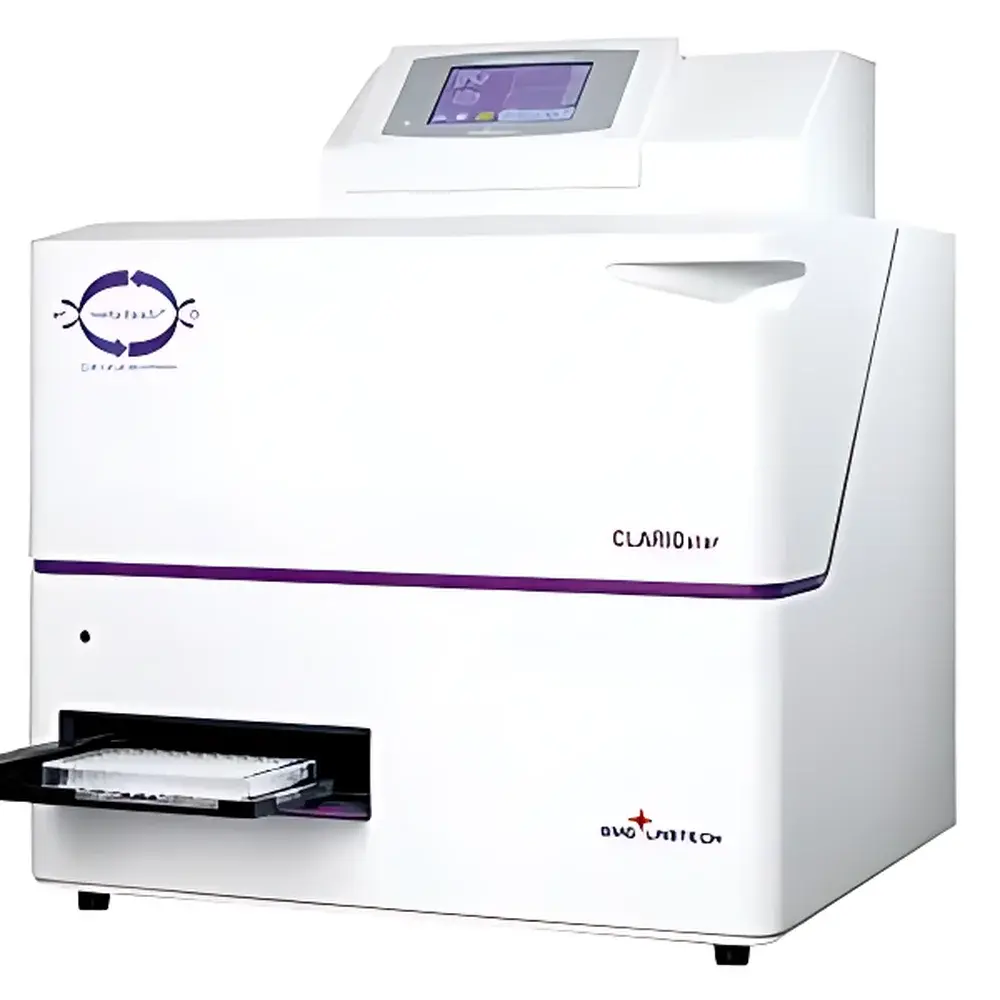
BMG LABTECH CLARIOstar ACU Ischemia-Reperfusion Research System
| Brand | BMG LABTECH |
|---|---|
| Origin | Germany |
| Model | CLARIOstar ACU Ischemia-Reperfusion Research System |
| Application | High-throughput, real-time intracellular oxygen monitoring under physiologically relevant O₂/CO₂-controlled conditions |
| Regulatory Status | Research Use Only (RUO), not for clinical diagnostic use |
| Compliance | Designed to support GLP-compliant workflows and FDA 21 CFR Part 11–ready software configurations (with optional audit trail and user access control) |
Overview
The BMG LABTECH CLARIOstar ACU Ischemia-Reperfusion Research System is a fully integrated, modular microplate reader platform engineered for precise, dynamic control of gaseous microenvironments—specifically O₂ and CO₂ partial pressures—within standard microplates during live-cell assays. Unlike conventional plate readers operating under ambient atmospheric conditions (~20.9% O₂), the CLARIOstar ACU enables programmable hypoxia (<1% to 14% O₂), normoxia (5–10% O₂), hyperoxia, and rapid deoxygenation/reoxygenation cycles—mimicking pathophysiologically relevant ischemia-reperfusion (I/R) transitions. Its core measurement principle combines time-resolved fluorescence (TRF) and dual-wavelength ratiometric detection with gas-permeable sensor plates and cell-permeable optical probes (e.g., MitoXpress®-Intra) to quantify intracellular oxygen tension (pO₂) in real time, without perturbing cellular metabolism. This system bridges a critical gap in translational cell biology: enabling high-content, kinetic assessment of mitochondrial respiration, redox stress, membrane potential collapse, and cell fate decisions—under gas conditions that reflect tissue-specific physiology rather than artificial atmospheric norms.
Key Features
- Integrated Atmospheric Control Unit (ACU): Independently regulates O₂ (0.1–21% ±0.2%) and CO₂ (0–20% ±0.1%) concentrations inside the reader chamber with <60-second equilibration time per setpoint change.
- Real-time intracellular pO₂ monitoring: Compatible with phosphorescence-quenching probes (e.g., MitoXpress®-Intra) for quantitative, non-invasive, subcellular O₂ sensing with millisecond temporal resolution.
- Simultaneous multimodal readouts: Concurrent detection of pO₂, mitochondrial membrane potential (ΔΨm; via JC-1 ratiometric fluorescence), reactive oxygen species (ROS; via DHE oxidation), apoptosis/necrosis (Annexin V/PI), and metabolic activity (resazurin reduction).
- Physiological relevance by design: Supports 2D monolayers, 3D spheroids, and iPSC-derived cardiomyocytes (e.g., Cor.4U®) under tunable O₂ gradients matching hepatic (2–5%), cardiac (1–5%), or neuronal (1–8%) tissue niches.
- High-throughput I/R modeling: Enables automated, plate-wide induction of synchronized ischemia (≤0.5% O₂ for defined duration) followed by controlled reperfusion (stepwise or ramped O₂ restoration), with full kinetic trace logging.
- Robust thermal and humidity control: Maintains stable incubation conditions (30–45°C ±0.2°C; 30–95% RH) throughout extended kinetic runs up to 72 hours.
Sample Compatibility & Compliance
The CLARIOstar ACU accommodates standard 6–384-well microplates—including black, white, clear-bottom, and gas-permeable μClear® plates—and is validated for adherent (HepG2, HUVECs), suspension (THP-1), and 3D-cultured cells (tumor spheroids, cardiac organoids). All assay protocols are compatible with ISO/IEC 17025-aligned validation frameworks and support Good Laboratory Practice (GLP) documentation requirements. While the system itself carries CE-IVD marking for RUO instrumentation, its software architecture supports optional 21 CFR Part 11 compliance modules—including electronic signatures, role-based access control, and immutable audit trails—for regulated preclinical studies. It does not meet clinical diagnostic standards and is explicitly designated “Research Use Only” per EU IVDR Annex XVI and US FDA guidance.
Software & Data Management
The MARS data analysis software (v4.20+) provides dedicated I/R experiment wizards, including stepwise O₂/CO₂ profile scripting, automatic baseline correction for probe photobleaching, and kinetic curve fitting using mono-/bi-exponential decay models for phosphorescence lifetime analysis. Raw fluorescence intensity, ratio, and lifetime values are exportable in .csv and .xlsx formats; metadata (gas setpoints, timestamps, temperature logs) is embedded in each dataset. For longitudinal studies, MARS integrates with LIMS via RESTful API and supports batch processing across multiple plates with QC flagging for wells exhibiting signal drift >5% SD over baseline. Optional cloud backup and multi-user collaborative workspaces ensure reproducibility across distributed research teams.
Applications
- Cardiovascular disease modeling: Quantifying ROS burst kinetics and ΔΨm collapse during simulated myocardial I/R in iPSC-cardiomyocytes.
- Neuroprotection screening: Evaluating compound efficacy in attenuating mitochondrial depolarization in primary cortical neurons exposed to transient hypoxia.
- Oncology metabolism studies: Mapping Warburg-to-oxidative phosphorylation shifts under tumor-mimetic hypoxia (1% O₂) and reoxygenation.
- Drug toxicity profiling: Differentiating on-target mitochondrial inhibition from off-target oxidative damage using multiplexed pO₂/ROS/ΔΨm endpoints.
- Stem cell differentiation optimization: Monitoring real-time O₂ consumption rates during mesodermal commitment under physiologically tuned O₂ gradients.
FAQ
Can the CLARIOstar ACU be used for long-term (>24 h) hypoxic culture?
Yes—the ACU maintains stable O₂/CO₂ setpoints for up to 72 h with continuous monitoring and active feedback control; humidity and temperature stability are independently verified over extended durations.
Is calibration of the O₂ sensor required before each experiment?
No—O₂ and CO₂ sensors are factory-calibrated and drift-compensated in real time via internal reference channels; users perform only a single-point verification using certified gas mixtures annually or after service.
Which probe types are validated for intracellular pO₂ measurement?
MitoXpress®-Intra (Luxcel Biosciences) is fully validated; alternative phosphorescent nanosensors (e.g., PtPFPP-based probes) may be used if emission lifetimes fall within the CLARIOstar’s TRF detection window (1–1000 µs).
Does the system support kinetic measurements during gas transitions?
Yes—data acquisition can be triggered synchronously with ACU gas step changes, enabling ms-resolution capture of early pO₂ redistribution and ROS onset immediately post-reperfusion.
Can I integrate this system into an automated liquid handling workflow?
Yes—CLARIOstar ACU supports standard SLAS/ANSI plate footprints and communicates via RS-232, USB, or Ethernet with third-party robotic arms and dispensers using ASCII command protocol.




