
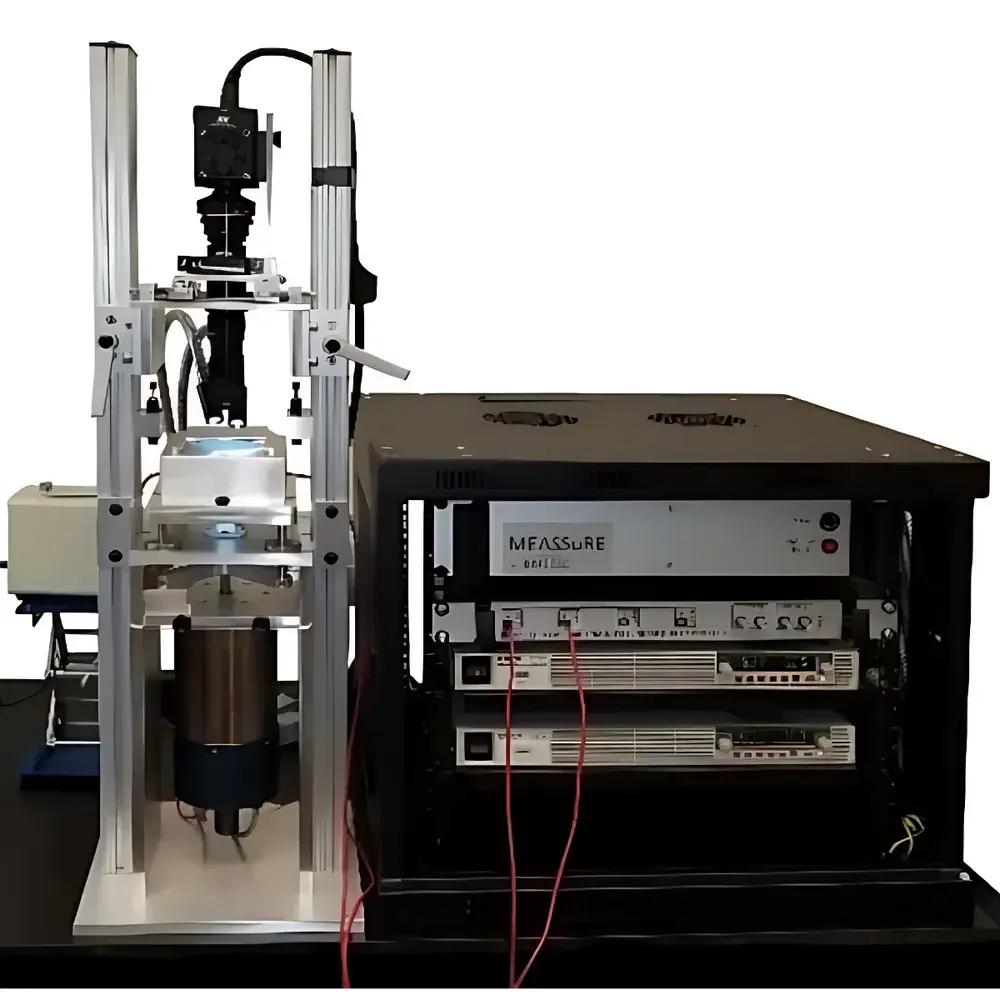
Bmseed MEASSuRE Integrated Mechanical Stretch-Electrophysiology-Imaging System
| Brand | Bmseed |
|---|---|
| Origin | USA |
| Manufacturer Type | Authorized Distributor |
| Product Category | Imported Instrument |
| Model | MEASSuRE |
| Electrode Spacing Options | 200, 330, 370, 400, 447, 960, 1140 µm |
| Electrode Diameter Options | 30, 70, 100, 200 µm |
| Electrode Count Options | 32, 60, 96 |
| Application | In Vitro Electrophysiological & Mechanobiological Studies |
Overview
The Bmseed MEASSuRE Integrated Mechanical Stretch-Electrophysiology-Imaging System is a purpose-built platform engineered for concurrent biomechanical stimulation, high-fidelity extracellular electrophysiological recording, and real-time live-cell optical imaging under controlled in vitro conditions. Unlike conventional modular setups requiring custom integration and synchronization, MEASSuRE employs a unified hardware architecture grounded in piezoelectric actuation, low-noise analog signal conditioning, and synchronized LED-based fluorescence/phase-contrast illumination. Its core measurement principle combines uniaxial or biaxial mechanical strain application (via programmable substrate deformation) with simultaneous multi-channel extracellular field potential acquisition across scalable microelectrode arrays (MEAs), all while maintaining optical access for time-resolved morphological and functional imaging. This tri-modal capability enables rigorous investigation of mechanoelectrical coupling—particularly relevant to cardiac myocytes, neuronal networks, skeletal muscle constructs, and engineered tissue models—under physiologically representative mechanical loading regimes.
Key Features
- Integrated tri-functional architecture: Co-registered mechanical stretch, electrophysiological acquisition, and optical imaging within a single calibrated coordinate system.
- Proprietary stretchable microelectrode arrays (sMEAs) fabricated using elastomeric substrates and conductive nanocomposite traces—exclusively licensed and manufactured by Bmseed—to maintain electrode integrity and signal fidelity during cyclic strain (up to ±20% elongation, depending on configuration).
- Programmable mechanical actuation module with sub-micron displacement resolution, closed-loop feedback control, and waveform flexibility (sinusoidal, step, ramp, custom-defined profiles).
- Low-noise, high-input-impedance electrophysiology front-end supporting DC-coupled recording, bipolar stimulation, and configurable gain/filtering (0.1 Hz–10 kHz bandwidth).
- Optical module compatible with standard inverted microscopy platforms; includes motorized Z-stage, LED excitation sources (365–630 nm), and integrated CMOS sensor with ≥16-bit dynamic range.
- Modular electrode configurations: selectable electrode counts (32, 60, 96), inter-electrode spacing (200–1140 µm), and electrode diameters (30–200 µm) optimized for specific cell types and network densities.
Sample Compatibility & Compliance
MEASSuRE supports adherent primary and stem-cell-derived cultures—including cardiomyocytes, cortical neurons, iPSC-derived neural organoids, and skeletal myotubes—grown on compliant silicone or PDMS substrates patterned with sMEA layouts. The system accommodates standard 6-, 12-, 24-, and 96-well plate formats with optical-grade bottom transparency. All electrical components comply with IEC 61010-1 safety standards for laboratory equipment. Data acquisition firmware implements timestamp-synchronized sampling across all modalities at user-defined rates (up to 50 kS/s per channel), ensuring temporal alignment required for GLP-compliant mechanobiology studies. While not certified for clinical use, MEASSuRE-generated datasets are structured to support audit-ready documentation per FDA 21 CFR Part 11 when deployed with validated software workflows.
Software & Data Management
The MEASSuRE Control Suite provides a unified graphical interface for experiment design, real-time monitoring, and post-hoc analysis. It supports deterministic scheduling of multi-parameter protocols (e.g., “apply 1 Hz sinusoidal strain at 10% amplitude for 30 min while recording field potentials at 20 kS/s and capturing phase-contrast images every 5 s”). Raw data are stored in HDF5 format with embedded metadata (electrode mapping, strain profile parameters, optical exposure settings). Built-in analysis modules include spike detection (template matching and threshold-based), local field potential (LFP) spectral decomposition (FFT, wavelet), strain-induced latency shift quantification, and cross-correlation between mechanical onset and electrophysiological response. Export options include MATLAB (.mat), Python-compatible NumPy arrays, and CSV for third-party statistical packages. Audit trails log all parameter modifications, user sessions, and file exports—enabling traceability in regulated research environments.
Applications
- Cardiac arrhythmia modeling: Quantifying stretch-activated ion channel contributions (e.g., SACs, TREK-1) to conduction velocity dispersion and ectopic activity in engineered heart tissues.
- Neurodevelopmental mechanosensing: Assessing how substrate stiffness and dynamic strain modulate spontaneous network bursting patterns and synaptic maturation in cortical co-cultures.
- Myopathies and muscular dystrophy research: Evaluating contractile dysfunction and compensatory electrophysiological adaptations in patient-derived myotube models subjected to physiological strain cycles.
- Drug safety pharmacology: Screening compound effects on mechano-electric feedback loops—particularly relevant for anti-arrhythmic and neuroactive agents where mechanical context alters pharmacodynamic profiles.
- Tissue engineering validation: Correlating structural remodeling (via time-lapse imaging) with functional electrophysiological maturation during mechanically conditioned bioreactor culture.
FAQ
Is the MEASSuRE system compatible with existing inverted microscopes?
Yes—optical module dimensions and mounting interfaces are designed to integrate with standard Nikon Eclipse Ti, Olympus IX83, and Zeiss Axio Observer platforms without optical path modification.
Can electrode configurations be customized beyond the listed options?
Custom sMEA designs (e.g., non-rectangular layouts, asymmetric spacing, or hybrid electrode materials) are available under NDA-supported development contracts with Bmseed’s microfabrication team.
What level of mechanical strain reproducibility does the system achieve?
Positional repeatability is ±0.3 µm over 10⁴ cycles; strain amplitude accuracy is ±1.2% of setpoint across the full operational range (0.5–20% uniaxial strain), verified via digital image correlation (DIC) calibration.
Does the system support optogenetic stimulation?
The optical module includes TTL-triggered LED drivers compatible with common opsins (ChR2, ReaChR); precise spatiotemporal alignment with electrophysiology channels is maintained via hardware-synchronized triggering.
How is data synchronization handled across the three modalities?
A central FPGA-based timing engine generates phase-locked clocks for all subsystems; absolute timestamps are embedded in each acquired frame/sample using a shared 10 MHz reference oscillator traceable to UTC via NTP sync.






