
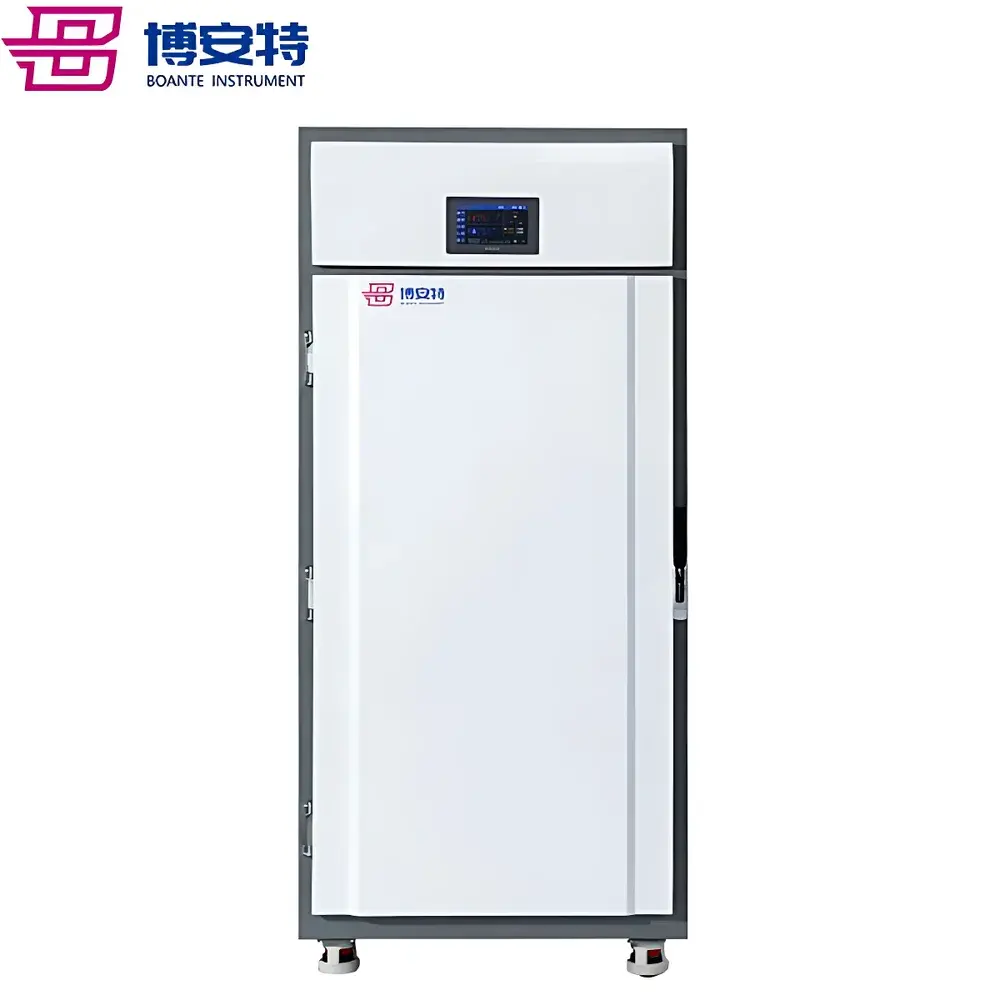
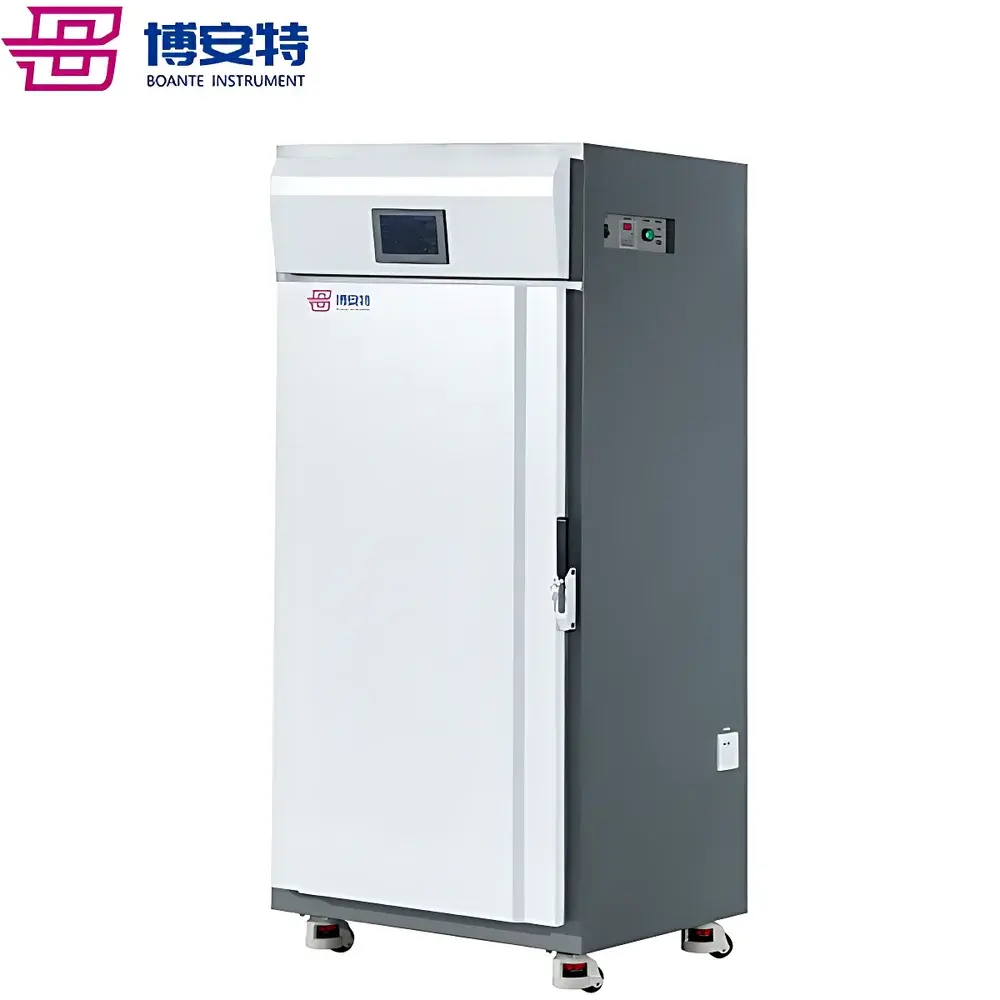
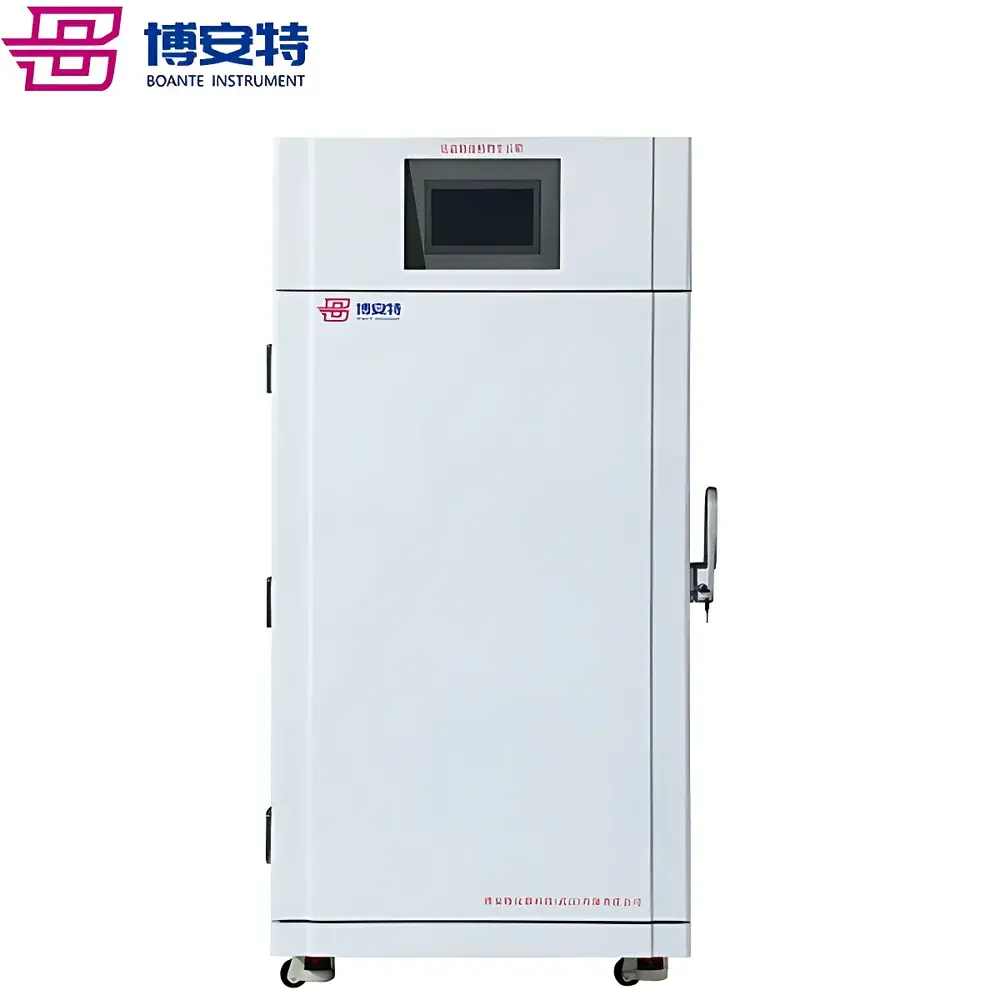
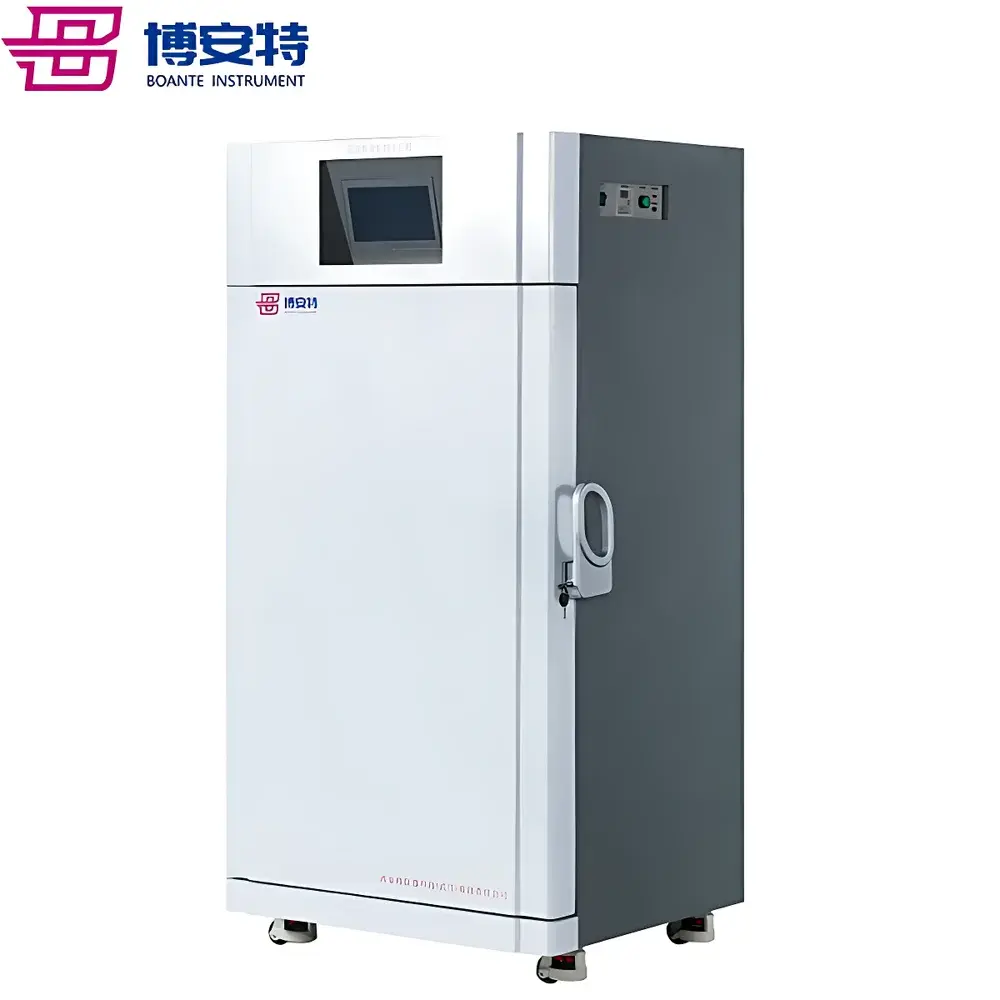
Boante BAT-Series Programmable Plant Growth Chambers for Stress Physiology Studies (High-Temperature & Low-Temperature Models)
| Brand | Boante |
|---|---|
| Origin | Hubei, China |
| Model Series | BAT600/800/1000/1250/1700/2000PG-HT (High-Temp) / BAT600/800/1000PG-DW (Low-Temp) |
| Temperature Range | 5–45 °C (HT) |
| Temp. Uniformity | ±0.5 °C (HT), ±1.0 °C (DW) |
| Temp. Stability | ±0.2 °C |
| Humidity Range | 40–80 %RH (light on), 50–90 %RH (light off) |
| Humidity Control Accuracy | ±1 %RH |
| Light Intensity | 0–600 µmol·m⁻²·s⁻¹ (at 100 mm from LED source) |
| Light Spectrum | Full visible spectrum (400–700 nm PAR) |
| Illumination Control | 0–100% stepless dimming per shelf |
| Chamber Volume | 600–2000 L |
| Shelf Configuration | Dual-layer independent lighting control |
| External Dimensions | Up to 1980 × 920 × 2080 mm |
| Internal Dimensions | Up to 1874 × 728 × 1500 mm |
| Power Management | Adaptive thermal bypass refrigeration with electromagnetic defrost |
| Control System | BAT200PG OS, 7-inch color touchscreen, 24-segment programmable logic, APID fuzzy algorithm, 5-year onboard data logging |
| Safety Protections | Compressor overheat, fan overheat, over-temperature, high-pressure cut-off, overload protection |
| Compliance | Designed for GLP-compliant environmental simulation |
Overview
The Boante BAT-Series Programmable Plant Growth Chambers are engineered for controlled-environment plant phenotyping under abiotic stress conditions—including temperature extremes, photoperiod variation, and humidity modulation. These chambers employ a dual-mode thermodynamic architecture: high-temperature models (PG-HT) operate from 5 °C to 45 °C, while low-temperature variants (PG-DW) extend down to –10 °C (optionally –20 °C), enabling reproducible simulation of cold acclimation, heat shock, and diurnal cycling protocols. Core environmental parameters—temperature, relative humidity, and photosynthetically active radiation (PAR)—are independently regulated across two vertically segregated shelves, each equipped with dedicated LED arrays and real-time feedback loops. The system integrates adaptive thermal bypass refrigeration and electromagnetic valve-based defrosting to eliminate humidity spikes and temperature overshoot during cyclic operation—critical for long-term physiological assays where microenvironmental stability directly impacts stomatal conductance, chlorophyll fluorescence, and biomass partitioning metrics.
Key Features
- APID (Adaptive Proportional-Integral-Derivative) fuzzy logic control algorithm ensures ±0.2 °C temperature stability and prevents thermal overshoot during setpoint transitions.
- Dual-shelf independent lighting system with per-layer 0–100% stepless dimming and full-spectrum white LEDs (400–700 nm), delivering up to 600 µmol·m⁻²·s⁻¹ at 100 mm distance—calibrated for consistent PAR distribution across growth surfaces.
- Thermal management via hot-gas bypass refrigeration enables continuous compressor operation, reducing mechanical wear and eliminating cold-start delays that compromise experimental repeatability.
- Electromagnetic defrost cycle eliminates manual defrosting and prevents uncontrolled humidity excursions during low-temperature operation—a known source of condensation-induced leaf necrosis in sensitive genotypes.
- BAT200PG operating system with 7-inch capacitive touchscreen supports 24-segment time-programming, real-time clock synchronization, power-failure memory, and automatic recovery upon grid restoration.
- Four-tier password hierarchy (Factory Admin, Lab Admin, Operator, Engineer) enforces role-based access control, preventing unauthorized parameter modification in shared core facilities.
- Onboard data logger retains ≥5 years of timestamped temperature, humidity, light intensity, and alarm history with CSV export capability for traceability and regulatory reporting.
Sample Compatibility & Compliance
These chambers accommodate standard plant growth vessels—including Petri dishes, Magenta boxes, soil-filled pots (up to 1300 mm height), and hydroponic trays—within configurable internal dimensions ranging from 740 × 585 × 1350 mm (BAT600) to 1874 × 728 × 1500 mm (BAT2000). All models comply with ISO 17025-aligned environmental control validation practices and support qualification protocols per ASTM E1980 (Standard Guide for Environmental Simulation Testing of Plants). When paired with optional CO₂ monitoring modules and validated third-party software, the system meets data integrity requirements outlined in FDA 21 CFR Part 11 for electronic records in regulated research environments. Humidity control is specified across the operational temperature range (15–45 °C), with ±1 %RH accuracy and ≤5 %RH fluctuation—enabling studies on drought response, transpiration efficiency, and xylem embolism thresholds.
Software & Data Management
The embedded BAT200PG OS provides local control without external PC dependency. It stores all environmental logs internally with millisecond-resolution timestamps and includes built-in diagnostic routines for sensor drift detection, compressor duty-cycle analysis, and LED driver health assessment. Data export is supported via USB flash drive in comma-separated values (CSV) format, compatible with MATLAB, R, and Python-based phenomics pipelines. Optional Ethernet or Wi-Fi modules enable remote monitoring and integration into institutional LIMS or ELN platforms. For GLP/GMP workflows, optional audit-trail-enabled firmware upgrades provide immutable event logging—including user login/logout, parameter changes, and alarm acknowledgments—with digital signature verification.
Applications
- Abiotic stress phenotyping: quantifying growth inhibition, electrolyte leakage, and antioxidant enzyme activity under controlled heat/cold exposure.
- Photomorphogenesis studies: dissecting phytochrome and cryptochrome signaling via programmable light-dark cycles with precise spectral fidelity.
- Seed germination kinetics: evaluating thermal time models (e.g., base, optimum, ceiling temperatures) across crop germplasm collections.
- Pathogen–host interaction assays: maintaining stable microclimates during inoculation and disease progression monitoring under defined humidity regimes.
- CRISPR-edited line validation: confirming stable expression of stress-responsive promoters (e.g., DREB, CBF) under graded temperature gradients.
- Pre-acclimation protocols for field transplanting: simulating ramped temperature shifts to assess hardening capacity in horticultural seedlings.
FAQ
What is the lowest achievable temperature with the DW-series chambers?
The standard PG-DW models operate down to –10 °C; an optional extended-range configuration supports –20 °C with enhanced insulation and dual-stage refrigeration.
Can light intensity be calibrated per shelf independently?
Yes—each shelf features isolated LED drivers and factory-calibrated PAR sensors, allowing independent intensity profiling without optical crosstalk.
Is humidity control active below 15 °C?
Humidity regulation is specified for 15–45 °C; below this range, RH is monitored but not actively controlled to prevent condensation-related hardware degradation.
How is data integrity ensured during extended power outages?
The controller retains all settings and logged data in non-volatile memory and resumes scheduled programs automatically upon power restoration, with time-synchronized continuity.
Are third-party sensor inputs supported for custom environmental monitoring?
RS-485 and analog (0–10 V / 4–20 mA) expansion ports are available for integrating external CO₂, ethylene, or leaf temperature sensors—subject to firmware version compatibility.




