
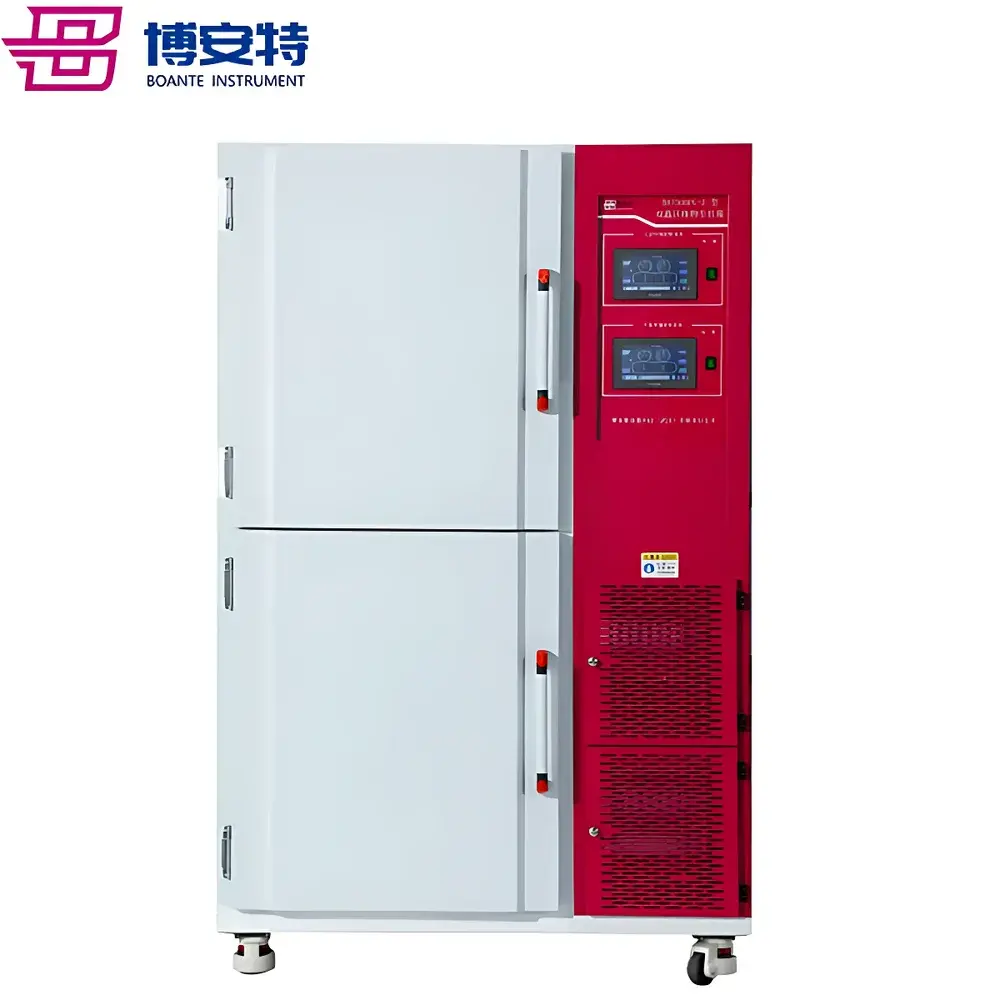
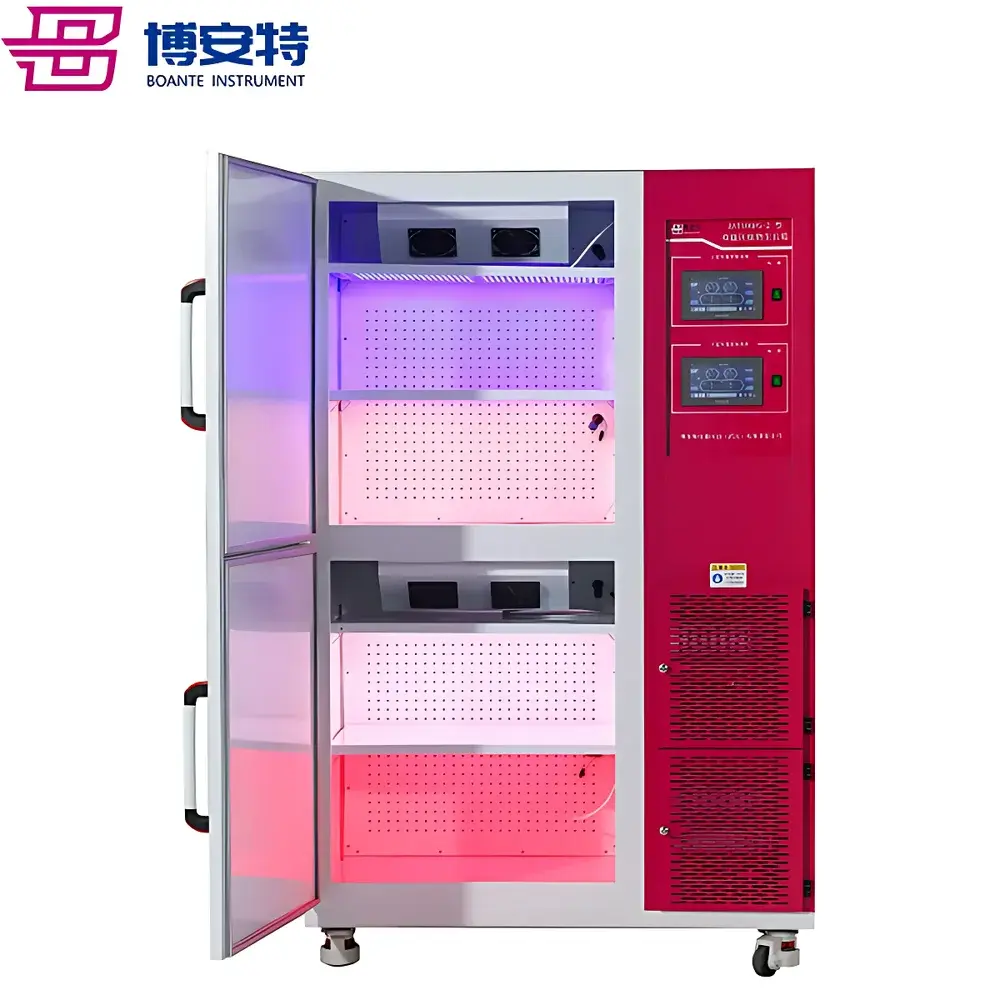
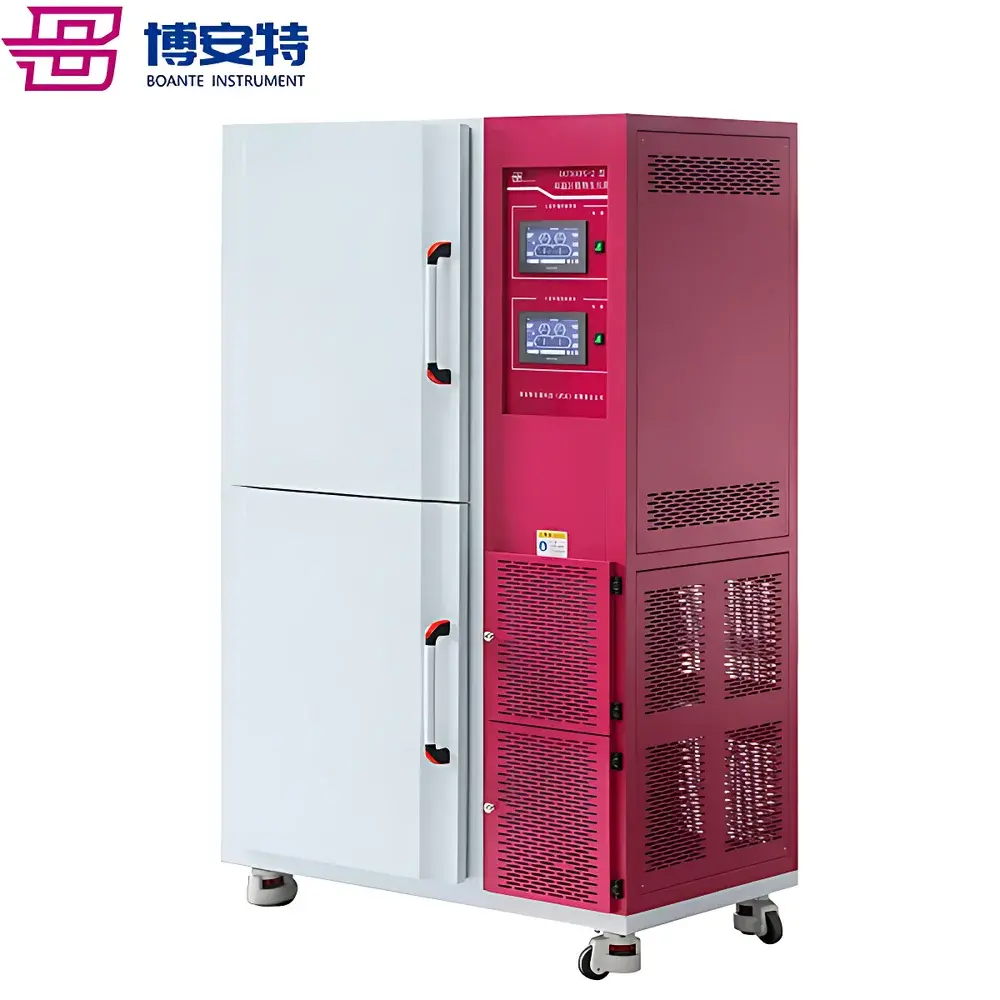
Boante BAT250PG/360PG/460PG/600PG-2 Dual-Zone Plant Growth Chamber
| Brand | Boante |
|---|---|
| Origin | Hubei, China |
| Model | BAT250PG-2 / BAT360PG-2 / BAT460PG-2 / BAT600PG-2 |
| Temperature Range | 5–45 °C (dark), 10–45 °C (with illumination) |
| Temperature Uniformity | ±0.5 °C (within zone) |
| Temperature Stability | ±0.2 °C |
| Humidity Range | 40–80 %RH (light on), 50–90 %RH (light off), within 15–45 °C operating range |
| Humidity Control Accuracy | ±1 %RH |
| Humidity Fluctuation | ±3 %RH |
| Illumination Intensity | 0–600 µmol·m⁻²·s⁻¹ (adjustable 0–100% steplessly) |
| Light Source | LED, visible spectrum |
| Light Distribution | independent top-mounted horizontal illumination per shelf |
| Chamber Volume | 250 L / 360 L / 460 L / 600 L |
| External Dimensions | 1120×720×1900 mm (BAT250PG-2) to 1625×880×2050 mm (BAT600PG-2) |
| Internal Dimensions | 600×520×700 mm × 2 zones (BAT250PG-2) to 1100×680×840 mm × 2 zones (BAT600PG-2) |
| Shelf Configuration | 2 independent dual-zone compartments, 4 total shelves (2 per zone), max plant height: 500–640 mm |
| Control System | BAT200PG OS, 7-inch color touchscreen, 24-segment programmable timeline with real-time Beijing time synchronization |
| Control Algorithm | adaptive three-stage fuzzy logic APID control |
| Data Logging | internal storage for ≥5 years |
| Security | four-tier password management (Factory Admin / User Admin / Operator / Engineer) |
| Defrosting | electromagnetic valve-based full-cycle defrost |
| Safety Protections | compressor overheat, fan overheat, overtemperature, high-pressure cutout, overload protection |
Overview
The Boante BAT250PG/360PG/460PG/600PG-2 Dual-Zone Plant Growth Chamber is an engineered environmental simulation platform designed for controlled-conditions plant physiology, phenotyping, and developmental biology research. Unlike single-zone incubators, this system integrates two thermally and hygroscopically isolated chambers within a single footprint—enabling simultaneous, independent regulation of temperature, relative humidity, and photosynthetic photon flux density (PPFD) in each zone. Each chamber operates under a dedicated microclimate, supporting rigorous experimental designs such as genotype-by-environment (G×E) studies, stress response assays (e.g., drought, heat, or photoperiodic variation), and parallel treatment comparisons without cross-contamination of environmental variables. The system employs a refrigeration architecture with hot-gas bypass technology to ensure continuous cooling operation—eliminating thermal cycling-induced instability—and integrates electromagnetic valve-driven defrosting to maintain humidity precision during extended unattended runs. All operational parameters adhere to the fundamental requirements of GLP-compliant plant science workflows, including traceable time-stamped environmental logging and audit-ready controller diagnostics.
Key Features
- Dual-zone architecture with fully independent PID-controlled temperature and humidity regulation per chamber—no shared air path or thermal coupling
- Top-mounted, shelf-level LED illumination systems delivering uniform PPFD (0–600 µmol·m⁻²·s⁻¹) with 0–100% stepless dimming; optional upgrade to 800 µmol·m⁻²·s⁻¹ or multi-spectral (red/blue/far-red) LED arrays
- BAT200PG operating system with 7-inch capacitive touchscreen interface, supporting 24-segment programmable cycles synchronized to real-time Beijing time—including independent day/night temperature, light intensity, and RH profiles per zone
- Adaptive three-stage fuzzy logic APID control algorithm minimizing overshoot and stabilizing setpoints within ±0.2 °C and ±1 %RH—validated across 15–45 °C and 40–90 %RH operational ranges
- Internal data logger retaining ≥5 years of timestamped environmental records (temperature, humidity, light status, alarms) with export via USB; supports CSV and XML formats for LIMS integration
- Four-tier hierarchical password management (Factory Admin, User Admin, Operator, Engineer) enforcing role-based access control in line with ISO/IEC 27001-aligned lab security protocols
- Comprehensive safety suite: compressor overheat protection, condenser fan thermal cutoff, independent overtemperature limit switches, high-pressure safety valves, and motor overload relays
Sample Compatibility & Compliance
This growth chamber accommodates standard botanical sample formats—including Petri dishes, Magenta boxes, square pots (up to 12 cm × 12 cm), hydroponic trays, and aeroponic mist chambers—across its configurable shelf layouts. Each zone supports up to 640 mm vertical growth clearance (model-dependent), enabling studies on rosette plants, seedlings, short-stature cereals, and model species such as Arabidopsis thaliana, Oryza sativa, and Zea mays. The system complies with core environmental test standards referenced in plant science literature, including ASTM E1826 (standard practice for controlled-environment testing), ISO 17025:2017 (for calibration traceability of onboard sensors), and USP Annex guidelines for non-sterile plant tissue culture environments. While not certified for FDA 21 CFR Part 11 compliance out-of-the-box, the data logging architecture supports validation documentation packages required for GxP-aligned academic and industrial phytochemistry labs.
Software & Data Management
The BAT200PG OS provides native support for environmental protocol definition, real-time parameter monitoring, and event-triggered alarm notifications (audible + visual). Controller firmware includes built-in self-diagnostic routines that identify sensor drift, actuator failure, or communication faults—displaying error codes aligned with service manuals for rapid troubleshooting. Logged datasets include date/time stamps, zone identifiers, setpoint vs. actual values, and alarm history—with automatic rollover to prevent memory overflow. Data export is performed via USB flash drive; no cloud dependency or proprietary software installation is required. For integration into centralized lab infrastructure, optional RS485 Modbus RTU or Ethernet TCP/IP modules enable connection to SCADA platforms or building management systems (BMS), facilitating centralized monitoring across multi-chamber installations.
Applications
- Photoperiod and vernalization response characterization under precisely decoupled thermal/light regimes
- High-throughput screening of abiotic stress tolerance (e.g., combined heat + low-humidity exposure)
- Controlled-environment phenotyping for QTL mapping and GWAS studies
- Seed germination kinetics and dormancy release assays requiring differential stratification conditions
- Pre-acclimation trials prior to field transfer or greenhouse scaling
- Microbial–plant interaction studies where root-zone and shoot-zone climates must be independently modulated
FAQ
Can the two zones operate at significantly different temperatures simultaneously?
Yes—the chambers are physically separated by insulated bulkheads and served by independent refrigeration circuits and humidification paths, enabling stable differential setpoints (e.g., 12 °C in Zone A, 32 °C in Zone B) without measurable thermal bleed.
Is CO₂ concentration control available as a factory-installed option?
CO₂ regulation is offered as an optional add-on module (part number BAT-CO2-2Z), featuring infrared NDIR sensing, solenoid-controlled gas injection, and closed-loop feedback integrated into the BAT200PG scheduler.
What is the calibration interval recommendation for temperature and humidity sensors?
Boante recommends annual verification against NIST-traceable reference standards; onboard sensors are field-calibratable using the Engineer-tier interface with two-point dry/wet check points.
Does the system meet IP rating requirements for laboratory splash resistance?
The controller enclosure meets IP54 (dust-protected, splash-resistant); refrigeration and lighting components are rated for indoor laboratory use per IEC 61000-6-3 EMC standards.
Can lighting spectra be customized beyond standard white LEDs?
Yes—multi-channel RGB+FR LED arrays are available as configured options, supporting user-defined spectral power distributions (SPDs) programmable via .csv spectral templates loaded onto the controller.




