
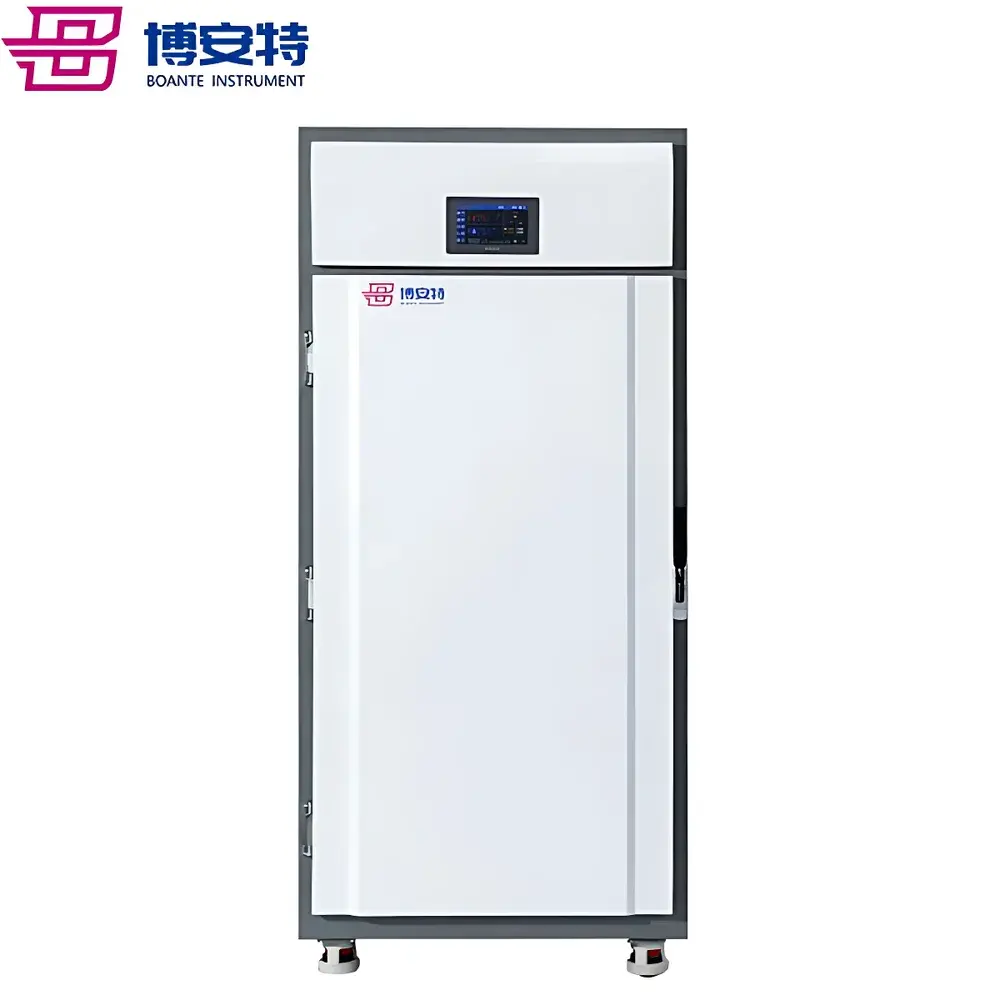
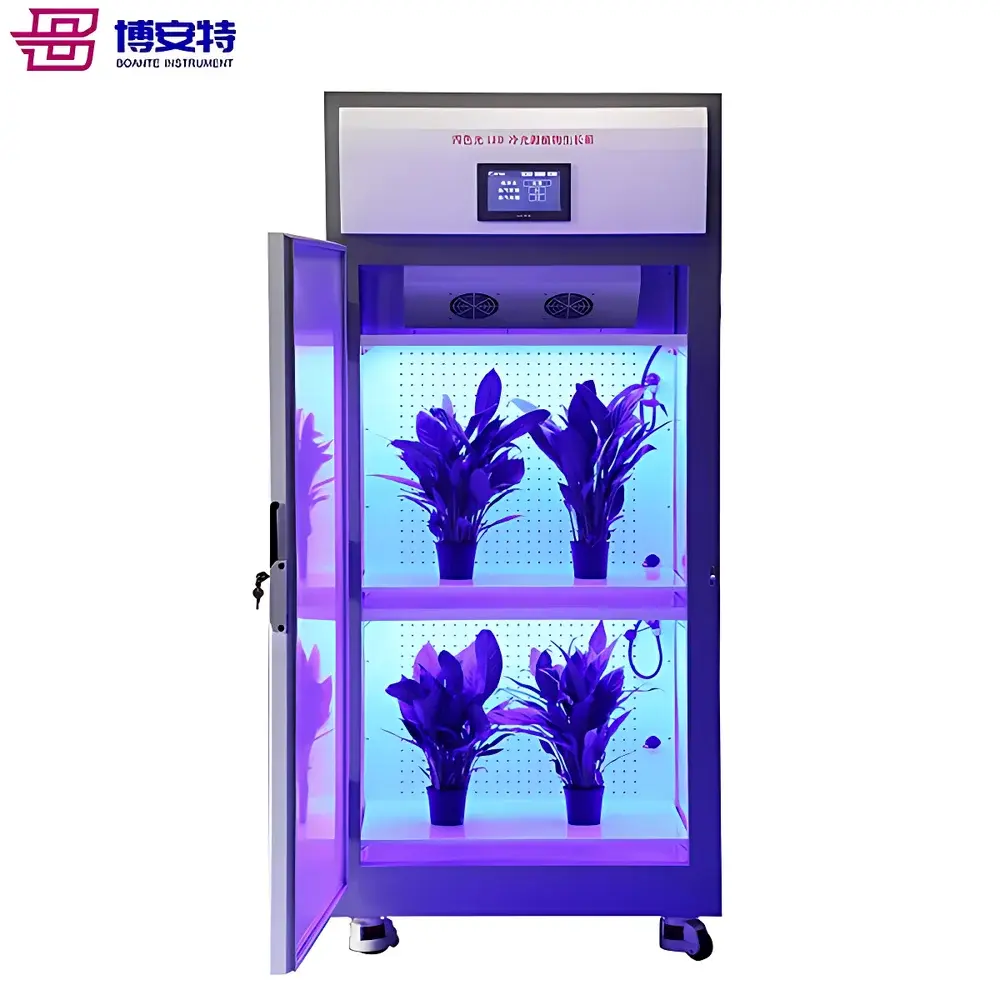
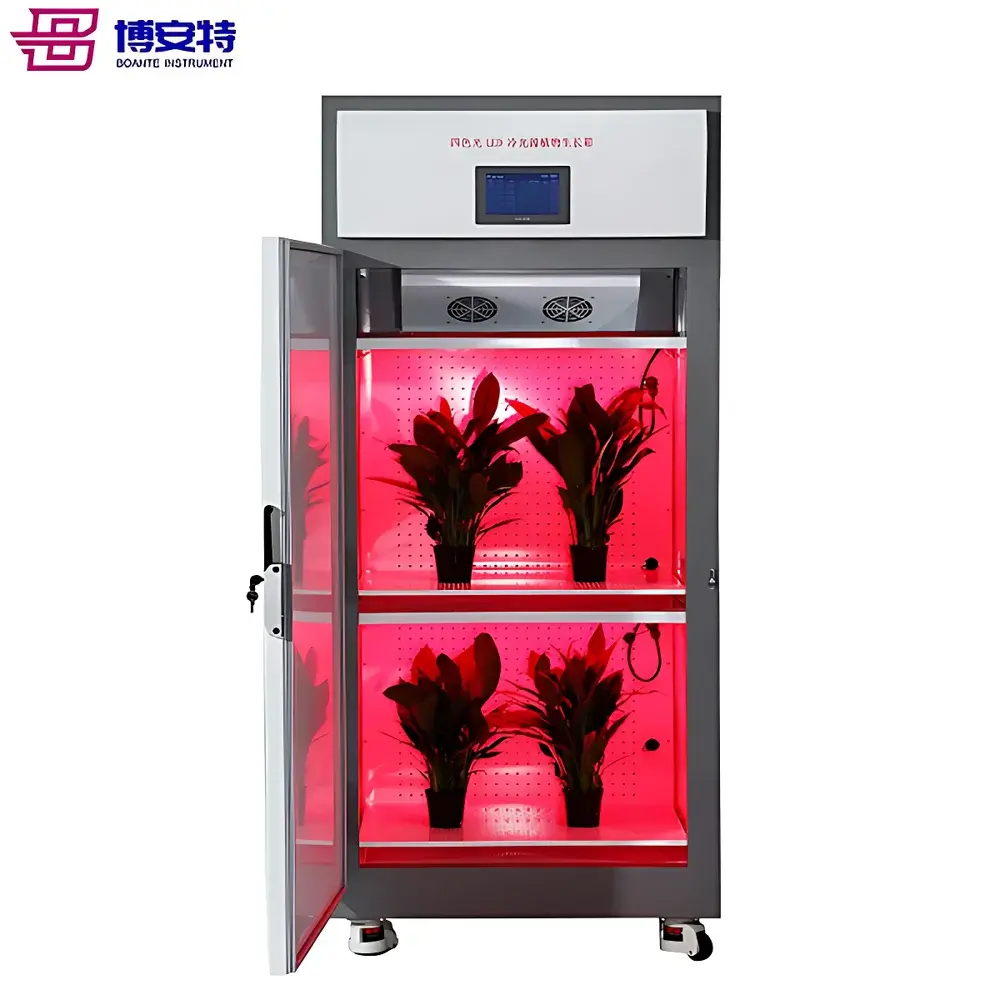
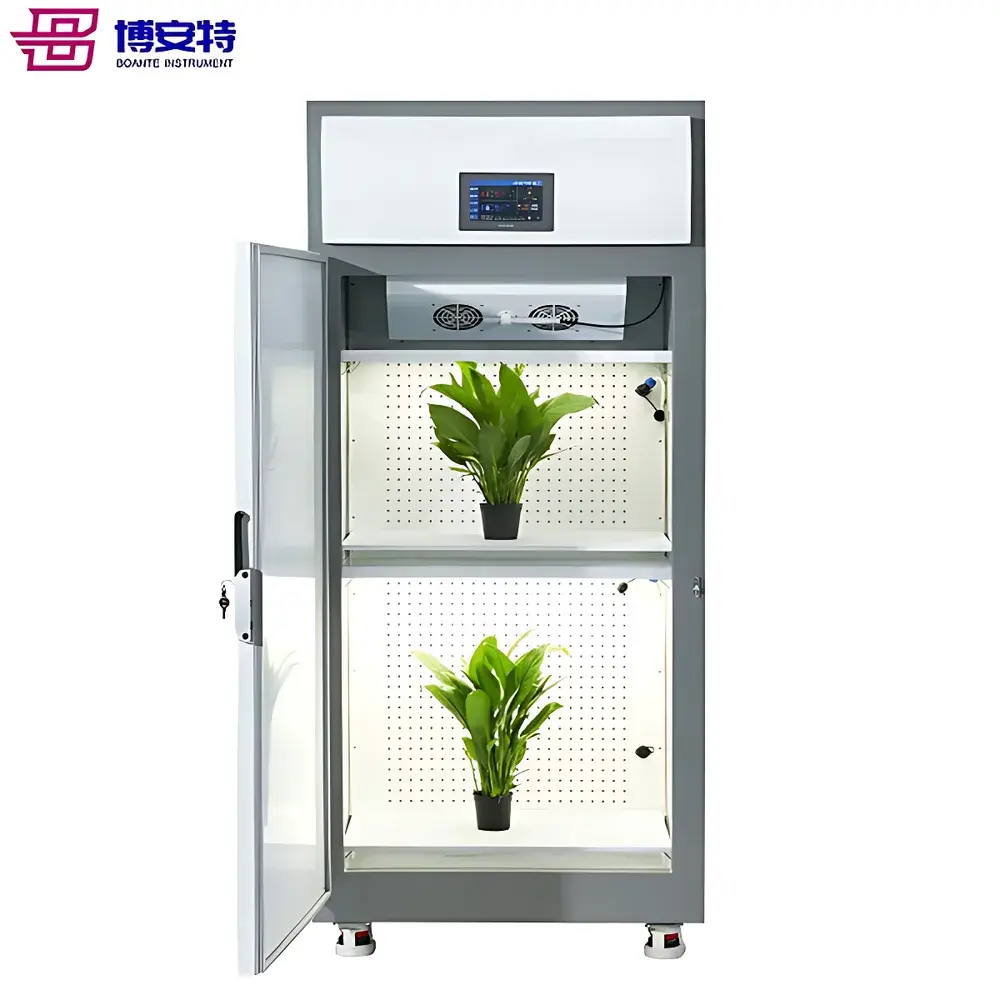
Boante BAT360/600/800/1000ZW-4 Quad-Channel Tunable-Spectrum LED Plant Growth Chamber
| Brand | Boante |
|---|---|
| Origin | Hubei, China |
| Model | BAT360/600/800/1000ZW-4 |
| Temperature Range | 5–45 °C |
| Temp. Uniformity | ±0.5 °C (within chamber plane) |
| Temp. Stability | ±0.2 °C |
| Humidity Range | 40–80 %RH (with lights on) |
| Humidity Stability | ±5 %RH |
| Light Intensity | 0–800 lx (also specified as 0–1000 μmol·m⁻²·s⁻¹ at 100 mm distance) |
| Spectral Channels | 4 independent LED bands — 450 nm (blue), 660 nm (red), 730 nm (far-red), and 6500 K white light |
| Light Control | 0–100 % continuous dimming per channel |
| Illumination Mode | Top-mounted horizontal LED array with adjustable light-layer shelves |
| Chamber Volume | 600 L / 800 L / 1000 L |
| External Dimensions | 850×805×1900 mm (BAT600ZW-4) |
| Compliance | Designed for GLP-compliant plant phenotyping, photobiology, and controlled-environment research |
Overview
The Boante BAT360/600/800/1000ZW-4 Quad-Channel Tunable-Spectrum LED Plant Growth Chamber is an engineered environmental control platform for reproducible, wavelength-resolved plant physiology studies. Unlike conventional growth chambers relying on fixed-spectrum fluorescent or broad-spectrum LED sources, this system integrates four independently controllable narrow-band LED channels—450 nm (blue), 660 nm (red), 730 nm (far-red), and 6500 K white light—enabling precise spectral composition tuning aligned with phytochrome (Pr/Pfr) and cryptochrome action spectra. The chamber operates on a closed-loop thermal management architecture featuring adaptive three-stage fuzzy logic PID control, minimizing temperature overshoot and ensuring spatial uniformity (±0.5 °C within any horizontal plane) across its full working range of 5–45 °C. Humidity is dynamically regulated between 40–80 %RH (lights on) and 50–90 %RH (lights off), with stability maintained within ±5 %RH under steady-state conditions. Its top-mounted, modular LED array delivers uniform irradiance (0–1000 μmol·m⁻²·s⁻¹ at 100 mm) without shadowing, supporting high-fidelity photomorphogenesis experiments from seedling establishment to reproductive staging.
Key Features
- Four-channel independent spectral control: Individual 0–100 % dimming for 450 nm blue, 660 nm red, 730 nm far-red, and 6500 K white LEDs—enabling dynamic simulation of diurnal spectral shifts, shade avoidance responses, and photoperiodic signaling pathways.
- BAT200PG intelligent controller with 7-inch color touchscreen interface: Supports up to 24 programmable time-segments synchronized to real-time clock; each segment allows concurrent setting of temperature, relative humidity, and all four light channels.
- Adaptive fuzzy logic PID temperature regulation: Prevents thermal overshoot during setpoint transitions and maintains chamber-wide uniformity (±0.5 °C) via distributed sensor feedback and thermal bypass refrigeration.
- Modular light-layer design: Adjustable-height LED shelf assemblies permit vertical customization of light-to-canopy distance and multi-tier cultivation configurations—compatible with standard growth trays, hydroponic racks, and pot-based systems.
- Robust data integrity architecture: Internal non-volatile memory retains ≥5 years of timestamped environmental logs (temperature, RH, light intensity per channel); supports audit-ready traceability in GLP/GMP-aligned workflows.
- Multi-level security framework: Four-tier password protection (Factory Admin, User Admin, Operator Template, Engineer Template) restricts access to calibration parameters, firmware updates, and program editing functions.
Sample Compatibility & Compliance
The BATZW-4 series accommodates a wide range of botanical specimens—including Arabidopsis thaliana, rice, wheat, tomato, lettuce, and tissue-cultured explants—across developmental stages from germination to flowering. Its internal dimensions (e.g., 740×585×1350 mm for BAT600ZW-4) support standard ISO 8573-1 compliant air filtration integration and optional CO₂闭环 control modules (sold separately). The chamber meets essential requirements for ASTM E1826 (Standard Practice for Environmental Chamber Performance Testing), ISO 17025-accredited calibration traceability, and FDA 21 CFR Part 11–compliant electronic record retention when paired with Boante’s optional remote monitoring gateway. All safety circuits comply with IEC 61000-6-2/6-4 immunity and emission standards, including compressor overheat, fan failure, overpressure, and overcurrent protection.
Software & Data Management
The embedded BAT200PG operating system records environmental parameters at user-defined intervals (1 min to 24 h resolution) and stores them locally in CSV-compatible binary format. Data export is supported via USB flash drive or optional Ethernet/WiFi module, enabling seamless ingestion into LIMS platforms or MATLAB/Python-based phenotypic analysis pipelines. Firmware updates are performed offline via SD card, preserving data continuity during maintenance. Remote supervision—available through optional cloud-enabled gateway—provides real-time dashboard visualization, SMS/email alerts for out-of-spec events (e.g., >±1 °C deviation for >5 min), and secure role-based API access for institutional IT integration.
Applications
- Photobiological characterization of light-sensitive mutants (e.g., phyB, cry1, hy5 knockouts) under spectrally defined regimes.
- Controlled-environment phenotyping for drought, heat, or shade stress response quantification using spectral indices (e.g., NDVI, PRI) derived from tunable illumination.
- Pre-commercial testing of LED lighting strategies for vertical farming systems, including energy-use efficiency (PPF/W) and biomass accumulation kinetics.
- Regulatory-compliant seed germination and vigor assays per ISTA guidelines, where spectral composition directly influences dormancy break and coleoptile elongation.
- Long-term circadian rhythm studies requiring stable, programmable light/dark cycles with wavelength-specific phase-shift capability.
FAQ
What spectral irradiance units does the system report, and how is calibration verified?
The system displays irradiance in both lux (photopic) and μmol·m⁻²·s⁻¹ (photosynthetic photon flux density), with factory calibration traceable to NIST-traceable spectroradiometric standards. Users may perform field verification using third-party quantum sensors.
Can the chamber operate continuously at 5 °C with full illumination?
Yes—the refrigeration subsystem employs hot-gas bypass technology to sustain stable sub-ambient operation without compressor cycling, ensuring uninterrupted 24/7 performance even at minimum temperature setpoints.
Is humidity control active during illumination periods?
Yes—humidity is actively regulated across the full operational temperature range (15–45 °C) and remains functional during both lit and unlit phases, though target RH ranges differ per lighting state to account for evaporative load.
How many independent light programs can be stored simultaneously?
Up to 100 complete 24-segment programs may be saved internally, each with unique temperature, humidity, and four-channel light profiles assignable to specific experimental runs.
Does the system support external trigger inputs for synchronization with imaging or gas exchange equipment?
Yes—optional digital I/O expansion module provides TTL-compatible start/stop signals and event timestamps compatible with LI-COR 6800, FluorCam, or hyperspectral imaging platforms.



