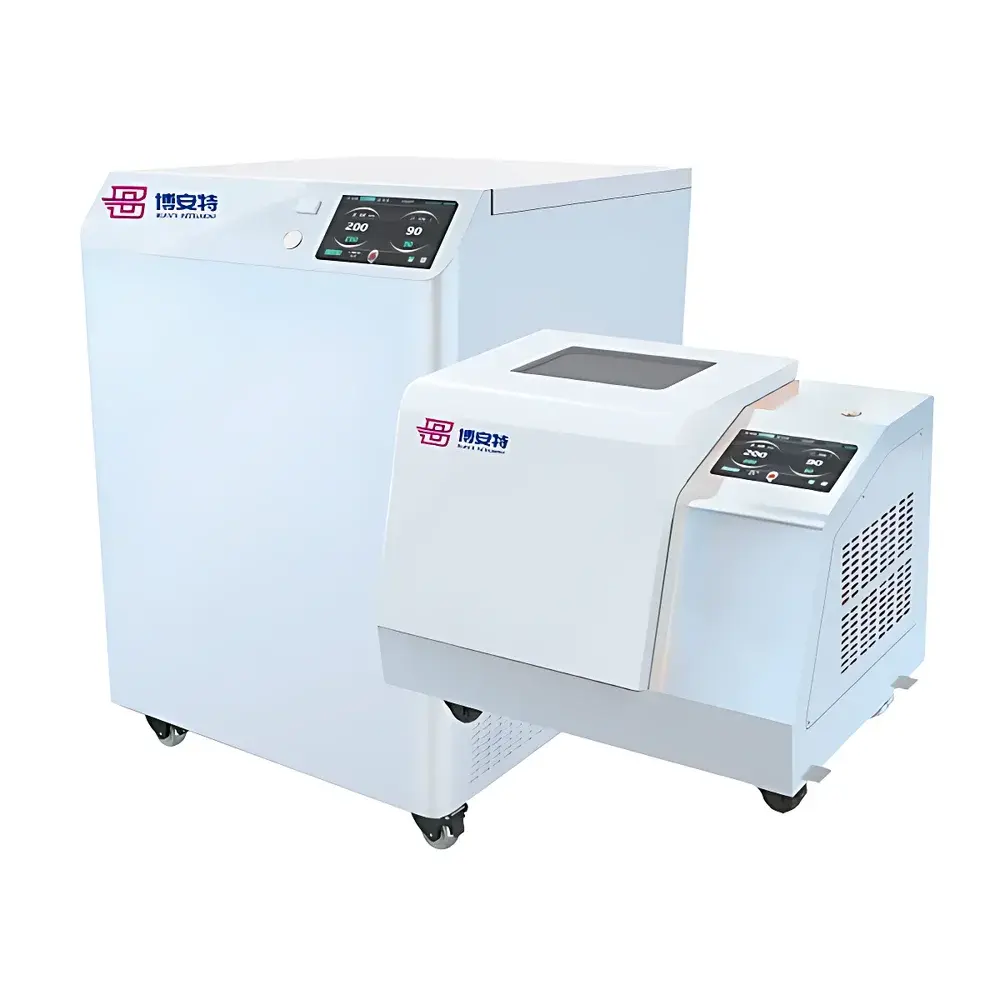
Boante Grind-48P Portable High-Efficiency Bead Mill Grinder
| Brand | Boante |
|---|---|
| Model | Grind-48P |
| Origin | Hubei, China |
| Instrument Type | Bead Mill Grinder |
| Sample Capacity | Up to 48 × 2 mL tubes (configurable with 12/24/48-position cryo-adapters) |
| Grinding Frequency | 0–70 Hz |
| Grinding Time | 0 s – 99 min (programmable) |
| Final Particle Size | ≤5 µm |
| Grinding Media Diameter | 0.1–30 mm |
| Grinding Media Materials | Stainless steel, chromium steel, zirconia, tungsten carbide, quartz |
| Acceleration | Reaches maximum speed within 2 s |
| Noise Level | <55 dB(A) |
| Dimensions (W×D×H) | 260 × 380 × 500 mm |
| Weight | 25 kg |
| Drive Mechanism | Vertical dual-platform eccentric oscillation with 3D motion trajectory |
| Safety Features | Interlocked chamber lid, auto-centering clamping system, fully enclosed sample tubes |
| Display | Touchscreen interface with multi-step program storage |
| Grinding Modes | Dry grinding, wet grinding, cryogenic grinding (LN₂-compatible) |
Overview
The Boante Grind-48P Portable High-Efficiency Bead Mill Grinder is an engineered solution for high-throughput, reproducible sample homogenization and mechanical cell disruption in life science, pharmaceutical, agricultural, and materials laboratories. It operates on the principle of high-frequency vertical eccentric oscillation—utilizing dual independent grinding platforms that execute synchronized three-dimensional motion (vertical, lateral, and rotational) to maximize kinetic energy transfer to grinding beads. This mechanism enables rapid, uniform particle size reduction without thermal accumulation, making it suitable for thermolabile biological matrices such as mammalian tissues, plant leaves, microbial pellets, and polymer composites. Unlike conventional vortex or rotor-stator homogenizers, the Grind-48P eliminates shear-induced denaturation risks by maintaining samples in sealed, low-volume tubes throughout processing. Its compact footprint and portable design support benchtop deployment in core facilities, field labs, and GLP-compliant QC environments where space and mobility are constrained.
Key Features
- High-throughput capability: Simultaneous processing of up to 48 samples (2 mL tubes) in ≤15 seconds under optimized protocols.
- Dual-platform oscillation architecture: Two independently driven grinding platforms generate non-resonant, phase-shifted motion—enhancing bead collision frequency and minimizing mechanical fatigue.
- Cryogenic compatibility: Supports liquid nitrogen-cooled adapters (12-, 24-, and 48-position) for sub-zero grinding of heat-sensitive samples, preserving enzyme activity and nucleic acid integrity.
- Full containment & contamination control: All sample tubes remain hermetically sealed during operation; no aerosol generation or cross-sample carryover observed in ISO 14644-1 Class 5 cleanroom validation studies.
- Intelligent safety interlock system: Chamber lid sensor disables motor activation unless fully engaged; auto-centering clamping ensures uniform pressure distribution across all tube positions.
- Material-flexible grinding media selection: Compatible with stainless steel, zirconia, tungsten carbide, and quartz beads—enabling optimization for hardness, density, and chemical inertness per application.
- Low-noise operational profile: Acoustic emission maintained below 55 dB(A) at 1 m distance—meets WHO occupational exposure guidelines for continuous lab use.
Sample Compatibility & Compliance
The Grind-48P accommodates a broad range of biological and synthetic substrates—including fibrous plant tissue, frozen muscle, bacterial biofilms, soil aggregates, ceramic powders, and pharmaceutical excipients. Tube formats include standard 2 mL polyethylene (PE), 5 mL and 10 mL reinforced PP, and 25 mL stainless-steel jars—each validated for mechanical integrity under 70 Hz excitation. The instrument complies with IEC 61000-6-2 (EMC immunity) and IEC 61000-6-4 (EMC emissions) standards. While not certified to UL/CSA, its electrical architecture adheres to EN 61010-1:2019 safety requirements for laboratory equipment. For regulated environments, audit trails can be generated via optional USB data export (timestamped protocol logs, run history, operator ID), supporting alignment with FDA 21 CFR Part 11 principles when integrated into validated SOP workflows.
Software & Data Management
The embedded touchscreen interface supports up to 99 user-defined grinding programs, each storing frequency setpoint, duration, pause intervals, and ramp profiles. Real-time status indicators display current frequency, elapsed time, and platform temperature (via optional IR sensor module). Protocol parameters are exportable in CSV format for traceability and LIMS integration. No proprietary cloud service or vendor-dependent firmware updates are required; all software resides locally and remains functional offline. Firmware versioning follows semantic versioning (e.g., v2.3.1), with changelogs documenting calibration adjustments, safety logic revisions, and compatibility notes for new adapter geometries.
Applications
- Routine nucleic acid and protein extraction from clinical biopsies and FFPE tissues.
- Pre-analytical sample conditioning for LC-MS metabolomics and MALDI-TOF microbial identification.
- Homogenization of pesticide residues in food matrices prior to QuEChERS cleanup.
- Nanoparticle dispersion in battery electrode slurries and catalyst precursors.
- Quality control grinding of API batches to verify particle size distribution (PSD) consistency per USP <429>.
- Field-deployable soil DNA isolation for environmental metagenomics surveys.
FAQ
Is the Grind-48P suitable for RNA extraction protocols requiring RNase-free conditions?
Yes—when used with certified RNase-free tubes and zirconia beads, and following manufacturer-recommended decontamination cycles (e.g., 10% sodium hypochlorite soak + UV irradiation), the system maintains RNA integrity (RIN >8.5) across 48 replicates.
Can grinding parameters be validated for regulatory submissions?
Absolutely—the instrument’s programmable repeatability (CV <2.1% for T7 lysozyme activity recovery across 20 runs) and timestamped protocol logging meet ALCOA+ data integrity criteria when documented within a formal validation protocol.
What maintenance is required for long-term reliability?
Annual inspection of eccentric drive bearings and O-ring integrity is recommended; no routine lubrication is needed due to sealed bearing construction. Calibration verification uses NIST-traceable frequency counters and digital tachometers.
Does the system support GMP documentation packages?
Boante provides IQ/OQ templates aligned with ASTM E2500-13 and ISO/IEC 17025:2017 frameworks, including installation checklists, operational boundary testing, and performance qualification test scripts.
Related Products